Cozy Home Library Ideas Without a Spare Room
I’ve always thought home libraries looked like something you needed a big house to pull off.
A dedicated room.
Wall-to-wall shelves.
A deep leather chair.
Maybe a ladder rolling across the bookcases if we’re really dreaming.
But the more small homes I’ve seen, the more I’ve realized that a good home library has much less to do with having a separate room.
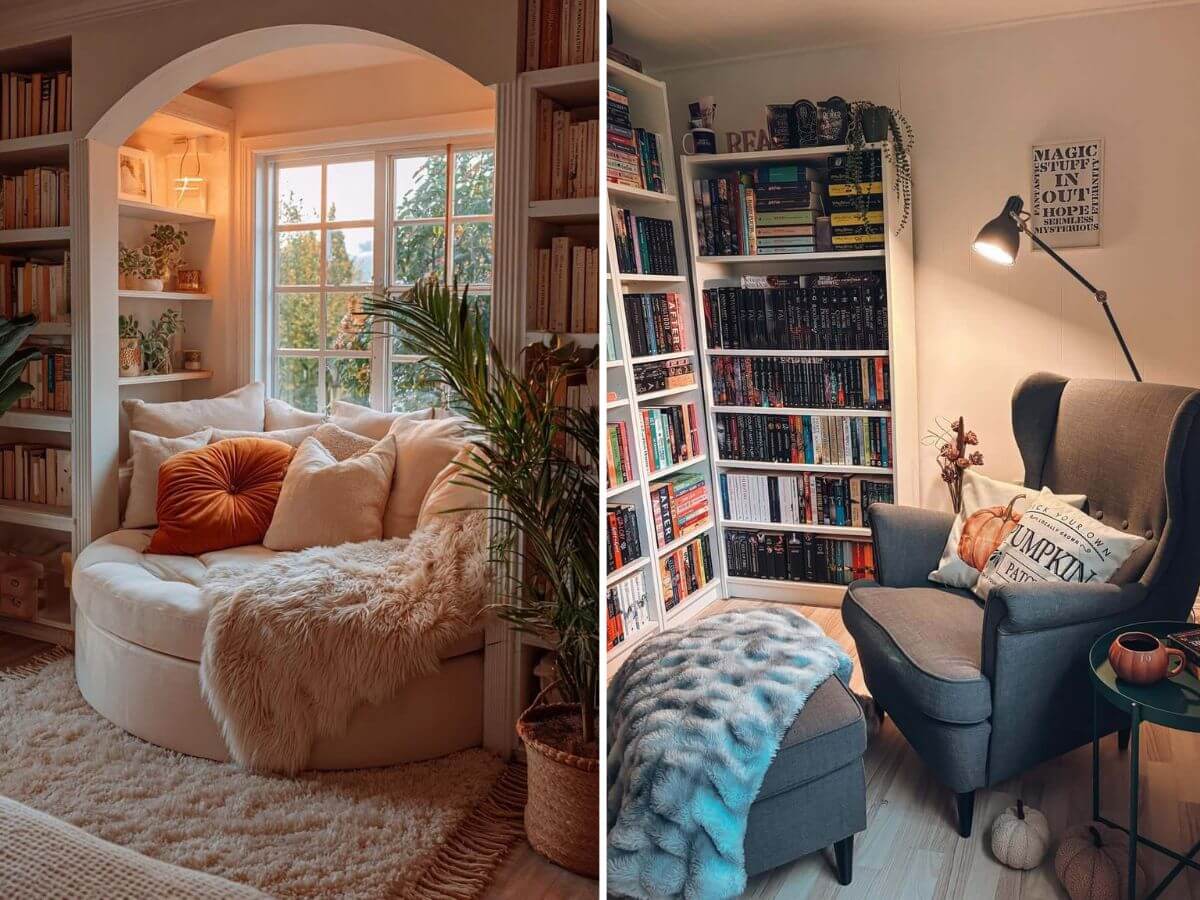
It has more to do with creating a place where books, comfortable seating, and good light come together on purpose.
That can happen in a bedroom corner.
Beside a living room window.
Along an empty dining room wall.
At the end of a hallway.
Even under a staircase.
The trick isn’t finding a room you can sacrifice.
It’s finding space you’re already underusing and giving it a better job.
Before buying anything, walk through your home and find three places where you could realistically sit with a book for 20 minutes.
Don’t worry about how “library-like” they look yet.
Just notice where you naturally want to slow down.
That’s where I’d start.
Start With the Place You Actually Want to Read
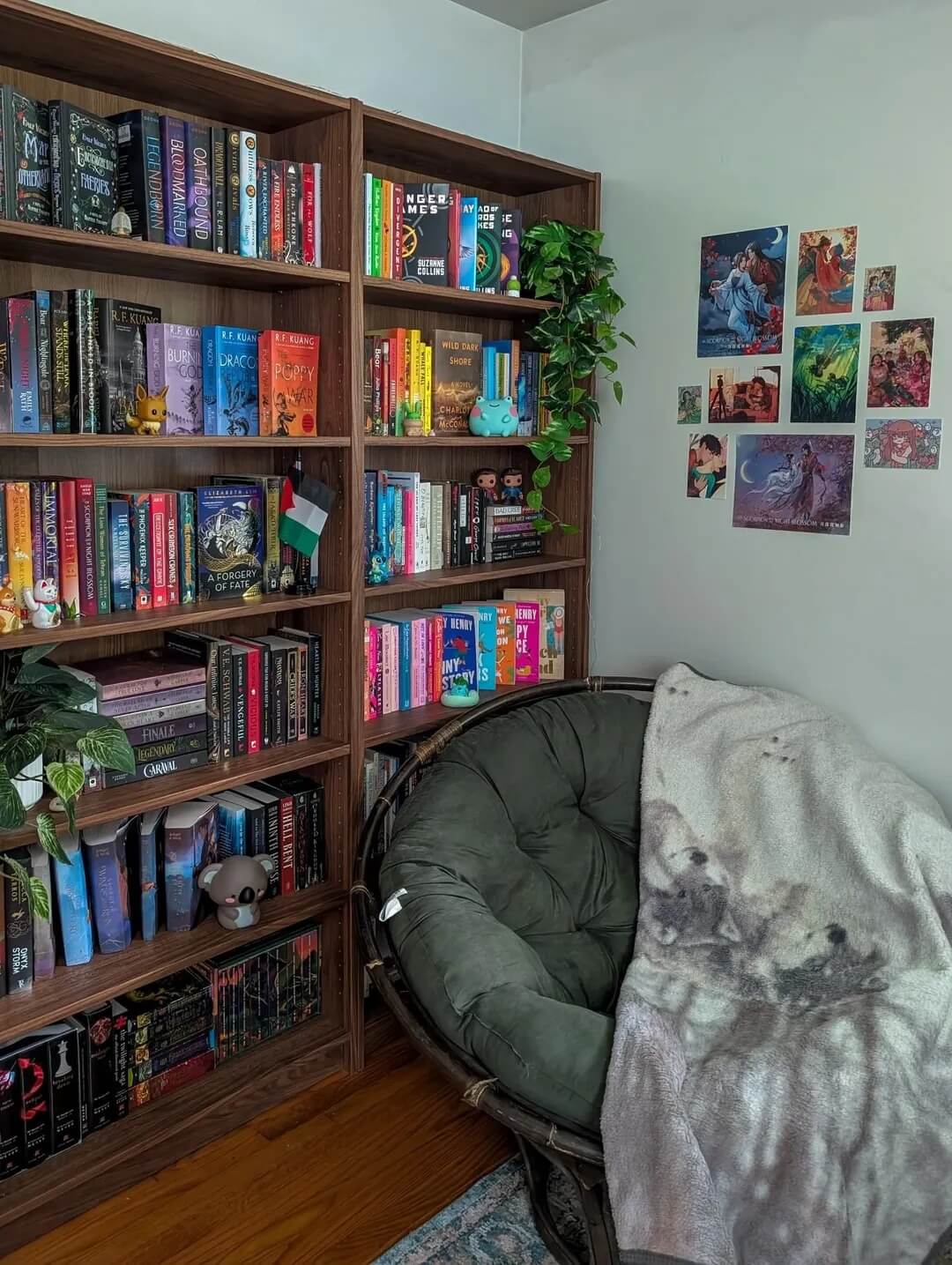
The emptiest corner isn’t always the best reading corner.
Maybe there’s an unused area beside the front door, but everyone walks through it all day.
Perhaps there’s a pretty window nook that becomes unbearably hot in the afternoon.
Or maybe the perfect-looking chair location sits directly beneath a vent and you never want to stay there.
Test the spot before you decorate it.
Put a chair there.
It doesn’t need to be the chair you’ll eventually use.
Grab something from another room and sit for 20 minutes.
Read.
Notice the noise.
Notice the light.
Check whether people keep walking past you.
See if there’s an outlet nearby.
Think about where you’d set a drink.
If you spend those 20 minutes wishing you were somewhere else, move on.
A home library should make reading easier, not simply make an empty corner prettier.
And if you don’t have an obvious dedicated space, that’s completely fine.
The Spruce makes this idea much less intimidating in its guide to creating an inexpensive home library, explaining that “a home library doesn’t need to be a spacious room—a spare bedroom, a walk-up attic, or even just a quiet corner.”
That opens up much more of the house than you might think.
Look for a Library in Spaces You’re Already Wasting
Walk around your home again, but this time look at the edges.
The end of the living room.
A wide hallway.
The wall beside your bed.
A corner near a fireplace.
The area beneath the stairs.
A window with nothing happening around it.
A section of the dining room that’s never really used.
You may only need a few feet of wall.
That’s enough for a narrow bookcase, a chair, and a lamp.
One thing I wouldn’t do is force a reading nook into a space that already has an important job.
If you constantly need the walkway clear, don’t narrow it with a chair simply because the corner photographs well.
If the dining area already feels cramped, don’t steal the last comfortable foot of circulation for shelves.
Use the forgotten space.
Not the necessary space.
Once you’ve found the location, let the books shape the next decision.
Measure Your Books Before Buying Shelves
It’s easy to buy shelving first because that’s the exciting part.
I wouldn’t.
Start with your books.
Pull out a handful and look at how different they actually are.
Paperbacks.
Hardcovers.
Large cookbooks.
Coffee-table books.
Reference books.
Children’s books.
Some may need much more height or depth than others.
Now measure the wall.
Write down its width and height.
Then measure the largest books you need the shelving to hold.
You don’t need an architectural drawing.
A simple note in your phone is enough.
Wall width.
Available height.
Largest book depth.
Largest book height.
Then think about growth.
If the shelves are already packed the day you install them, every new book becomes a storage problem.
Leave yourself some breathing room.
This little exercise can keep you from buying a beautiful bookcase that turns out to be too shallow, too short, or strangely inefficient.
And in a small home, vertical storage matters more.
Go Up the Wall Before Going Across the Floor
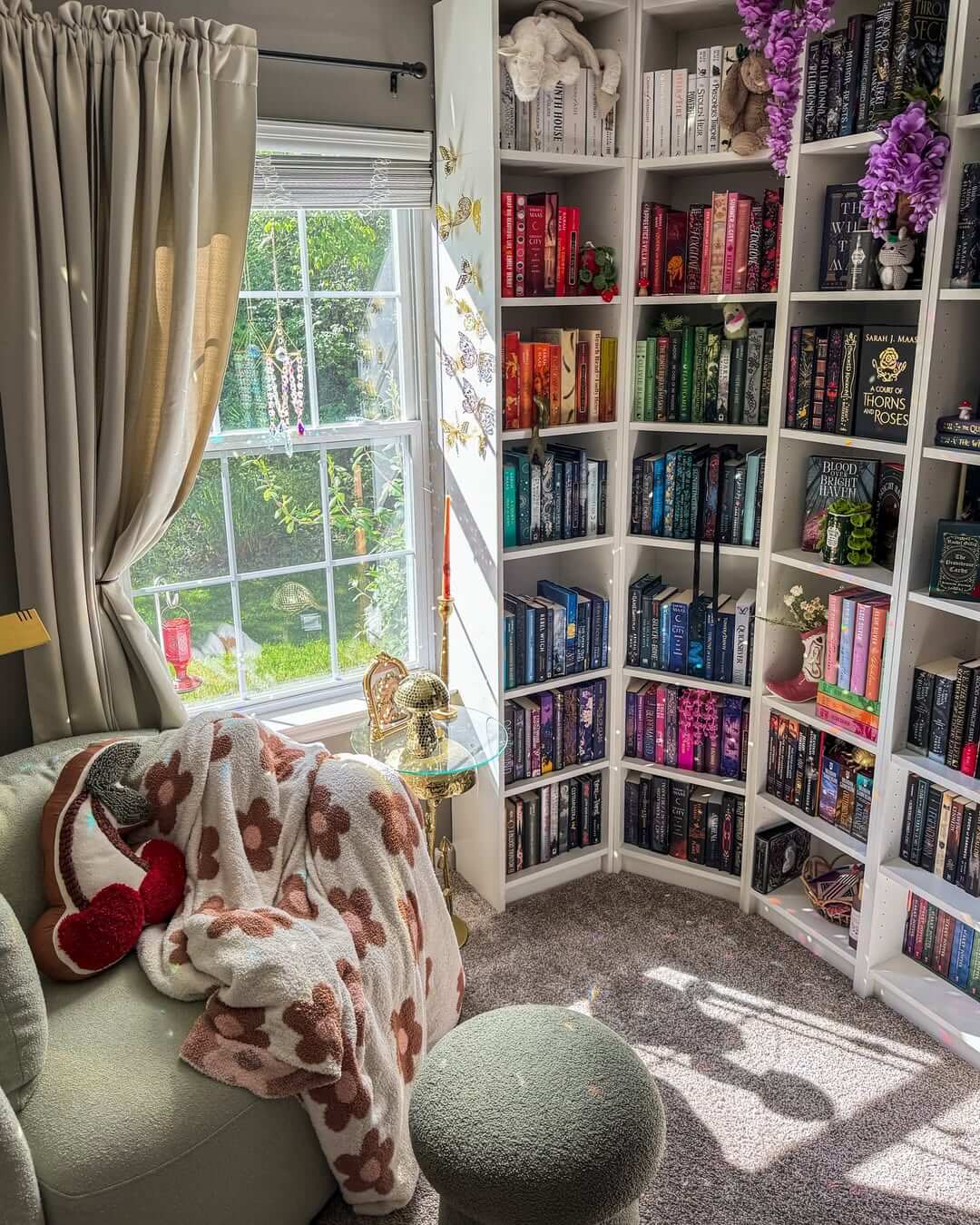
Floor space is limited in a small home, so vertical storage matters more.
That’s why I’d look at taller shelving before adding another low cabinet or cube organizer.
A tall bookcase can hold far more books without taking much more floor width.
But that doesn’t mean every wall should become floor-to-ceiling storage.
Choose one strong location.
Let that wall do most of the work.
Keep the books you reach for often at a comfortable height.
Use upper shelves for books you read less frequently.
And don’t store things high up just because you technically can.
If accessing something becomes a weekly ladder exercise, it’s probably in the wrong place.
Also think about safety.
Tall shelving should be appropriately secured for the setup and household.
Once the vertical space is working, you may need fewer storage pieces than you expected.
Use One Strong Bookcase Instead of Several Little Ones
Several small shelving units can make a room feel chopped up.
One cube shelf.
A narrow cart.
Two floating shelves.
Another little cabinet.
Suddenly, the books are everywhere but the room still doesn’t feel like a library.
One appropriately scaled bookcase can make the collection feel calmer and more intentional than several smaller storage pieces.
If you’re shopping online, use painter’s tape to mark the approximate width and height on the wall.
Then step back.
Does it feel substantial enough?
Too wide?
Too tall?
Would one taller piece look calmer than two shorter ones?
This is also where secondhand furniture becomes appealing.
A solid bookcase with a little age can bring far more character than several new organizers bought simply to fill the wall.
And that brings us to one of the biggest budget myths around home libraries.
Don’t Assume You Need Expensive Built-Ins
Built-in shelves are beautiful.
They’re also not required.
You can get much of the visual effect by placing freestanding bookcases thoughtfully.
Two matching or related units placed together can read almost like one library wall.
Painting the wall behind them a deeper color can make the setup feel more intentional.
Even a substantial old cabinet with open shelving can work beautifully if the scale suits the room.
Better Homes & Gardens suggests exactly this kind of budget-friendly thinking in its home library ideas guide, noting, “Furniture sourced from thrift stores, antique shops, and flea markets offers a budget-friendly alternative to built-in home library shelves.”
That’s where I’d spend time before spending a lot of money.
Look for substantial furniture.
Something with enough scale to carry the wall.
You can refine the styling later.
The important part is giving the books one deliberate home.
Create One Library Wall Instead of Spreading Books Everywhere
A little stack on the nightstand.
A few books on the coffee table.
More on the console.
Several in the office.
A basket beside the sofa.
Nothing is necessarily wrong with that.
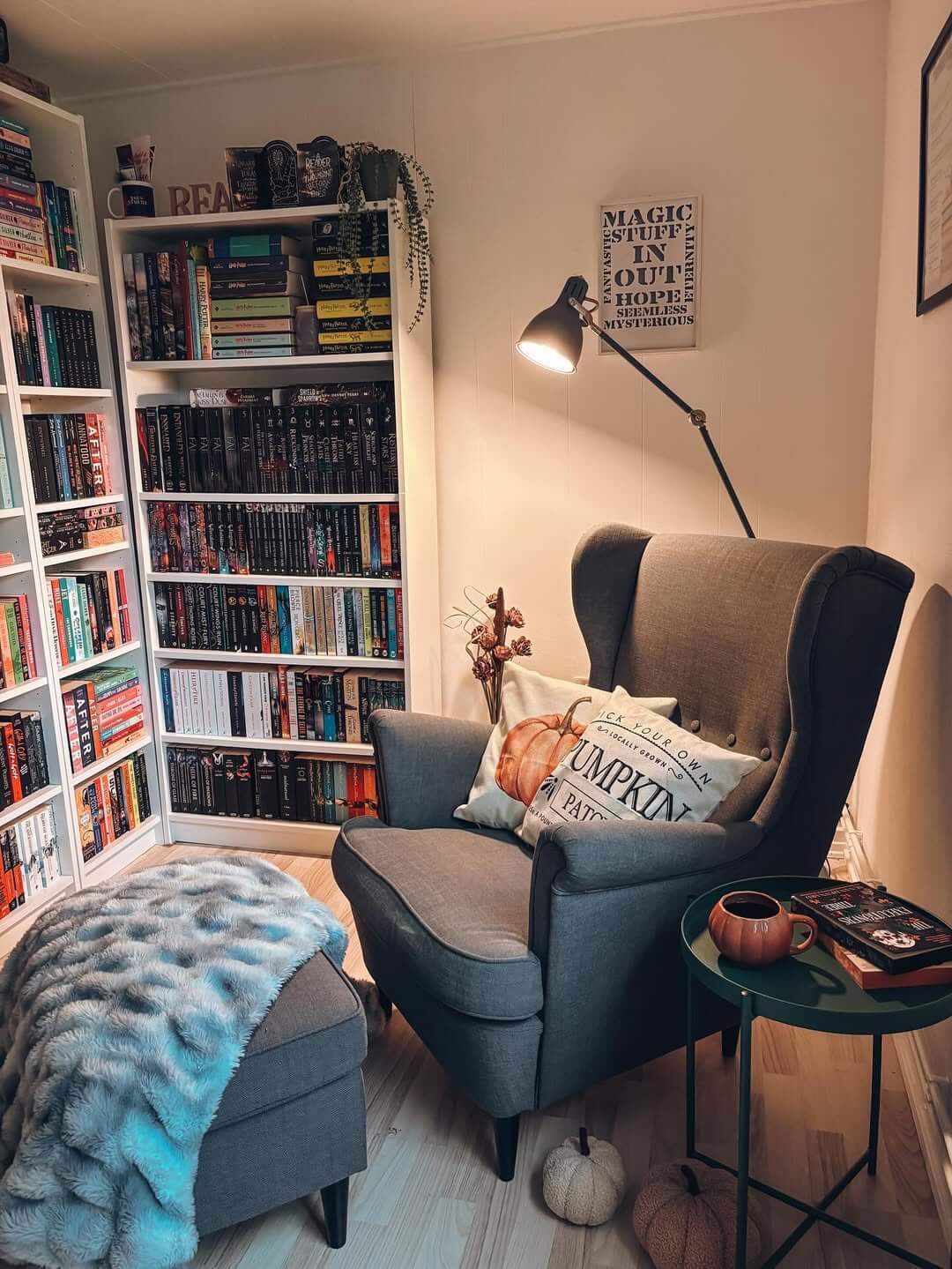
But if you want the feeling of a home library, concentrating more of the collection in one place can make a big difference.
Choose one wall.
Let most of the books live there.
Now position the reading chair so it visually belongs with that wall.
Suddenly, you’re not decorating a random corner.
You’re creating a zone.
This is especially helpful in a living room or bedroom where the space still needs to do other things.
The library gets one strong area.
The rest of the room can stay calmer.
And once the books are together, let them do some of the decorating.
Let the Books Do More of the Decorating
Books already bring color.
Texture.
Pattern.
History.
Personality.
You don’t need to buy a collection of decorative objects just because the shelves look empty in a Pinterest photo.
Start with the books.
Then add only a few personal things if the shelf actually needs them.
Maybe that’s a photograph.
A small bowl.
A travel object.
One piece of art.
But don’t turn every shelf into a styling exercise.
If half the available book space is filled with decor, the library may be working harder as a display than as a place to keep books.
Leave a little breathing room too.
Not every shelf needs to be packed edge to edge.
That makes the collection easier to see and gives future books somewhere to go.
And while you’re arranging them, use a system that helps you actually find things.
Organize Books for the Way You Actually Read
There’s no prize for having the most photogenic bookshelf.
If you genuinely find books by color, organize them by color.
But if you remember authors, subjects, or genres, use that instead.
The point is making the library work for you.
Maybe fiction lives together.
Travel books get one section.
Cookbooks live near the kitchen.
Reference books stay higher.
Children’s books belong lower where they’re reachable.
You could also create one small shelf for books you’re currently reading.
I like that because it keeps the active pile from migrating to the sofa, bed, kitchen counter, and every other flat surface.
Keep the system loose enough to grow.
A library that requires 20 minutes of reshuffling every time you buy a book is too tightly organized.
Once the books have a home, the next priority is somewhere you actually want to sit.
Give Yourself One Chair You Really Want to Use
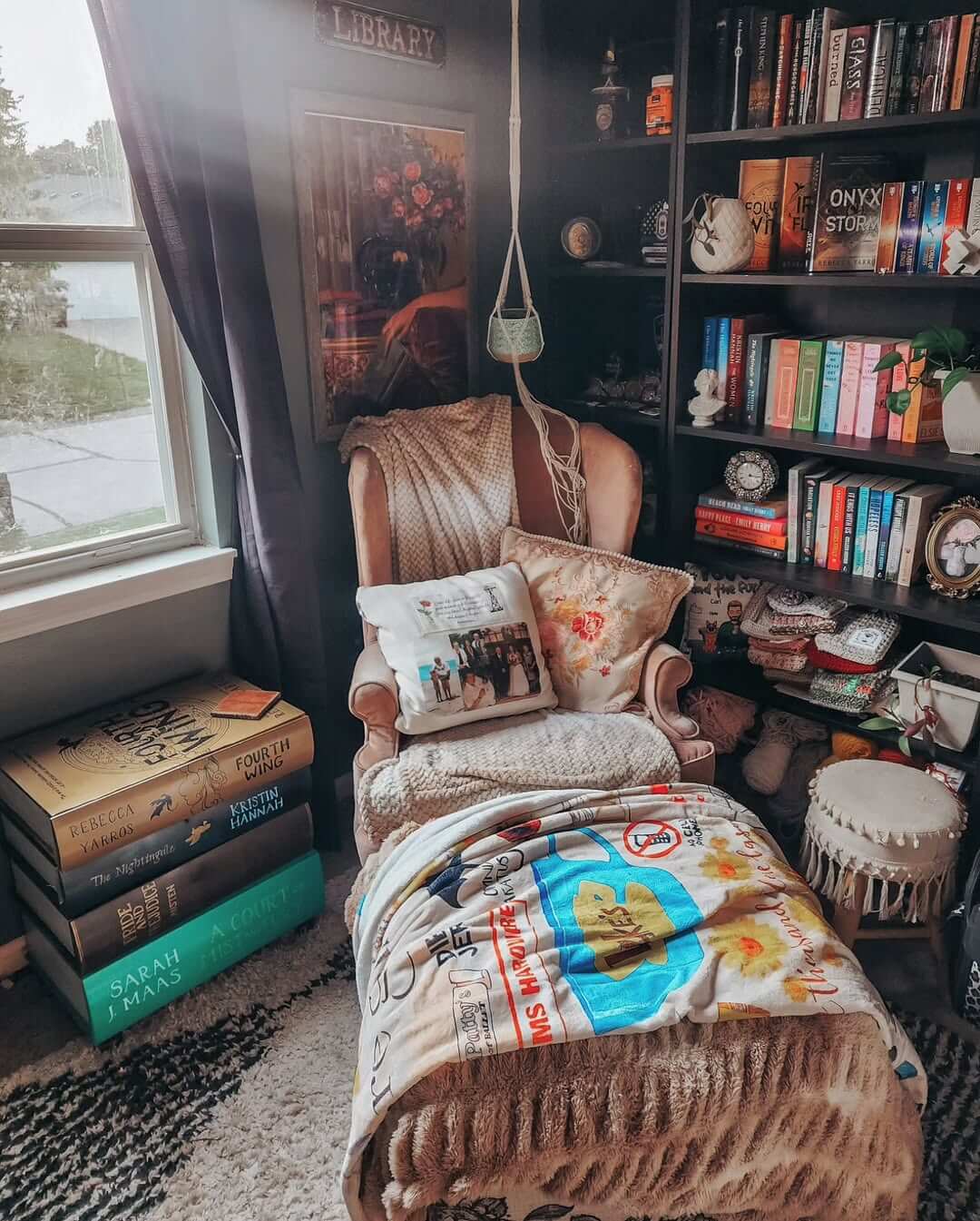
A home library without comfortable seating is just book storage.
Don’t choose the chair based only on how beautiful it looks in the corner.
Sit in it.
Does your back feel supported?
Are the arms comfortable?
Can you stay there for an hour?
Do you like curling up when you read, or do you prefer sitting more upright?
That should shape the chair.
And you don’t necessarily need to buy a new one.
Try moving a chair from another room first.
Use it in the proposed spot for a few days.
Read there in the morning and evening.
Notice whether the light bothers you, whether someone constantly walks through the space, or whether the chair blocks a drawer or cabinet.
If the setup works, then you know the location deserves a better chair if you still want one.
If the space is tiny, one comfortable seat is enough.
You don’t need a loveseat, ottoman, side chair, and bench just to prove it’s a reading nook.
One good chair can carry the whole space.
Add One Small Landing Surface
You need somewhere for a drink.
Maybe glasses.
A phone.
A bookmark.
The book you just finished.
That doesn’t mean you need a full-size end table.
A small stool can work.
So can a compact table.
Maybe there’s already a piece somewhere else in the house that fits.
Put the chair in position and sit down.
Reach naturally to the side.
That’s roughly where the surface should be.
You shouldn’t have to stand up every time you want your tea.
And don’t cover that little table with decor before you’ve even used it.
Leave room for the things the surface is actually there to hold.
Once the seat and table work, lighting becomes the next priority.
Get the Reading Light Right
A cozy library corner can look wonderful and still be frustrating to read in.
That’s why I’d solve the light before buying decorative accessories.
Sit in the chair with a book.
Where does the light land?
If the room has a floor lamp, is it actually illuminating the page or just glowing somewhere behind you?
Would a wall-mounted light work better?
Would a small table lamp put the light closer to where you need it?
Think about the evening too.
A window can make a reading nook look beautiful during the day, but that natural light eventually disappears.
Homes & Gardens makes the distinction clearly in its guide to creating a reading nook: “While this nook offers good daylight, a wall light introduces the task lighting needed for reading after dark.”
That’s why I’d plan for both.
Let daylight make the corner pleasant during the day.
Give yourself a reliable reading light after that.
And if you’re lucky enough to have a window nearby, use it carefully.
Use the Window, but Don’t Depend on It
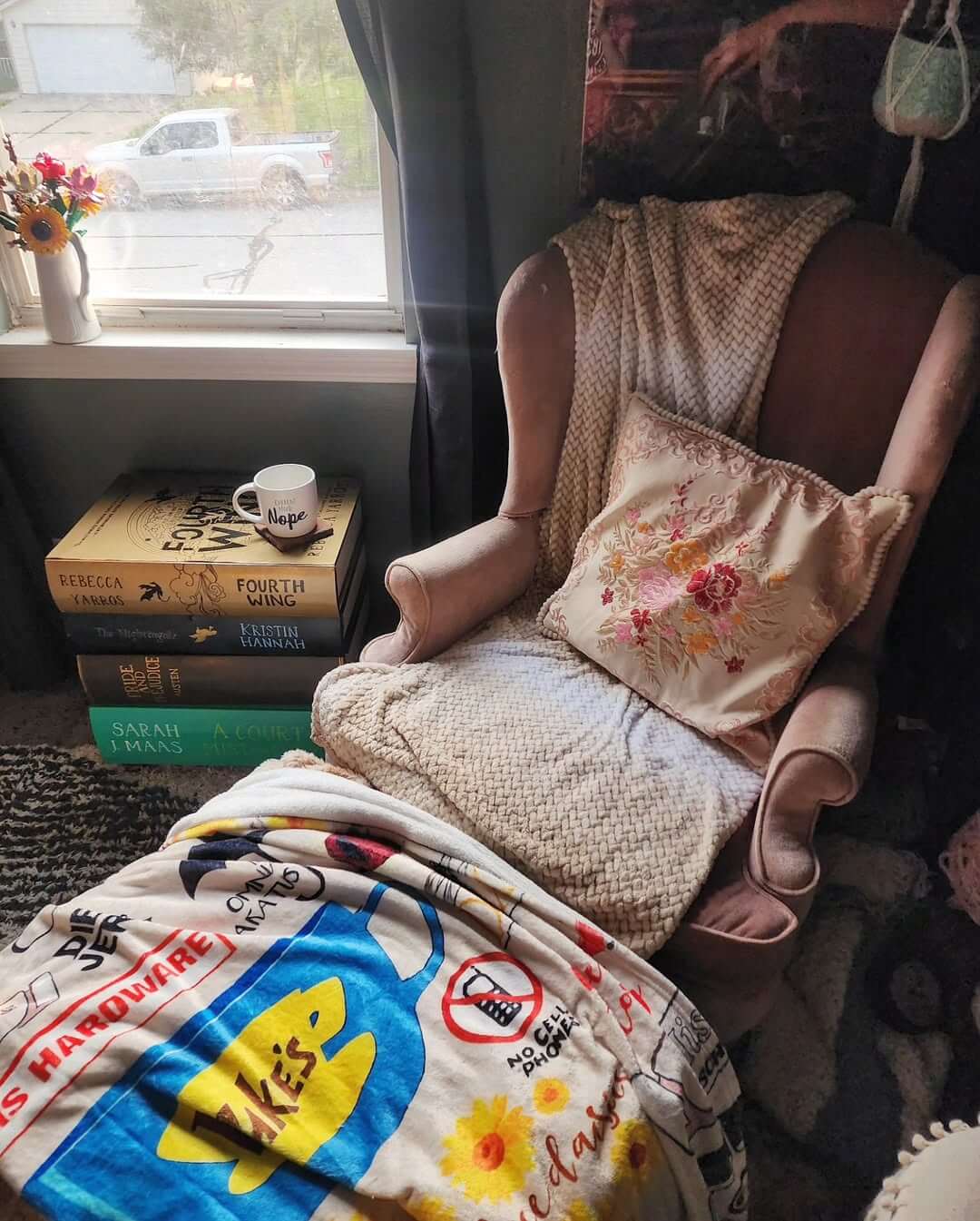
Window reading nooks are hard to resist.
You get natural light.
A view.
A sense of separation without putting up a wall.
But the window doesn’t solve everything.
Notice what happens throughout the day.
Does direct sun hit the chair in the afternoon?
Is there glare on a tablet?
Does the area get noticeably colder in winter?
Can people see directly into the nook at night?
Those details matter.
If the window works, don’t block it with a tall shelf just because you’re trying to squeeze more books into the corner.
Use the wall beside it instead.
Keep some of the view open.
That visual depth can make a small reading area feel much less enclosed.
Then use one or two simple elements to give the nook a sense of its own space.
Make the Library Feel Separate Without Adding Walls
Your reading corner can feel like its own little room without becoming one.
A rug can define the floor area.
The bookcase itself can create one visual edge.
A lamp can mark the reading zone.
A deeper wall color might distinguish the library wall from everything around it.
Furniture orientation can do a lot too.
If the chair is angled slightly toward the books rather than the center of the room, the nook starts feeling more inward and intentional.
Use one or two of those ideas.
You don’t need all of them.
Too many visual boundaries can make a tiny area feel boxed in.
The goal is creating a sense of place without taking away the openness that made the corner useful in the first place.
Choose a Rug Only If It Helps
A rug can make a reading nook feel warmer.
It can also make it feel cluttered if it’s too small or completely unnecessary.
If you’re considering one, test the approximate size before buying.
Does it connect the chair and table?
Or does it look like a little island beneath the chair?
Now look at the existing flooring.
If you already have warm wood, perhaps you don’t need to cover it.
If the nook feels cold because of tile or another hard surface, a rug may earn its place.
Think about cleaning too.
If the library sits in a high-traffic living room, the rug needs to survive real life.
Cozy should make the nook easier to enjoy, not harder to maintain.
And you can create plenty of coziness without adding many objects.
Make It Cozy With Texture, Not Clutter
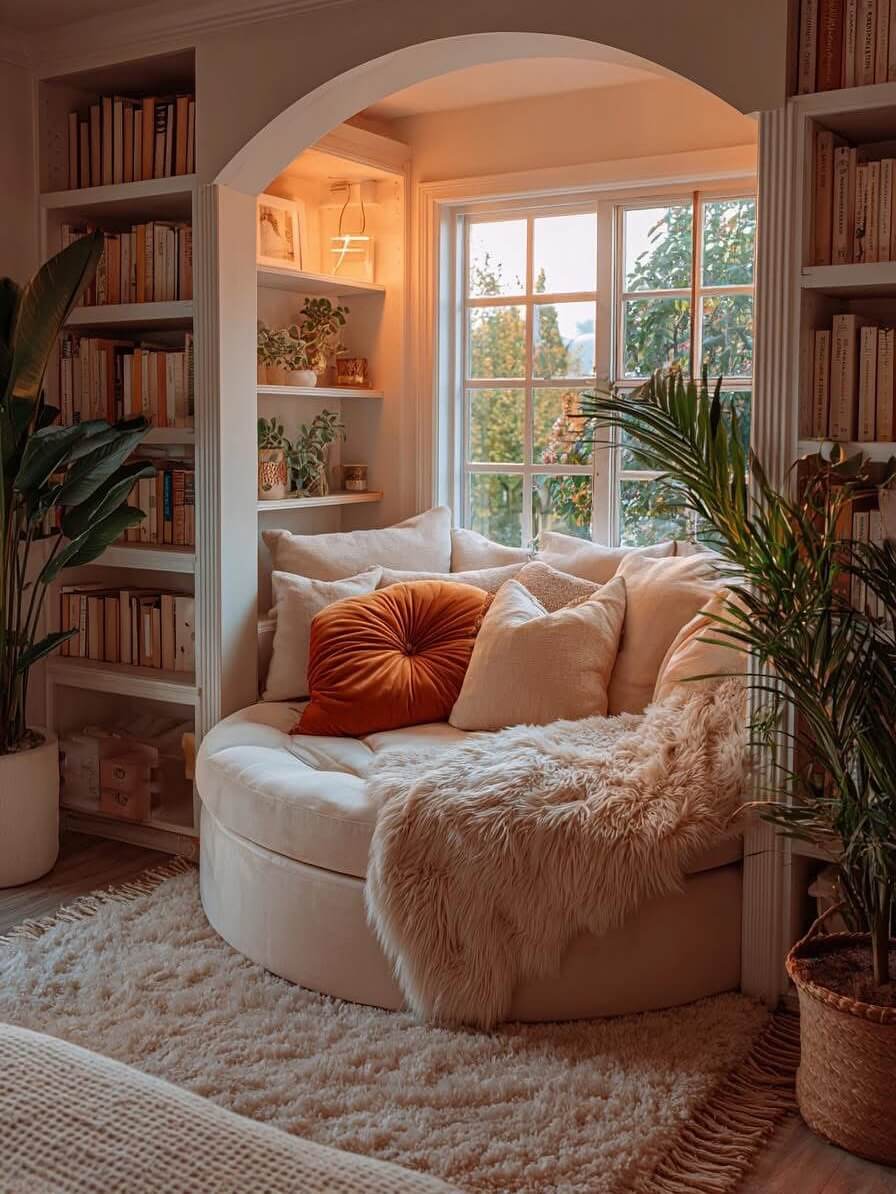
When people hear “cozy reading nook,” it’s easy to imagine piles of blankets, pillows, candles, baskets, and decor.
You don’t need all of that.
Start with one soft layer.
Maybe it’s a throw across the chair.
Perhaps it’s one cushion.
A rug may already provide enough softness.
Curtains can help if the nook sits beside a window.
You want to balance the hard lines of books and shelves.
Not bury them.
If the space already has upholstery, a rug, and curtains, another basket of blankets may not add much.
Look at what the nook is actually missing.
Softness?
Warmth?
Color?
If it already feels cozy, stop.
Keep the Library Connected to the Room Around It
Your library corner may feel special.
It still belongs to the room.
So pull something from the surrounding space into it.
Maybe the living room has walnut furniture.
Repeat that wood tone in the library table or shelf.
Perhaps the room uses warm cream and muted green.
Let one of those colors show up in the chair or rug.
You don’t have to match everything.
You’re simply creating a bridge.
This keeps the nook from looking like a separate Pinterest image pasted into the corner of your real home.
And if you want more atmosphere, you can still go darker without repainting the entire room.
Don’t Be Afraid of a Moody Library Corner
Small spaces don’t automatically need pale paint.
A deeper color behind the shelves can give a library corner beautiful depth.
Maybe it’s muted green.
Deep blue.
Warm brown.
Charcoal.
A darker neutral.
You don’t have to paint the entire room.
One wall may be enough.
Or even the back of a bookcase.
The key is balancing that depth with enough light.
If the corner already receives little daylight and the reading light is weak, dark paint isn’t going to fix that.
Solve the lighting first.
Then test the color in the actual space during the day and at night.
You want atmosphere.
Not a corner where you can’t see the book titles.
Once the wall and shelves are doing enough, be selective with artwork too.
Use Art Where It Actually Adds Something
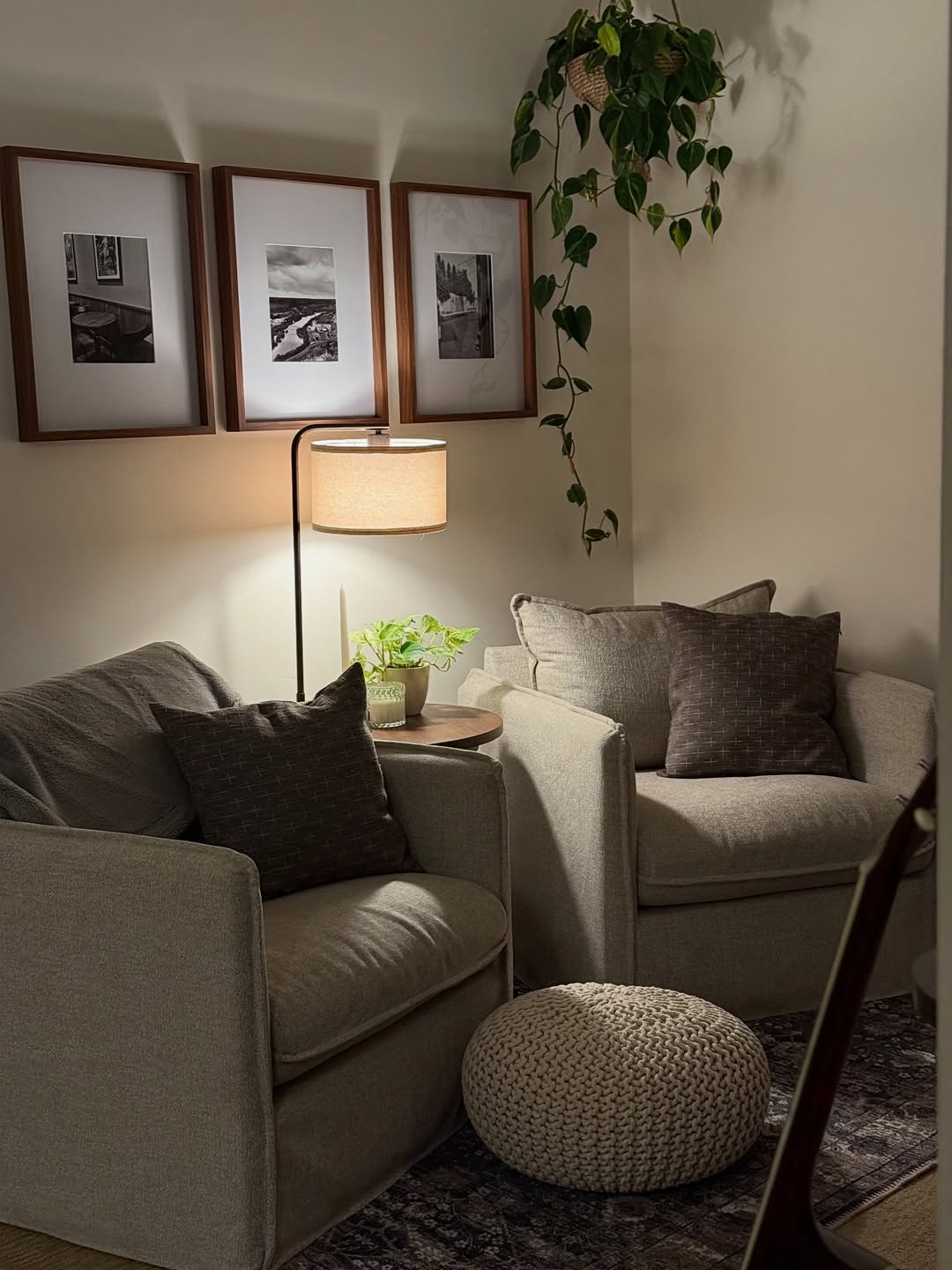
A library doesn’t need a sign that says “READ.”
The books have already made the point.
If you have art you love, use it.
Maybe there’s a small wall beside the shelving.
Perhaps one framed piece can sit above the chair.
A family photograph might mean more to you than generic library decor.
A travel print could connect beautifully with books you’ve collected from trips.
Let the art say something personal.
But don’t sacrifice useful book space simply because every shelf needs an object.
If the shelves are already visually interesting, the wall may need less than you think.
And before buying anything decorative, search the rest of your house.
Shop Your Own Home Before Shopping for the Library
This is where a budget library can get surprisingly good.
Walk through every room.
Look for pieces that aren’t being used particularly well.
A chair in the bedroom.
A little table in the hallway.
A lamp sitting on a console where nobody needs it.
A basket.
A framed print.
A throw.
Move them temporarily.
Put them in the library corner.
Now use the arrangement.
You might discover that the chair looks much better beside books than it ever did in the bedroom.
Maybe the little table finally has a useful job.
Perhaps the lamp is exactly the right height.
Don’t worry if everything isn’t perfectly coordinated at first.
Function comes first.
Once you’ve used the nook for a while, you’ll know which pieces genuinely need replacing.
And that’s when I’d start spending.
Buy the Expensive Pieces Last
I wouldn’t begin a budget home library with decorative shopping.
I’d spend in this order.
Shelving.
Comfortable seating.
Useful lighting.
Then everything else.
Those first three things determine whether the library actually works.
The decorative pieces are much easier to improvise.
You can thrift them.
Move them from another room.
Or live without them.
Books already provide plenty of character anyway.
If your budget is tight, wait for the right substantial furniture rather than buying several cheap pieces simply because you want the library finished this weekend.
A home library can look better when it develops slowly.
Books accumulate.
Furniture moves.
Objects become meaningful.
That’s part of the charm.
And if your whole home is small, the library should probably share its space with something else.
Make a Tiny Home Library Work Harder
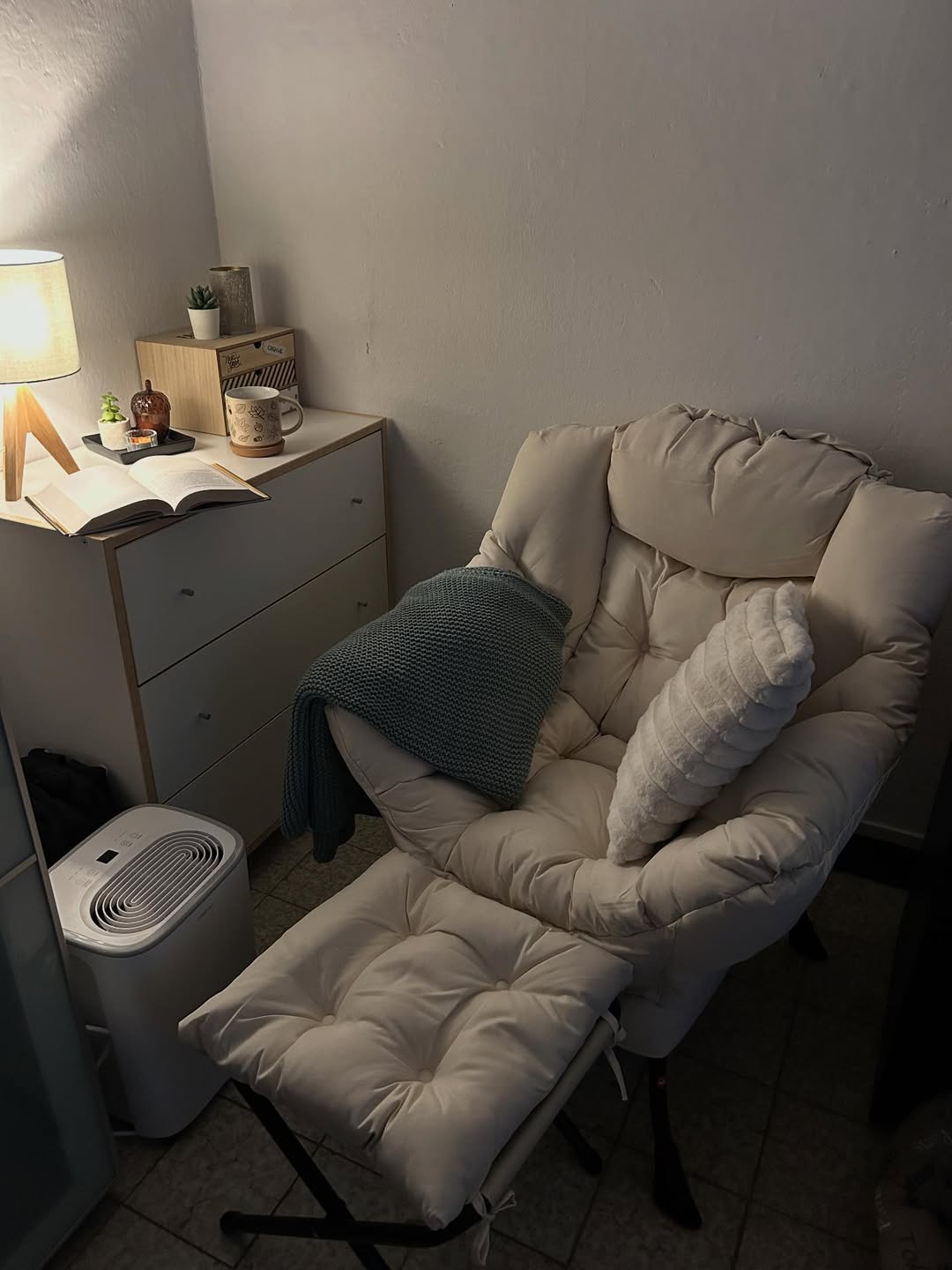
A small home rarely has enough square footage for every interest to get its own room.
That’s okay.
Let the library share.
Living room plus library.
Bedroom plus library.
Office plus library.
Guest room plus library.
Dining room plus library.
The trick is keeping the reading setup compact.
One wall for books.
One comfortable chair.
One light.
One small landing surface.
That’s enough to create the experience.
Don’t add furniture simply because a “proper library” should have it.
If you already have a sofa nearby, maybe you don’t need another chair.
If the desk chair is genuinely comfortable for reading, perhaps that’s the seat.
The goal is making reading feel easy, not proving the house has a library.
And one small feature can make using it every day much easier.
Create a Currently Reading Station
Books have a way of wandering.
One beside the bed.
One on the sofa.
Another on the dining table.
Two near the coffee maker for some reason.
Give your active books one home.
It could be one shelf.
A small basket.
The side table.
A little stack on a dedicated surface.
Keep only what you’re actually reading there.
Maybe your notebook or reading glasses live there too.
This creates a small ritual.
You sit down and the book is waiting.
You finish and put it back.
The main shelves stay calmer, and your current books don’t become clutter everywhere else.
As your collection changes, give the shelves room to change too.
Leave Space for Books You Haven’t Bought Yet
A completely full bookcase looks satisfying for about five minutes.
Then you buy another book.
Now there’s nowhere for it to go.
Leave a little room.
Not huge empty shelves.
Just breathing space.
And every so often, look through what you own.
Are there books you know you’ll never read again?
Books you didn’t enjoy?
Duplicates?
Things that belonged to a version of your life that has moved on?
You don’t have to keep every book simply because it’s a book.
Donate what you’re ready to release.
That keeps the collection personal rather than simply large.
And once everything is in place, do one final test that has nothing to do with styling.
Try the 20-Minute Reading Test
Sit down.
Actually read for 20 minutes.
Don’t photograph the nook.
Don’t adjust a pillow.
Don’t style the shelves.
Read.
Then notice what annoyed you.
Was the chair uncomfortable?
Was the lamp in the wrong place?
Did someone keep walking directly in front of you?
Were you balancing your mug on the floor?
Did sunlight hit the page?
Was the room too noisy?
Fix that problem first.
Not the styling.
A reading nook can look stunning and still fail at the one thing it was supposed to help you do.
The best test is whether you want to stay there.
And before adding one final decorative piece, look at the whole room again.
Do the Doorway Test Before Adding Anything Else
Stand where you normally enter the room.
Don’t look only at the bookcase.
Look at everything.
Does the library feel like part of the room?
Is the bookcase too large for the wall?
Does the chair interrupt the walkway?
Are there too many small decorative objects?
Does the nook immediately look like somewhere you’d want to sit?
If something feels off, rearrange before shopping.
Move the chair.
Remove one object.
Shift the lamp.
Clear one shelf.
You may find that the library needs less rather than more.
That’s usually a good sign.
The Best Home Library Is the One You Actually Use
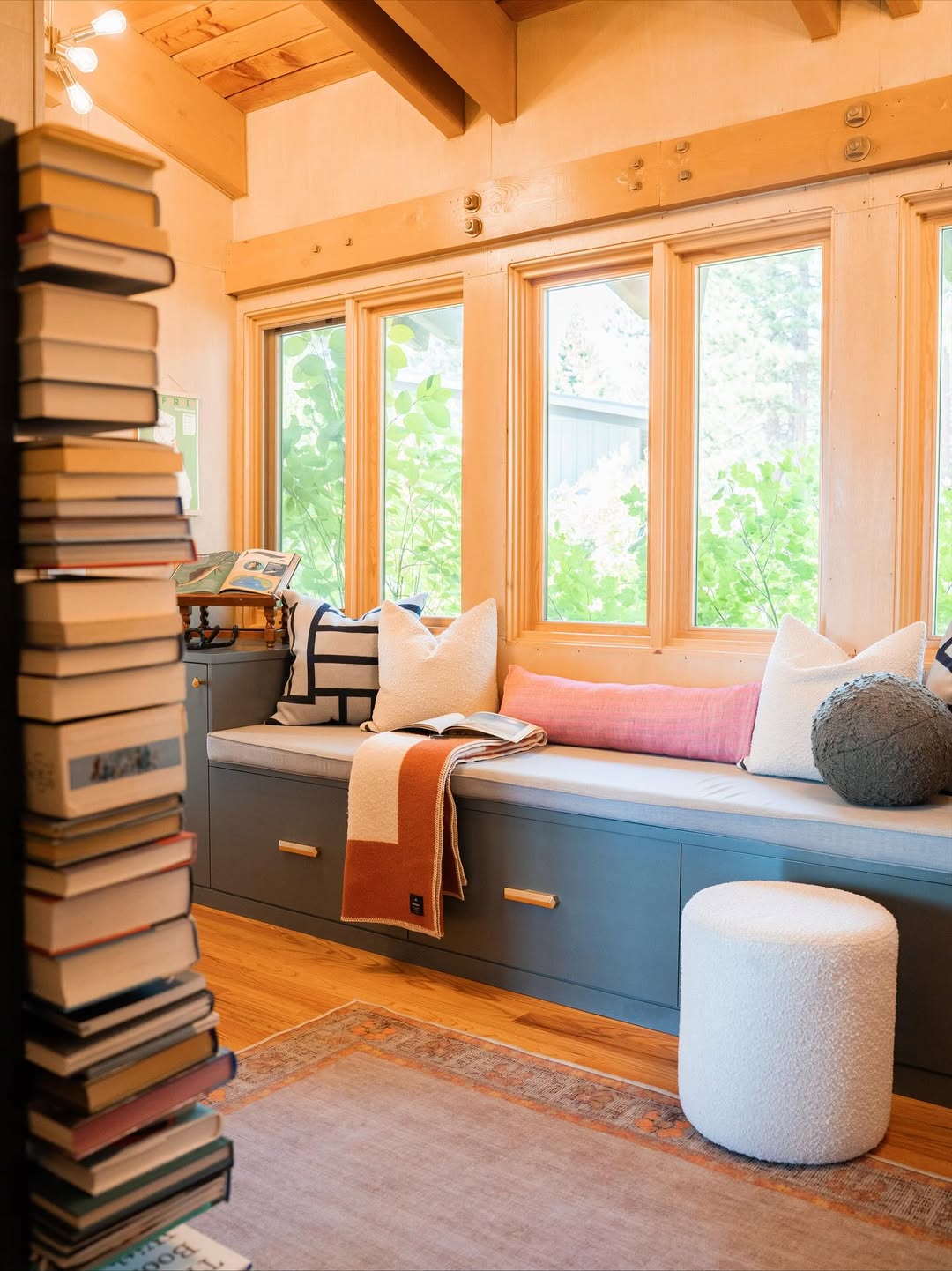
You don’t need a spare room to have a home library.
You don’t need custom shelving either.
And you definitely don’t need hundreds of books.
Find the place where you’d actually enjoy reading.
Measure the books and the wall.
Use height before taking more floor space.
Give the collection one strong home.
Add a chair you genuinely want to sit in.
Get the light right.
Then bring in just enough softness to make the corner inviting.
The goal isn’t creating a room that photographs like a library.
It’s creating a place that makes picking up a book feel easier.
A place where you sit down for 20 minutes and accidentally stay for an hour.
And if that happens in one quiet corner of your living room instead of a grand room lined with shelves, that doesn’t make it less of a library.
It means you used the space you had well.
Also read: