Front Porch Lighting Ideas That Feel Cozy at Night
I never paid much attention to front porch lighting during the day.
The fixtures were there. The bulbs worked. That seemed good enough.
Then one evening while walking through a nearby neighborhood, I noticed something interesting.
Some homes felt inviting long before I reached the front door.
Others felt cold.
A few almost disappeared into the darkness.
The difference wasn’t expensive landscaping.
It wasn’t larger porches.
It wasn’t newer homes.
More often than not, it came down to lighting.
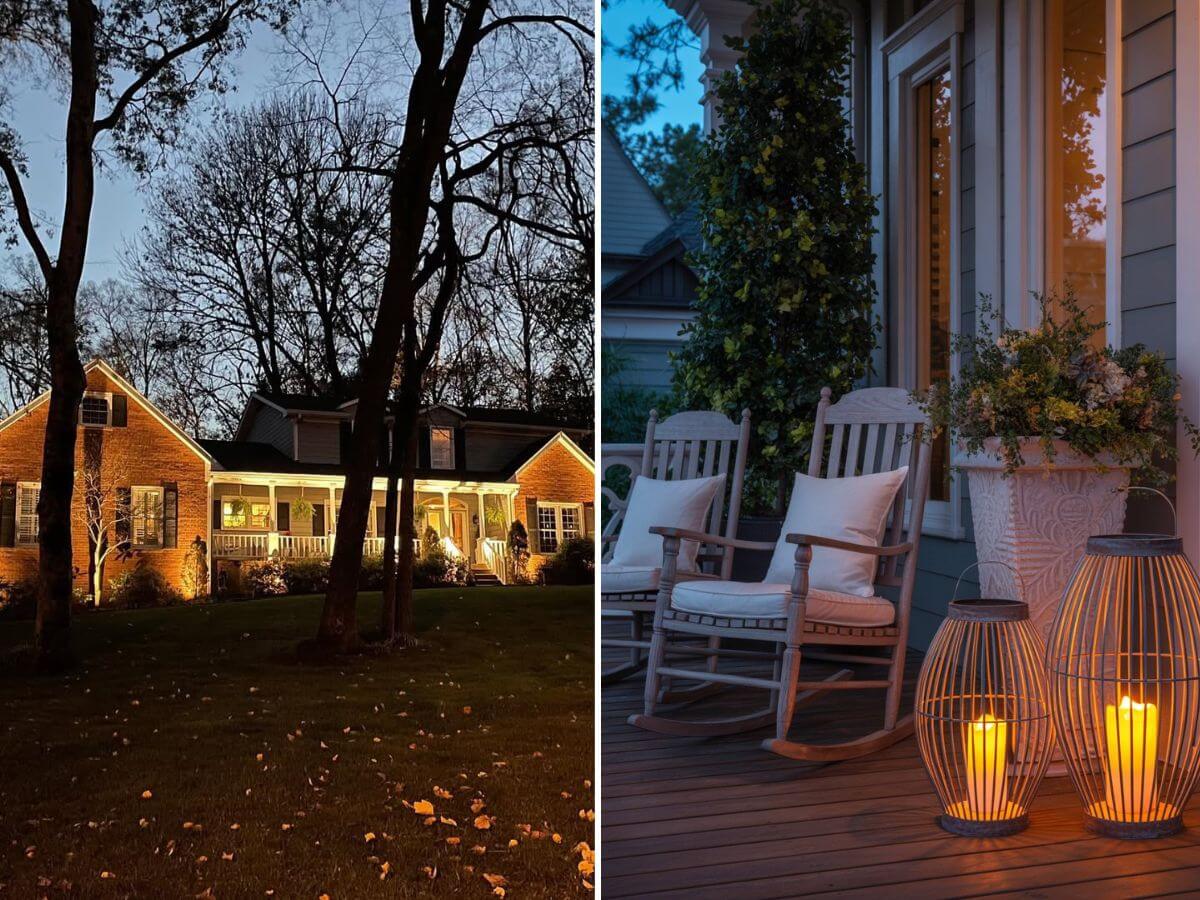
A warm glow spilling across the front steps. Soft light highlighting a planter near the entrance. A lantern tucked beside a chair. Small details that completely changed how a home felt after sunset.
That’s when I realized many homeowners focus on decorating their porch during the day but rarely think about what happens when the sun goes down.
The funny thing is that lighting often has a bigger impact at night than almost any decorative item you can buy.
Done well, it makes a porch feel welcoming, comfortable, and lived in.
Done poorly, it can feel harsh, flat, or strangely uninviting even when everything else looks beautiful.
The good news is that creating a cozy front porch doesn’t require major electrical work or a huge budget.
Most of the biggest improvements come from a few simple decisions about bulb color, fixture placement, and how different light sources work together.
In this guide, I’ll share front porch lighting ideas that can help you create a warmer atmosphere, improve curb appeal, highlight your home’s best features, and make your porch a place that feels inviting every time you come home after dark.
Let’s start with the biggest misconception people have about outdoor lighting.
What Makes a Front Porch Feel Cozy at Night?
Most people assume a brighter porch automatically feels better.
In reality, brightness alone rarely creates comfort.
Think about your favorite restaurant patio, outdoor café, or cozy backyard gathering.
Chances are it wasn’t flooded with bright white light.
Instead, there was balance.
Some areas were illuminated.
Others remained softly shadowed.
The space felt warm rather than overly lit.
Front porches work the same way.
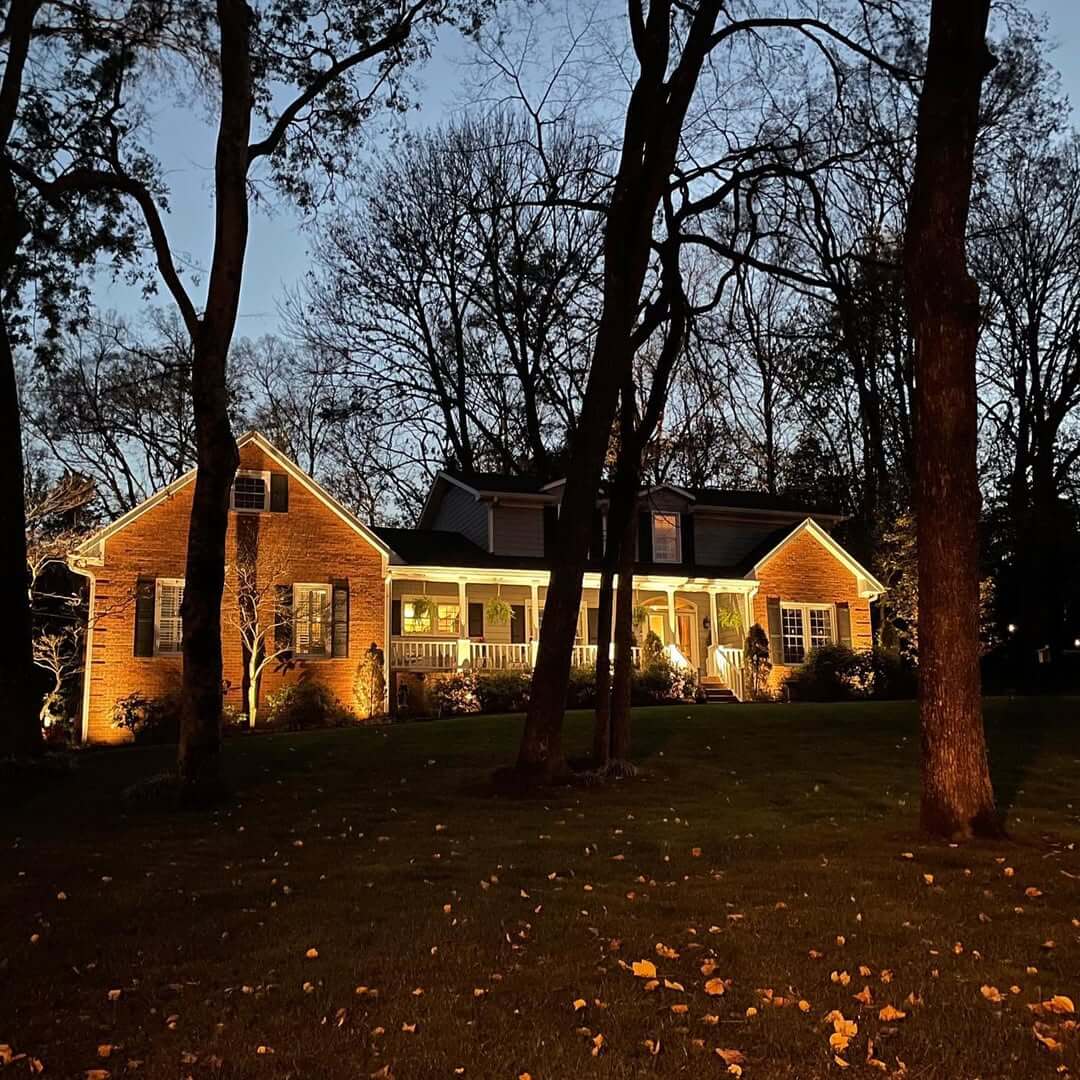
A cozy porch creates enough light to feel welcoming without making every surface equally bright.
The goal isn’t turning your porch into a parking lot.
The goal is creating a sense of arrival.
When someone walks toward your front door, their attention should naturally move through the space. The pathway feels clear. The entrance feels inviting. The lighting gently highlights the details you want people to notice.
I’ve experimented with both extremes.
At one point, I installed brighter bulbs thinking more light would improve curb appeal.
The opposite happened.
The porch suddenly felt stark and uncomfortable. Shadows disappeared. The space lost depth. Instead of feeling warm, it felt exposed.
After switching to softer lighting and adding a second light source near a planter, the entire porch felt more relaxed despite actually using less brightness overall.
That’s why cozy lighting is less about intensity and more about atmosphere.
Warm tones, layered light sources, and thoughtful placement usually create a stronger result than simply increasing brightness.
Quick Takeaway
Before buying new fixtures, ask yourself one question:
Does my porch feel welcoming after dark?
If the answer is no, adding more brightness may not be the solution. Better placement and warmer light often create a bigger improvement.
And that starts with choosing the right type of light.
Start With Warm Light Instead of Bright White Light
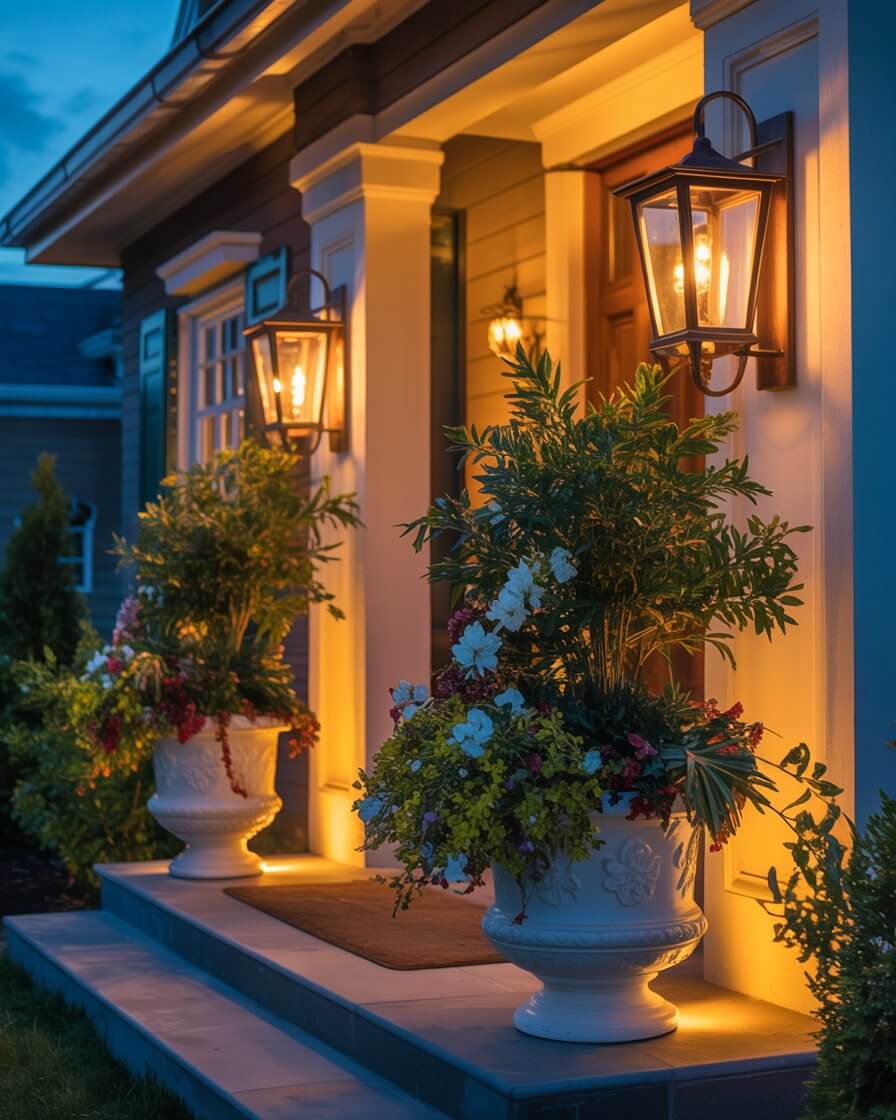
If I could recommend only one change for most front porches, this would be it.
Switch to warmer bulbs.
Many homes still use bright white bulbs outdoors because they seem cleaner or more powerful.
The problem is that cool white light often creates a harsh feeling at night.
It can make architectural details appear flat and can remove much of the warmth that makes a porch feel inviting.
Warm lighting tends to feel softer and more comfortable because it’s closer to the type of light people naturally associate with evening relaxation.
That’s why restaurants, hotels, and outdoor gathering spaces rarely rely on bright blue-toned lighting.
The lighting feels comfortable first.
Brightness comes second.
The experts at The Spruce explain this perfectly: “Warm lighting feels natural to us in the evenings and promotes relaxation.”
That single idea explains why warm-toned porch lighting usually feels more welcoming than cooler alternatives.
The difference becomes especially noticeable around:
- Front doors
- Seating areas
- Porch ceilings
- Lantern displays
- Decorative planters
- Outdoor dining spaces
One small bulb change can completely shift the mood of the entire entrance.
I noticed this myself after replacing bright white bulbs near my front door with warmer ones.
Nothing else changed.
Same fixture.
Same porch.
Same furniture.
Yet the entire space immediately felt calmer after sunset.
Quick Action Step
Take a photo of your porch tonight.
Then stand across the street and look at it from a distance.
If the light feels stark, bluish, or overly bright, start by replacing the bulb with a warmer option before changing anything else.
It’s one of the easiest upgrades you can make.
Once you’ve chosen the right light color, the next step is making sure that light isn’t coming from only one place.
That’s where layering comes in.
Layer Different Types of Light for a More Inviting Porch
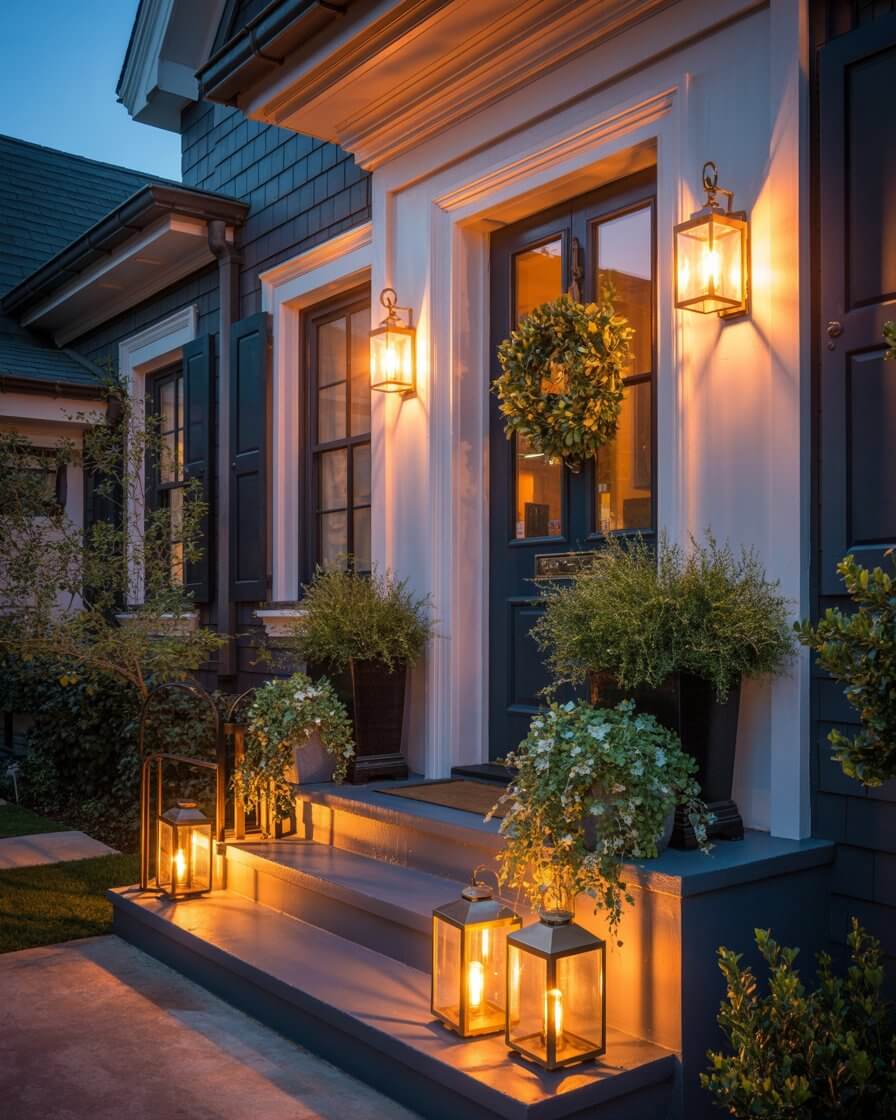
One of the quickest ways to make a porch feel unfinished at night is relying on a single light source.
You see this all the time.
A bright fixture hangs above the front door, doing all the work by itself.
The doorway is illuminated.
Everything else fades into darkness.
The result is functional, but it rarely feels cozy.
The porches that feel welcoming after sunset usually use more than one type of light.
Not because they’re expensive.
Because the light is distributed throughout the space.
A wall sconce near the entrance.
A lantern beside a chair.
A pathway light near the steps.
A soft glow highlighting a planter.
Each light serves a purpose, but together they create atmosphere.
That’s why professional outdoor lighting rarely depends on one fixture alone.
The team at Homes & Gardens explains it this way: “Just like with indoor lighting, the best way to think about your outdoor lighting ideas is in layers.”
That idea completely changed how I approached my own porch.
For years I assumed the overhead light was enough.
Technically, it was.
I could see the keyhole.
Guests could find the door.
Mission accomplished.
Or so I thought.
Then I added a small lantern beside a planter near the entry steps.
Suddenly the porch felt deeper.
More inviting.
The entrance no longer looked like a bright spot surrounded by darkness.
The light felt intentional instead of purely functional.
That’s the power of layering.
Each source creates its own small zone of light. Together, those zones make the porch feel balanced and welcoming.
Start With Three Simple Layers
You don’t need a complicated lighting plan.
Most front porches benefit from three basic layers.
Ambient Lighting
This is your main source of illumination.
Examples include:
- Porch ceiling fixtures
- Pendant lights
- Flush-mount fixtures
- Primary wall sconces
Its job is to provide general visibility.
Accent Lighting
Accent lighting highlights specific features.
Examples include:
- Planters
- Porch columns
- Decorative architectural details
- Seasonal displays
These lights add depth and visual interest.
Decorative Lighting
This is where the cozy atmosphere often comes from.
Examples include:
- Lanterns
- Battery-operated candles
- String lights
- Small tabletop lights
Decorative lighting softens the overall look and makes the porch feel more lived in.
Why Layering Works So Well
Think about how your eye moves through a space.
If everything is equally bright, nothing stands out.
The porch feels flat.
Layered lighting creates gentle contrast.
The front door becomes a focal point.
Planters gain texture.
Seating areas feel inviting.
Architectural details become more noticeable.
The porch develops character.
This matters even more on small porches.
Many homeowners assume limited square footage means fewer lighting options.
I’ve found the opposite is often true.
A compact porch can feel dramatically more welcoming when light is spread thoughtfully throughout the space instead of concentrated in a single overhead fixture.
Even one lantern and one accent light can make a noticeable difference.
Quick Action Step
Tonight, step outside after dark.
Turn on only your existing porch light.
Take a photo.
Then place a lantern or battery-operated candle near a planter, chair, or porch corner and take another photo.
Compare the two images.
Most homeowners are surprised by how much warmer the second version feels.
The goal isn’t adding more brightness.
It’s creating layers that make the porch feel inviting.
Once you start thinking in layers, the next place to focus becomes obvious.
The entrance itself.
A well-lit doorway naturally draws people in, and one of the easiest ways to create that effect is with properly placed wall sconces.
Use Wall Sconces to Frame the Entryway
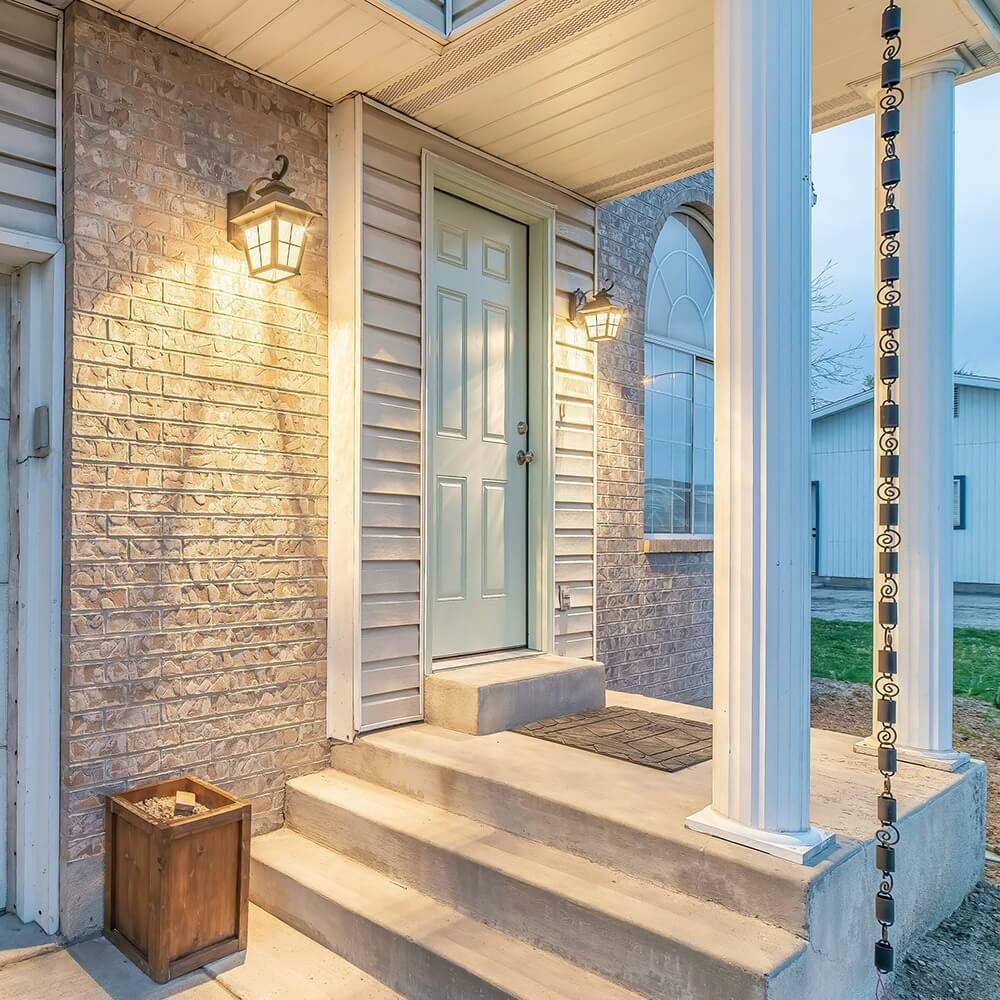
If your front door is the focal point of the porch, wall sconces act like the frame around a favorite photograph.
They help draw attention exactly where you want it to go.
That’s one reason so many well-designed entrances use matching sconces on either side of the door. The arrangement creates balance and makes the entrance feel more intentional before anyone even reaches the porch.
I started noticing this while looking at homes that always seemed welcoming at night.
Many of them weren’t using elaborate lighting systems.
In fact, some had only two fixtures.
The difference was placement.
Instead of putting all the attention on a single overhead light, they used wall-mounted fixtures to visually anchor the doorway.
The entrance felt clear.
Easy to find.
Comfortable to approach.
That simple adjustment can completely change how a porch feels after dark.
Why Symmetry Works So Well
Our eyes naturally respond to balance.
When sconces are positioned evenly on both sides of a front door, the entire entryway feels organized and visually grounded.
The effect doesn’t need to be formal.
Modern homes, farmhouse-style porches, traditional entries, and even small front stoops can benefit from symmetrical lighting.
The goal isn’t perfection.
The goal is creating a clear focal point.
When visitors approach your home, the entrance should immediately stand out as the destination.
Wall sconces help accomplish that naturally.
Pay Attention to Fixture Scale
One mistake I see often is choosing fixtures that are too small for the space.
A tiny sconce beside a large front door can disappear during the day and look underwhelming at night.
The opposite can happen too.
An oversized fixture may overwhelm the entry and compete with other architectural details.
Before purchasing anything, step back and look at your front door from the curb.
Think about the overall scale of the house.
A larger home generally benefits from larger fixtures.
A smaller porch often looks best with lighting that feels proportional to the entrance.
The fixture should complement the door, not compete with it.
Small Porch Tip
If your porch only has room for a single wall light, don’t worry.
You can still create balance.
Try pairing the wall fixture with another source of light nearby, such as:
- A lantern on a side table
- A softly illuminated planter
- A decorative floor lantern near the entrance
- A small battery-operated candle display
The eye reads the overall balance of the space, not just the number of fixtures installed.
Even compact porches can feel layered and welcoming.
Think Beyond the Door
Wall sconces don’t just illuminate the entrance.
They can also help highlight nearby details.
Warm light spilling across brick, stone, wood, or painted trim creates texture that often disappears during daylight hours.
One evening I noticed this on my own porch after replacing a harsh overhead bulb with softer wall lighting.
The front door looked better.
But so did everything around it.
The surrounding trim suddenly had more depth.
The planters felt connected to the entry.
The porch felt less like a collection of separate pieces and more like one cohesive space.
That’s often what cozy lighting does best.
It helps everything work together.
Quick Action Step
Tonight, stand at the street and look at your home after dark.
Can you immediately identify the front door?
If not, your entrance may need stronger visual framing.
Wall sconces placed near the doorway are often one of the easiest ways to make the entrance feel more welcoming and easier to notice from a distance.
Once the doorway feels inviting, the next opportunity is creating depth around it.
And one of the simplest ways to do that is by highlighting the plants and greenery already on your porch.
Highlight Planters and Greenery With Soft Lighting
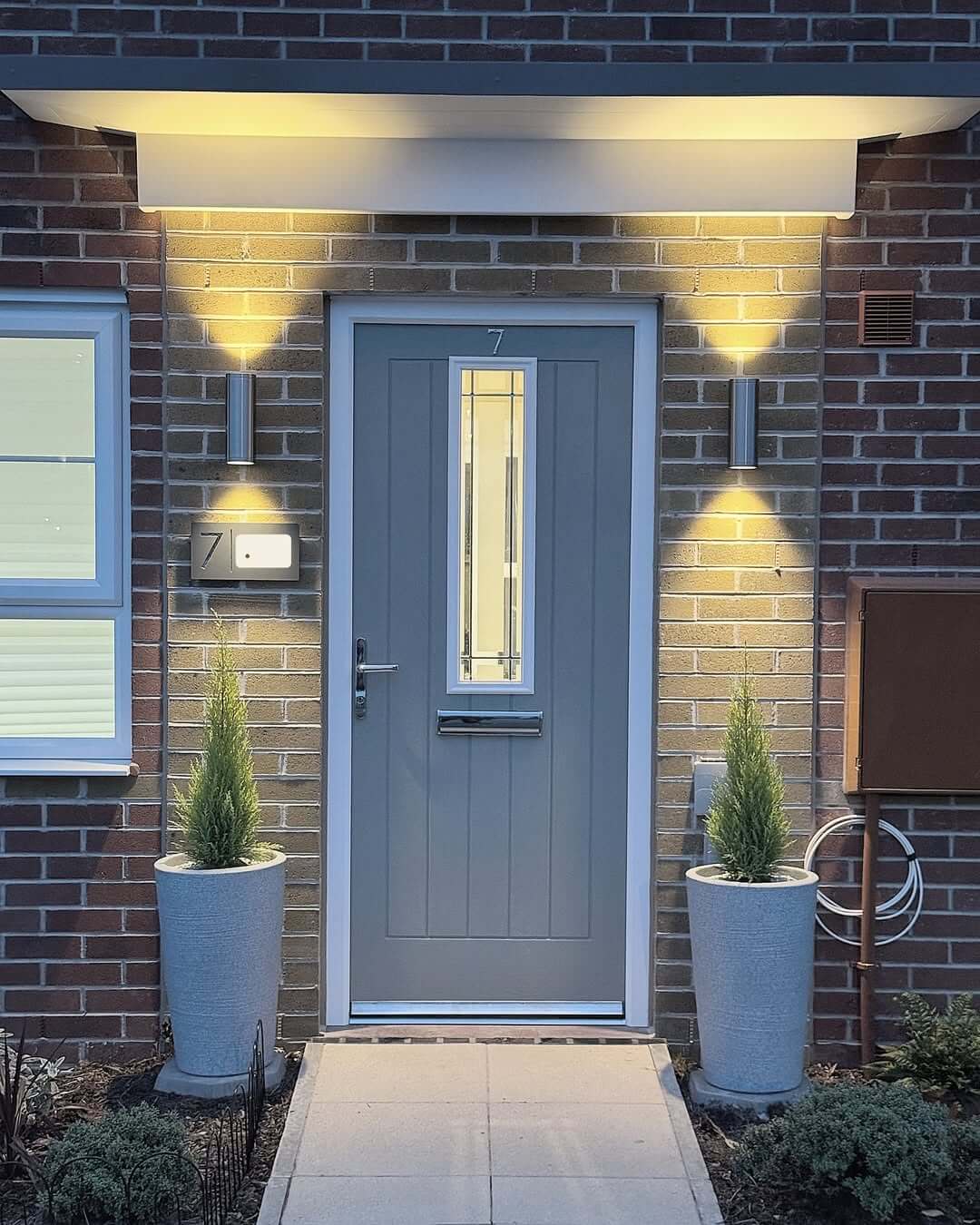
Plants add life to a porch during the day.
At night, they can become some of the most beautiful features of the entire entrance.
The challenge is that once the sun goes down, much of that texture and color disappears.
A lush planter that looked stunning in the afternoon can fade into the background after dark if there’s no light nearby.
That’s why a little illumination around greenery can make such a dramatic difference.
Not bright spotlights.
Not floodlights.
Just enough light to reveal shapes, textures, and layers.
When light brushes across leaves and branches, it creates gentle shadows that add depth to the porch. Suddenly the space feels more dimensional and welcoming.
This is one of my favorite lighting tricks because the effect often looks expensive even when it costs very little.
Focus on One Feature Instead of Everything
A common mistake is trying to illuminate every plant on the porch.
That usually creates visual clutter.
A better approach is choosing one focal point.
Maybe it’s a pair of planters flanking the front door.
Maybe it’s a large fern beside a porch chair.
Maybe it’s a statement container near the steps.
Draw attention to one feature first.
Let the rest of the greenery remain slightly darker.
That contrast creates depth and gives the eye somewhere to land.
Think of it like decorating a room.
You don’t highlight every object equally.
You create focal points.
Outdoor lighting works the same way.
Use Light to Reveal Texture
Plants become much more interesting when light hits them from the side rather than directly overhead.
Large leaves create dramatic shadows.
Ornamental grasses catch movement and light.
Trailing vines add softness around containers.
Evergreens develop shape and dimension.
Even simple greenery can look completely different after sunset when it’s illuminated thoughtfully.
One evening I moved a lantern closer to a planter near my front steps.
The difference surprised me.
The plant itself wasn’t special.
It wasn’t rare.
It wasn’t particularly colorful.
Yet the soft glow revealed texture I rarely noticed during the day.
The entire corner suddenly felt warmer and more inviting.
Small Porch Owners Have an Advantage Here
If your porch is small, this technique becomes even more effective.
You don’t need multiple fixtures.
You only need one attractive focal point.
A single illuminated planter can create enough visual interest to make the entire porch feel more welcoming.
In many cases, a small porch benefits from restraint.
One highlighted container often looks far better than several competing light sources.
Great Places to Add Soft Plant Lighting
Look for areas where greenery naturally draws attention.
Examples include:
- Planters beside the front door
- Containers near porch steps
- Hanging baskets
- Window boxes
- Small shrubs near the entrance
- Decorative seasonal displays
These locations already contribute to curb appeal during the day.
Lighting helps them continue working after sunset.
Quick Action Step
Tonight, place a lantern, battery-operated candle, or small outdoor light beside your favorite planter.
Step back to the curb and view the porch from a distance.
Notice how the illuminated greenery creates depth and helps break up large dark areas around the entrance.
Sometimes a single planter becomes the feature that makes the whole porch feel warm at night.
Once greenery starts working after dark, the next area to focus on is the path leading visitors to your door.
Because a cozy porch should feel welcoming long before someone reaches the front steps.
Make Walkways Feel Safer Without Looking Like a Runway
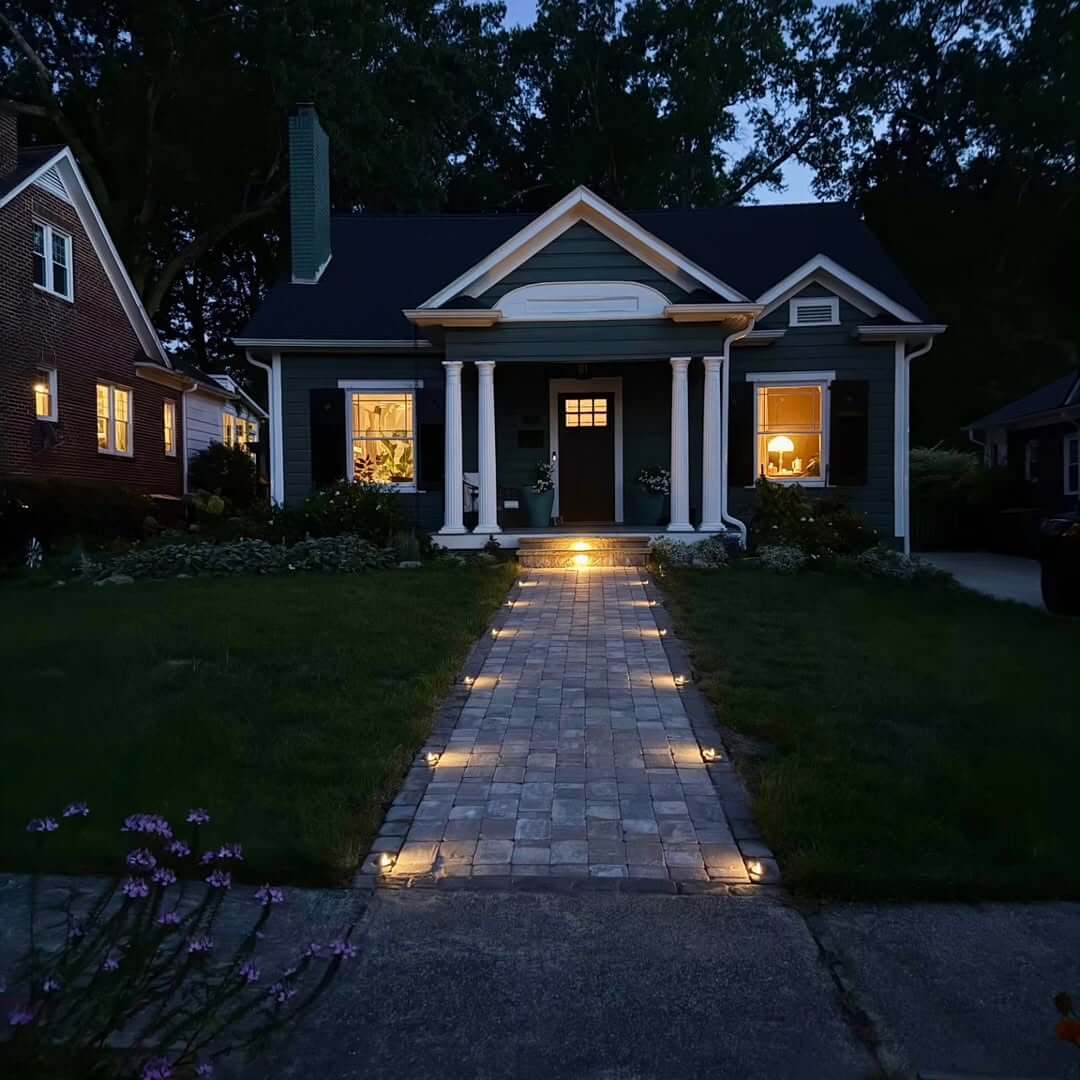
A cozy front porch doesn’t begin at the front door.
It begins the moment someone steps onto the walkway.
That’s why pathway lighting deserves just as much attention as the porch itself.
The challenge is finding the right balance.
Too little light can make guests feel uncertain about where they’re walking.
Too much light can make the front yard feel more like an airport runway than a welcoming entrance.
The goal is guidance, not glare.
You want people to comfortably see where they’re going without feeling surrounded by bright lights at every step.
That’s where thoughtful placement makes all the difference.
The outdoor lighting specialists at CAST Lighting put it simply: “Path lighting combines aesthetics with functionality.”
That’s exactly how I think about walkway lighting.
It should help people move safely through the space while also contributing to the overall atmosphere.
When those two goals work together, the entire approach to your home feels more inviting.
Stop Lighting Every Few Feet
One of the most common mistakes homeowners make is placing pathway lights at perfectly equal intervals all the way down the walk.
At first glance, it seems logical.
More lights should mean better visibility.
In reality, it often creates visual clutter.
The eye notices the fixtures more than the landscape.
The lighting becomes the feature rather than the home itself.
Instead, focus on key areas.
The beginning of the path.
Changes in direction.
Steps.
Transitions between the walkway and porch.
These locations naturally need more visual guidance.
The rest of the path can remain softly illuminated.
This creates a much more relaxed atmosphere.
Create Pools of Light Instead of a Continuous Line
One trick I picked up after studying professionally designed outdoor spaces is that they rarely illuminate everything equally.
Instead, they create pockets of light.
A gentle glow near the entry.
A small illuminated area around a planter.
A softly lit section of the path.
The spaces between those areas remain slightly darker.
This contrast creates depth and makes the lighting feel more natural.
It also prevents the yard from feeling overlit.
The result is often more attractive while using fewer fixtures.
Let the Landscape Participate
Path lighting doesn’t always need to point directly at the ground.
Nearby plants, shrubs, and decorative containers can help reflect and soften light.
A small fixture positioned near ornamental grasses or low shrubs often creates a richer visual effect than one standing alone in open space.
The light interacts with leaves and textures, creating movement and interest without requiring additional fixtures.
This works especially well near the front porch where landscape elements already contribute to curb appeal.
Small-Space Tip
If you have a short walkway, resist the urge to fill it with lights.
I’ve seen tiny front paths lined with so many fixtures that the lighting overwhelms the space.
A few well-positioned lights usually create a stronger result.
In smaller yards, restraint often feels more expensive than abundance.
One light near the path entrance and another near the porch may be all you need.
Think About the View From the Street
Many homeowners evaluate pathway lighting while standing on the porch.
That’s useful.
But it’s not where most people first see your home.
After dark, step back to the sidewalk or across the street.
Look at how the lighting guides your eye toward the entrance.
Can you easily identify the path?
Does the porch feel welcoming?
Do certain areas feel too bright compared to everything else?
Viewing your lighting from a distance often reveals opportunities you won’t notice up close.
Quick Action Step
Go outside tonight and count the number of lights illuminating your walkway.
Then ask yourself whether every fixture is actually serving a purpose.
If two lights are illuminating the exact same area, consider removing one temporarily and seeing how the space feels.
You may discover that fewer lights create a warmer atmosphere while still providing plenty of visibility.
Once the path gently guides visitors toward the entrance, it’s time to add a layer of charm that makes the entire porch feel more personal.
That’s where lanterns come in.
Add Lanterns for Instant Charm
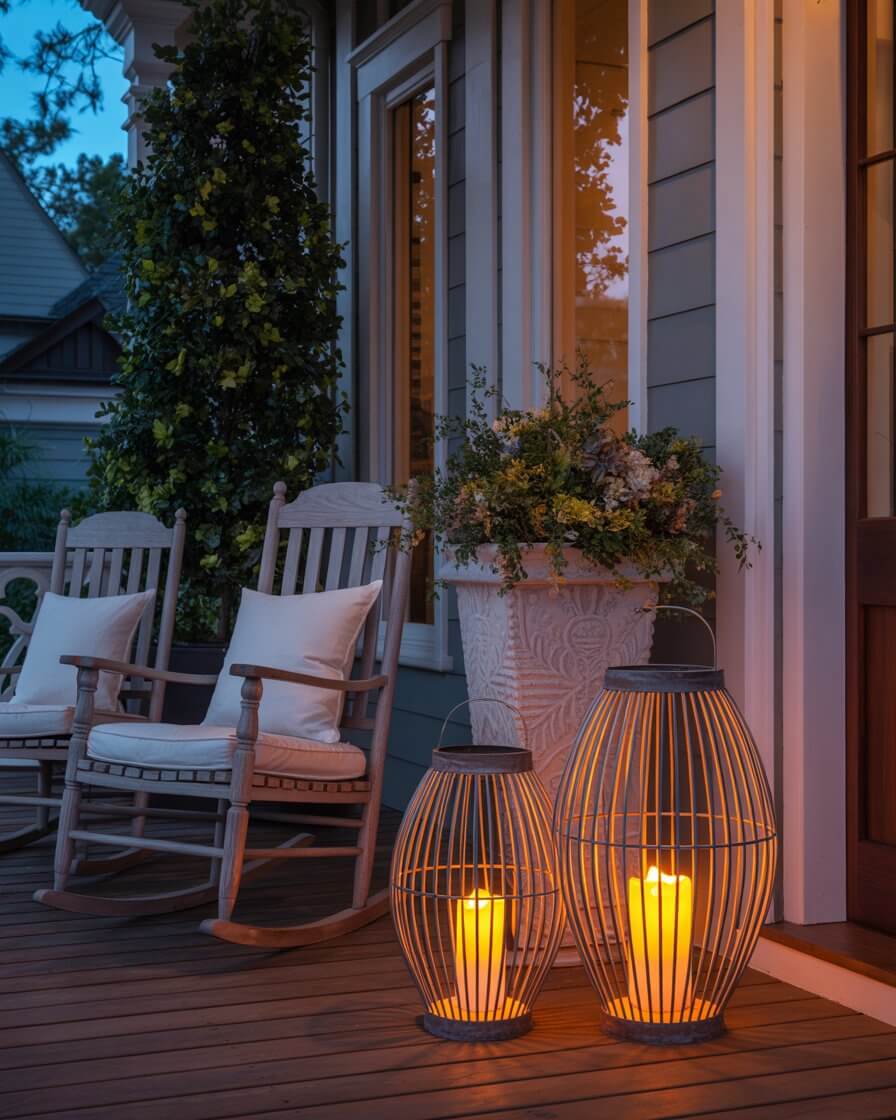
If there’s one decorating element that can make a porch feel warmer in less than five minutes, it’s a lantern.
Not because lanterns produce a huge amount of light.
Because they create atmosphere.
A porch illuminated entirely by mounted fixtures can sometimes feel functional but a little predictable.
Add a lantern beside a chair, near the front door, or next to a planter, and suddenly the space feels more personal.
It feels lived in.
It feels like someone actually spends time there.
That’s why lanterns show up so often on welcoming porches, cozy patios, and outdoor entertaining spaces. They soften the overall lighting scheme and introduce a gentle glow that makes the area feel more relaxed.
Bigger Isn’t Always Better
One thing I’ve learned is that scale matters more than quantity.
Many homeowners buy several small lanterns and scatter them around the porch.
The result can feel cluttered.
Instead, one larger lantern often creates a stronger visual statement.
A substantial lantern beside the front door or tucked next to a planter becomes a focal point. It draws attention without competing with everything around it.
This works especially well if your porch already has wall sconces providing general illumination.
The lantern doesn’t need to do the heavy lifting.
Its job is adding warmth and character.
Battery-Operated Candles Work Surprisingly Well
Years ago, battery-operated candles looked obviously fake.
That’s changed.
Many now mimic the soft flicker of real candlelight and create a surprisingly convincing glow.
For front porches, they offer several advantages.
You don’t need outlets.
You don’t need wiring.
You don’t need to worry about wind extinguishing a flame.
You simply place them where they look best.
For many homeowners, that’s the easiest way to experiment with layered lighting without making permanent changes.
Pair Lanterns With Existing Features
Lanterns tend to look most natural when they’re grouped with something else.
For example:
- Beside a large planter
- Next to a porch chair
- Near a bench
- Beside seasonal décor
- Adjacent to the front steps
These combinations create small visual moments throughout the porch.
The lantern becomes part of a larger scene rather than an isolated object.
One arrangement I particularly liked involved placing a lantern beside a tall planter filled with ornamental grass.
During the day, the planter provided height and texture.
At night, the lantern illuminated the grass from below, creating movement and shadow that completely changed the look of that corner.
Neither item felt especially remarkable on its own.
Together, they became one of the most attractive parts of the porch.
Lanterns Work Especially Well on Small Porches
Small porches often don’t have room for additional fixtures.
Lanterns solve that problem.
They provide visual interest without taking up much space and can be moved whenever needed.
A narrow front stoop, townhouse entrance, or compact porch can often benefit from one carefully placed lantern more than multiple decorative accessories.
The goal isn’t filling every corner.
The goal is creating one or two inviting focal points.
Use Lanterns Throughout the Year
Another reason I like lanterns is their flexibility.
The same lantern can work during every season.
In spring, it might sit beside flowering planters.
During summer, it can accompany a small seating area.
Fall decorations naturally pair with lanterns.
Even winter greenery and evergreen arrangements look better with a warm glow nearby.
Instead of replacing décor every few months, the lantern becomes a constant element while the surrounding accessories change.
Quick Action Step
Choose the darkest corner of your porch tonight.
Place a lantern there and turn it on.
Then step back to the curb and look at the porch from a distance.
You’ll often notice that the added glow creates balance and makes the space feel larger, warmer, and more welcoming.
And speaking of making a porch feel larger, lighting can do far more than illuminate a space.
Used strategically, it can actually change how large that space appears after dark.
Use Lighting to Make a Small Porch Feel Larger
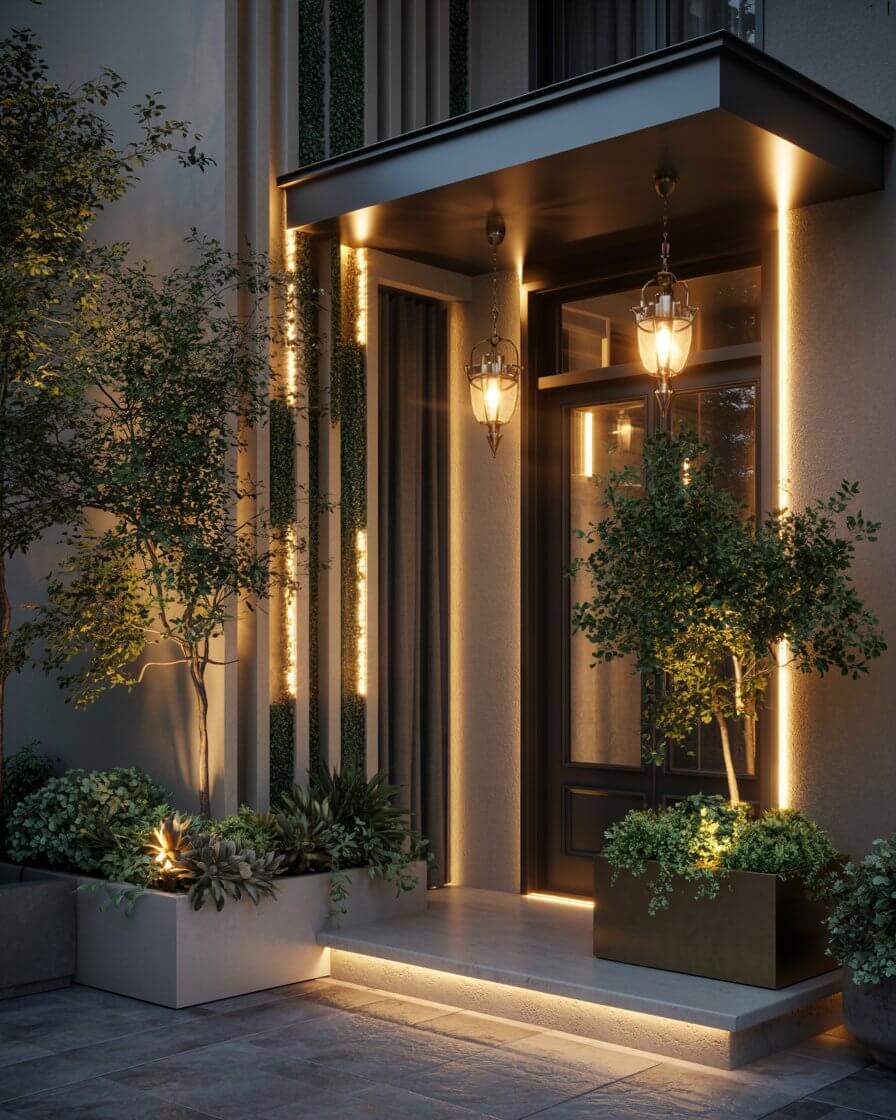
Small porches come with one advantage that larger spaces don’t.
Every improvement makes a bigger impact.
A single planter stands out more.
A new rug changes the entire look.
And thoughtful lighting can completely change how spacious the porch feels after dark.
Many homeowners assume limited square footage limits their design options.
I’ve found the opposite is often true.
The trick isn’t adding more décor.
It’s directing attention where you want the eye to go.
Good lighting can make a compact porch feel more open, more inviting, and more visually interesting without changing a single structural element.
Draw the Eye Upward
One reason some small porches feel cramped is that everything happens at ground level.
The eye never moves beyond the floor, furniture, and entry steps.
Lighting can help change that.
Wall sconces, hanging lanterns, pendant lights, and illuminated architectural details naturally encourage the eye to travel upward.
When attention moves vertically, the entire porch feels taller and more spacious.
This works especially well on porches with:
- High ceilings
- Decorative columns
- Tall front doors
- Vertical siding
- Hanging baskets
The lighting doesn’t need to be dramatic.
Even a softly illuminated wall fixture can help create the feeling of additional height.
Eliminate Dark Corners
Dark corners have a way of making small spaces feel even smaller.
At night, they visually shrink the porch because portions of the space disappear completely.
That doesn’t mean every corner needs a dedicated light fixture.
Sometimes all it takes is repositioning an existing lantern or adding a small accent light near a planter.
The goal is allowing the eye to see the full shape of the porch.
When more of the space becomes visible, the area immediately feels larger.
One of the biggest improvements I made to a smaller porch was illuminating a corner that had previously disappeared after sunset.
The porch wasn’t actually any bigger.
It simply felt bigger because the entire space could be seen.
Create Depth With Multiple Focal Points
Another common mistake is concentrating all the light around the front door.
The entrance becomes bright while everything else fades into darkness.
This flattens the space visually.
Instead, try creating two or three areas of interest.
For example:
- A wall sconce near the door
- A lantern beside a chair
- A softly illuminated planter
Now the eye moves throughout the porch rather than stopping at a single bright spot.
That movement creates depth.
And depth makes spaces feel larger.
Use Reflection to Your Advantage
Certain materials naturally help distribute light.
Glass lanterns.
Light-colored planters.
Reflective metal finishes.
Bright trim around windows and doors.
When these surfaces catch nearby light, they gently spread illumination throughout the space.
This subtle reflection often makes a porch feel brighter without increasing bulb brightness.
It’s a simple trick that many homeowners overlook.
Keep the Lighting Consistent
A mix of dramatically different light colors can make a small porch feel disconnected.
One fixture may appear warm and inviting while another feels stark and cold.
The result feels visually busy.
Keeping a consistent lighting tone throughout the porch creates a more unified appearance.
Everything feels connected.
The space feels calmer.
And that sense of cohesion often makes even modest porches feel larger and more polished.
Small Porch Lighting Formula
If you’re working with limited space, try this simple formula:
- One primary light near the entrance
- One lantern or decorative light source
- One illuminated planter or architectural feature
That’s it.
Three carefully chosen light sources are often enough to transform a small porch without overcrowding it.
Quick Action Step
Take a photo of your porch tonight from the sidewalk.
Then identify the darkest area in the image.
Ask yourself whether that darkness adds atmosphere or simply makes the porch feel smaller.
If it’s the latter, adding a small accent light or lantern may be all that’s needed to make the space feel more open.
Once the lighting foundation is working well, you can easily adapt it throughout the year without replacing fixtures or starting over each season.
Create Seasonal Lighting Changes Without Rewiring Anything
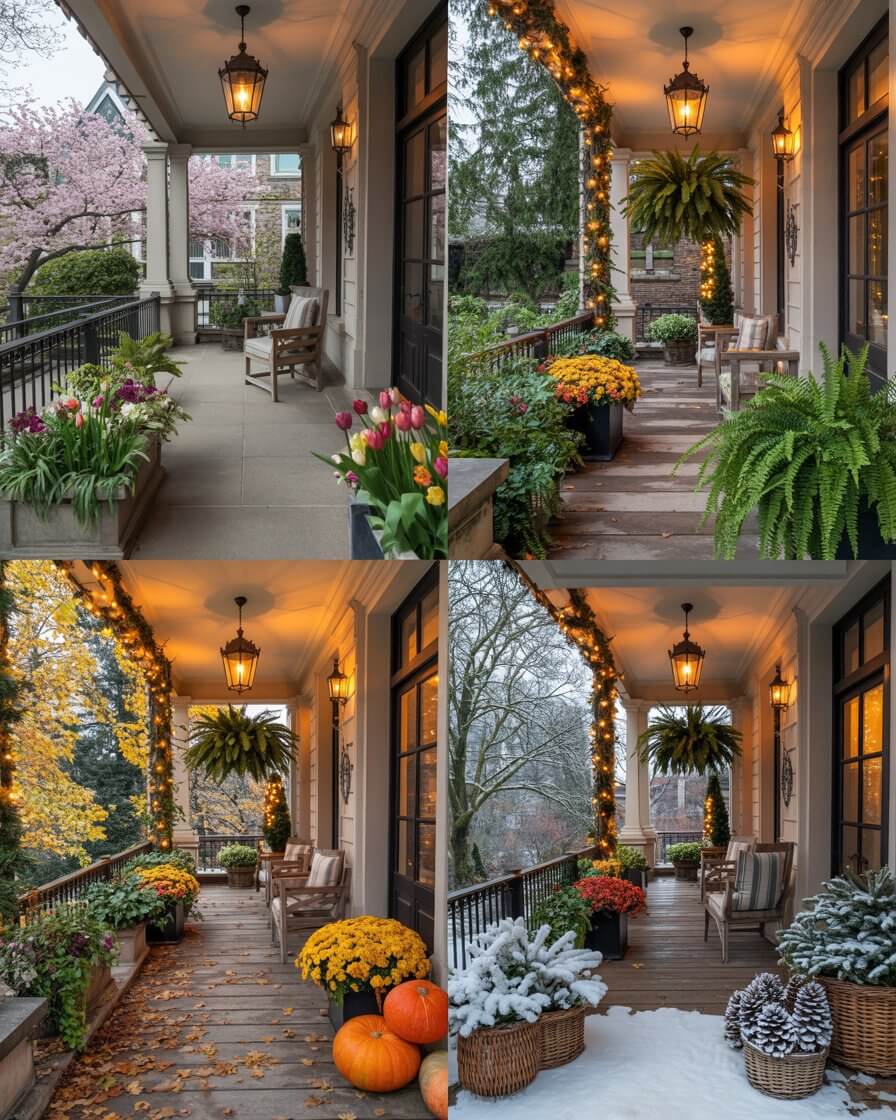
One of the biggest myths about outdoor lighting is that you need a completely different setup for every season.
You don’t.
In fact, the most inviting porches usually keep the same lighting foundation year-round and make small seasonal adjustments around it.
That’s good news for homeowners because it means you don’t have to replace fixtures, hire an electrician, or constantly buy new décor every few months.
The wall sconces stay.
The pathway lighting stays.
The lanterns stay.
What changes is how you style the space around them.
Think of your lighting as the framework.
The seasonal touches simply help it feel fresh throughout the year.
Summer Is About Extending the Evening
Summer naturally encourages people to spend more time outside after sunset.
The porch becomes a place to sit with a cold drink, chat with neighbors, or enjoy cooler evening temperatures.
This is where decorative lighting really shines.
Lanterns can stay out longer.
Battery-operated candles create a softer glow.
A small table lamp designed for outdoor use can make a seating area feel surprisingly cozy.
The goal isn’t increasing brightness.
It’s making the porch feel comfortable enough that you actually want to spend time there.
Fall Lighting Feels Naturally Cozy
Few seasons pair better with porch lighting than fall.
The days become shorter.
Sunsets arrive earlier.
Warm lighting suddenly plays a bigger role in curb appeal.
This is when lanterns, illuminated planters, and softly lit seasonal displays feel especially inviting.
Pumpkins, ornamental grasses, and autumn containers often look even better after dark when they’re highlighted by gentle lighting.
One thing I love about fall decorating is that many daytime decorations naturally become nighttime focal points with a little illumination nearby.
A planter arrangement that looked attractive during the afternoon suddenly becomes the feature everyone notices after sunset.
Winter Benefits From Extra Warmth
Winter can make porches feel empty.
Trees lose leaves.
Gardens slow down.
Color becomes harder to find.
Lighting helps fill some of that gap.
Evergreen planters, winter containers, and simple seasonal greenery all gain visual interest when illuminated after dark.
The warm glow creates contrast against colder outdoor conditions and helps the porch feel welcoming even during the darkest months of the year.
This doesn’t require holiday decorations.
Even simple greenery paired with soft lighting can completely change the atmosphere.
Spring Is the Season of Subtle Refreshes
By spring, many homeowners are ready for something lighter and brighter.
Fortunately, the lighting foundation doesn’t need to change.
The fixtures that worked in winter will likely work just as well in spring.
What changes is what they illuminate.
Fresh flowers.
New planters.
Emerging greenery.
Seasonal containers.
The porch begins to feel alive again, and lighting helps showcase those details after sunset.
This is one reason I prefer investing in timeless fixtures rather than highly seasonal lighting products.
Good lighting works in every season.
The décor around it can evolve naturally.
Let Decor Do Most of the Seasonal Work
When people think about seasonal decorating, they often focus on buying more things.
A simpler approach is allowing existing lighting to highlight seasonal features.
The lantern doesn’t change.
The planter beside it changes.
The wall sconce doesn’t change.
The wreath beneath it changes.
The pathway light stays exactly where it is.
The flowers nearby change with the season.
This keeps decorating easier, less expensive, and far less overwhelming.
Quick Action Step
Before buying seasonal lighting, walk outside after dark and look at your current setup.
Ask yourself what existing fixture could highlight a seasonal planter, wreath, lantern display, or decorative arrangement.
You may discover that the lighting you already own is enough.
Often the biggest improvement comes from changing what the light shines on rather than changing the light itself.
Of course, even beautiful lighting can lose its cozy atmosphere if a few common mistakes get in the way.
Let’s look at the issues that often prevent front porches from feeling warm and inviting after dark.
Common Front Porch Lighting Mistakes That Ruin the Cozy Effect
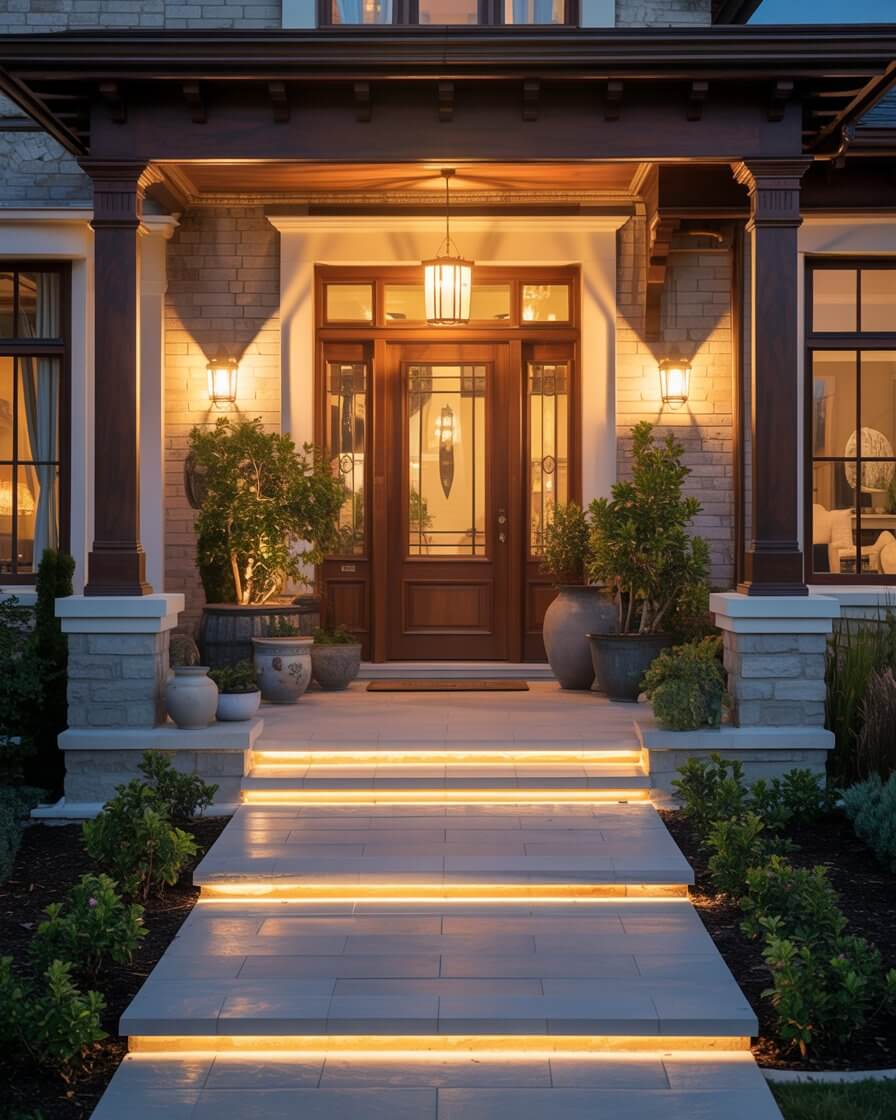
Creating a cozy front porch isn’t usually about buying more lighting.
More often, it’s about avoiding a few mistakes that quietly work against the atmosphere you’re trying to create.
I’ve seen beautifully decorated porches lose much of their charm after dark simply because the lighting wasn’t working with the space.
The good news is that most of these issues are easy to fix once you know what to look for.
Using Bulbs That Are Too Bright
This is probably the most common mistake homeowners make.
When a porch feels dark, the natural reaction is to install a brighter bulb.
Sometimes that helps.
Often it doesn’t.
A bulb that’s too bright can wash out architectural details, flatten textures, and create uncomfortable glare.
Instead of feeling welcoming, the porch starts to feel harsh.
I’ve made this mistake myself.
At first, the brighter light seemed like an improvement.
Everything was easier to see.
But after a few evenings, the porch felt less comfortable than before.
The lighting drew attention to itself instead of the space around it.
A softer glow usually creates a much warmer atmosphere.
Mixing Different Light Colors
Imagine walking onto a porch where one fixture produces warm golden light while another produces bright bluish-white light.
Something immediately feels off.
The eye notices the mismatch even if you can’t explain exactly why.
Different light temperatures can make a porch feel disconnected.
One area feels cozy.
Another feels clinical.
The result lacks cohesion.
Whenever possible, keep your lighting consistent throughout the porch.
The fixtures don’t have to match.
The overall tone of the light should.
Treating Every Area Equally
Not every part of the porch deserves the same amount of attention.
Yet many homeowners illuminate every corner with equal brightness.
The result often feels flat.
Nothing stands out.
There’s no focal point.
No visual hierarchy.
A better approach is deciding what deserves attention first.
Maybe it’s the front door.
Maybe it’s a beautiful planter arrangement.
Maybe it’s a seating area.
Let that feature become the star.
The surrounding lighting should support it rather than compete with it.
Ignoring Scale
Lighting that feels perfectly sized in a showroom can look completely different once it’s installed.
A tiny fixture beside a large front door often looks underwhelming.
An oversized fixture on a narrow porch can dominate the entire entrance.
Scale matters just as much with lighting as it does with furniture and planters.
Whenever possible, evaluate fixture size from the street rather than from directly beneath it.
That’s how most people experience your home.
Forgetting About Maintenance
Even the best lighting design loses its impact if the fixtures aren’t maintained.
Dirty glass reduces brightness.
Dust and pollen dull finishes.
Burned-out bulbs create dark spots.
Spider webs become surprisingly visible when illuminated at night.
A quick cleaning every so often keeps fixtures looking their best and helps maintain the atmosphere you’ve worked to create.
It’s a small task that produces a noticeable difference.
Overlooking What Visitors Actually See
One mistake I rarely hear discussed is evaluating the porch only from the porch itself.
Most homeowners stand near the front door and assess the lighting from there.
Visitors don’t experience the space that way.
They approach from the sidewalk.
The driveway.
The street.
That’s where the lighting should be evaluated.
Some of my best lighting adjustments happened after stepping across the street and looking back at the house.
The view revealed bright spots, dark corners, and missed opportunities that weren’t obvious from the porch.
Quick Action Step
Tonight, take a photo of your porch from the curb after dark.
Then ask yourself three questions:
- What draws my attention first?
- Does the entrance feel welcoming?
- Is there any light that feels too bright or out of place?
The answers often reveal exactly what needs adjusting.
And the good news is that most fixes involve simple tweaks rather than major upgrades.
Now let’s put everything together into a simple lighting plan that almost any homeowner can follow.
A Simple Front Porch Lighting Plan You Can Copy
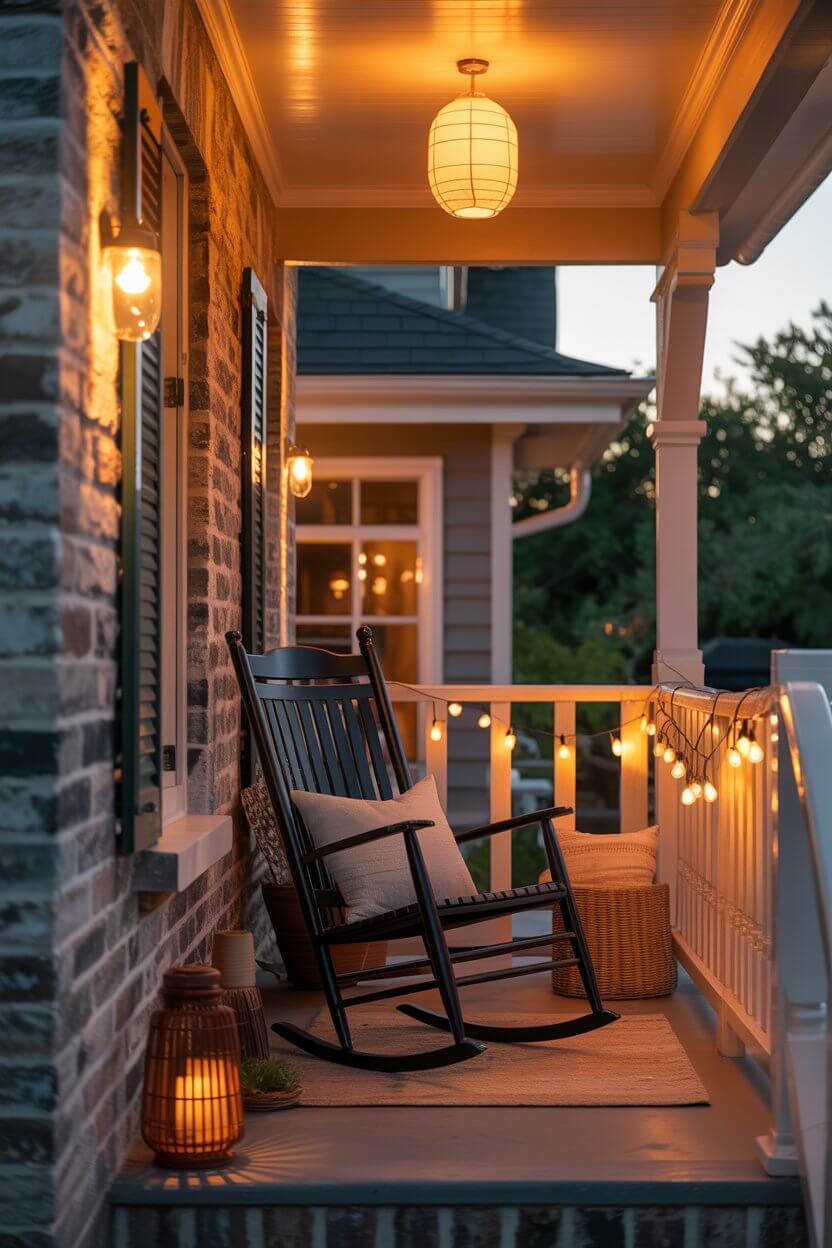
By this point, you might be thinking:
This all sounds great, but where do I actually start?
The good news is that creating a cozy front porch doesn’t require a complicated design plan.
You don’t need a dozen fixtures.
You don’t need professional landscape lighting.
And you definitely don’t need to light every inch of the porch.
In fact, some of the most inviting front porches use surprisingly few light sources.
They simply place them well.
If I were starting from scratch today, this is the exact approach I would follow.
Step 1: Choose Warm Lighting First
Before adding anything new, look at your existing bulbs.
If the light feels harsh, bluish, or overly bright, start there.
The atmosphere of a porch can change dramatically when warm light replaces cool white light.
This one adjustment often delivers the biggest improvement for the least amount of effort.
Think of warm lighting as the foundation everything else builds upon.
Step 2: Make the Front Door the Main Focal Point
Every porch needs a visual destination.
Most of the time, that’s the front door.
Whether you’re using wall sconces, a porch light, or another fixture, the entrance should naturally attract attention.
When someone approaches your home after dark, they shouldn’t have to wonder where the door is.
The lighting should guide them there naturally.
If your entrance currently blends into the rest of the porch, focus your first improvements here.
Step 3: Add One Secondary Light Source
This is where many porches start feeling cozy.
Instead of relying entirely on the main fixture, introduce one additional source of light.
It could be:
- A lantern beside a planter
- A battery-operated candle display
- A softly illuminated container garden
- A small accent light near a seating area
The purpose isn’t increasing brightness.
The purpose is creating depth.
Once light exists in more than one location, the porch immediately feels more layered and welcoming.
Step 4: Light the Path, Not the Entire Yard
If visitors use a walkway to reach your porch, make sure the route feels easy to follow.
Focus on:
- Steps
- Changes in elevation
- Direction changes
- The transition from walkway to porch
You don’t need lights every few feet.
A few thoughtfully positioned fixtures usually create a cleaner and more attractive result.
Remember, guidance is the goal.
Not maximum brightness.
Step 5: Highlight One Feature You Love
Every porch has something worth drawing attention to.
Maybe it’s a beautiful planter.
A seasonal arrangement.
A bench.
A decorative column.
A hanging basket.
Choose one feature and give it a little extra attention with nearby lighting.
This creates a focal point and helps the porch feel more personal.
One well-lit feature often has more impact than several competing highlights.
Step 6: Check the View From the Street
This step is surprisingly important.
After making adjustments, walk to the sidewalk or across the street and look back at the house.
Ask yourself:
- Does the porch feel welcoming?
- Is the front door easy to identify?
- Are any areas distracting?
- Does the lighting feel balanced?
Many lighting decisions that seem perfect up close look completely different from a distance.
The street view often reveals the final tweaks needed to pull everything together.
Step 7: Adjust Before Buying More
This is a habit that’s saved me a lot of money.
Before purchasing another fixture, try repositioning what you already have.
Move a lantern.
Relocate an accent light.
Shift a planter closer to an existing fixture.
Change a bulb.
Small adjustments often produce bigger improvements than adding new products.
Give your current setup every chance to succeed before expanding it.
The Goal Isn’t Perfection
One thing I’ve learned is that the coziest porches rarely look perfect.
They’re not showroom displays.
They’re not trying too hard.
They simply feel welcoming.
A warm glow near the entrance.
A little depth around the planters.
A clear path to the front door.
Those small details create an atmosphere people notice immediately, even if they can’t explain exactly why.
Quick Action Step
If you only tackle one thing this week, step outside tonight and identify the darkest, least inviting part of your porch.
Then improve that one area.
Add a lantern.
Move a planter closer to a light source.
Replace a bulb.
Create a small focal point.
Often a single improvement is enough to change the entire feel of the space.
The best part is that once your lighting foundation is in place, maintaining that cozy atmosphere becomes much easier throughout the year.
Frequently Asked Questions
What color light is best for a cozy front porch?
Warm light is usually the best choice for creating a comfortable atmosphere after dark.
Warm lighting tends to feel softer and more inviting than cooler white light. It also complements natural materials such as wood, brick, stone, and greenery more effectively.
The goal isn’t making the porch brighter.
It’s creating a space that feels welcoming when you arrive home in the evening.
If your current lighting feels harsh or overly stark, switching to warmer bulbs is often the easiest improvement you can make.
How bright should front porch lights be?
A front porch should be bright enough to safely identify steps, pathways, and the entrance without creating glare.
Many homeowners assume brighter automatically means better.
In reality, excessive brightness can flatten textures and make a porch feel less comfortable.
A softer, layered approach often creates a better atmosphere while still providing plenty of visibility.
Think comfortable rather than intense.
Are solar lights good for front porches?
Solar lights can work very well when used thoughtfully.
They’re particularly useful along pathways, near planters, and around landscape features where running electrical wiring may not be practical.
The best results usually come from using solar lighting as part of a larger lighting plan rather than relying on it as the only source of illumination.
A combination of porch fixtures, decorative lighting, and solar accents often creates the most balanced look.
Where should porch lights be placed?
The most important area to illuminate is the entrance itself.
Beyond that, lighting can be used to guide visitors toward the front door and highlight attractive features around the porch.
Common placement areas include:
- Beside the front door
- Along walkways
- Near porch steps
- Around planters and greenery
- Adjacent to seating areas
- Near architectural features worth highlighting
The best placement usually directs attention naturally toward the entrance while maintaining a comfortable atmosphere.
How can I make my front porch look more expensive at night?
You don’t necessarily need more fixtures.
You need better lighting decisions.
Warm light, layered illumination, balanced fixture placement, and thoughtful focal points often create a high-end appearance without requiring a large budget.
One illuminated planter, a pair of well-placed sconces, and a lantern can often create a stronger impression than several overly bright fixtures competing for attention.
The most inviting porches tend to feel intentional rather than overdecorated.
Do lanterns actually make a difference on a front porch?
Absolutely.
Lanterns introduce a softer layer of light that many built-in fixtures can’t provide on their own.
They help create warmth, add visual interest, and make the porch feel more personal.
They’re also one of the easiest upgrades because they don’t require wiring or installation.
A single lantern placed near a planter or seating area can noticeably improve the atmosphere of a porch after dark.
Can a small porch still feel cozy at night?
In many cases, small porches have an advantage.
Because the space is compact, even minor lighting adjustments can have a dramatic impact.
A warm bulb, a lantern, and one highlighted planter may be all that’s needed to create a welcoming atmosphere.
The key is avoiding clutter and focusing on a few carefully chosen focal points rather than filling every corner with decorations or lighting.
Should all outdoor lights match?
Not necessarily.
The fixtures themselves can vary in style as long as they feel cohesive with the home’s overall design.
What’s often more important is consistency in the quality and color of the light being produced.
When lighting feels visually connected, the entire porch tends to feel more polished and welcoming.
Final Thoughts
A cozy front porch isn’t created by a single fixture.
It’s created by the feeling people experience when they arrive at your home after dark.
The warm glow near the front door.
The softly illuminated planter beside the steps.
The lantern tucked into a quiet corner.
The pathway that naturally guides visitors toward the entrance.
Individually, these details may seem small.
Together, they completely change how a porch feels.
One thing I’ve learned over the years is that the most inviting homes aren’t always the brightest.
They’re the homes that feel welcoming.
The homes that make you want to slow down for a moment before heading inside.
The homes where lighting creates atmosphere instead of simply providing visibility.
The good news is that achieving that look doesn’t require a major renovation or a complicated outdoor lighting system.
A warmer bulb.
A better-placed lantern.
A little layering.
A little restraint.
Small adjustments like these can transform the mood of your porch in a single evening.
Start with one improvement this week.
Step outside after dark, look at your porch from the street, and identify one area that feels overlooked.
Then make a simple change.
You might be surprised how quickly a front porch begins to feel warmer, more welcoming, and far cozier at night.
If you’re working on creating a more inviting exterior overall, you may also enjoy Front Porch Planter Ideas That Instantly Boost Curb Appeal and Front Porch Decorating Ideas That Make Your Home Feel Warm, where you’ll find more simple ways to make your home’s entrance feel welcoming in every season.