Rental Bathroom Upgrades That Look Custom but Aren’t Permanent
I’ve lived with bathrooms where almost everything I wanted to change technically belonged to someone else.
The tile wasn’t my choice. Neither was the vanity, mirror, flooring, or overhead light. And when you’re renting, tearing out the things you dislike usually isn’t an option.
But I’ve learned that a bathroom doesn’t have to be renovated to feel more considered.
Sometimes the biggest difference comes from changing what surrounds those permanent pieces.
A better shower curtain can soften a wall of dated tile. Good lighting can change how the room feels at night. A larger rug can pull attention away from flooring you don’t love. Better storage can make a basic vanity feel much calmer.
That’s how I like to approach rental bathroom upgrades.
Instead of asking, “How can I make this bathroom look renovated?” ask, “What is making this bathroom feel temporary?”
Take a straight-on photo from the doorway before buying anything.
Don’t clean up specifically for the photo.
You want to see the bathroom the way it normally looks.
Now find the three things that bother you first.
Maybe the countertop looks crowded. Perhaps the shower curtain feels flimsy. The lighting might be harsh, or the floor may dominate the entire room.
Keep those three things in mind.
We’re going to work on what you can actually control.
Start With What You Can’t Change
Before making a shopping list, look at everything that’s staying.
The tile.
The vanity.
The countertop.
The flooring.
The tub or shower.
Maybe the mirror too.
These are the surfaces your temporary upgrades need to live beside.
I wouldn’t spend much energy trying to disguise every permanent finish you dislike.
Instead, figure out what those finishes are already doing to the room.
Say your bathroom has warm beige tile.
Adding icy gray accessories because you love them in somebody else’s bathroom may make that beige look even warmer.
Cream, muted green, warm wood, or another softer tone might sit beside it more naturally.
The same thinking works with cool gray tile, dark countertops, or an older wood vanity.
Which permanent finish occupies the most visual space?
You don’t necessarily need to change it.
You need to decide whether the rest of the bathroom should blend with it, soften it, or pull your attention somewhere better.
And in many rental bathrooms, there’s one removable piece large enough to do exactly that.
Let the Shower Curtain Do More of the Decorating
A shower curtain is basically a huge piece of fabric hanging in the room.
Treat it that way.
If your bathroom feels cold and hard, texture can soften it.
If everything is beige, gray, or white, the curtain can introduce controlled color.
If the room already has busy tile or several competing finishes, a quieter curtain can calm things down.
Before buying one, remove your existing shower curtain for a minute.
Now look at all that empty visual space.
What does the bathroom need there?
Color?
Pattern?
Texture?
Or simply something softer?
I’d answer that before scrolling through hundreds of curtains online.
Pay attention to proportion too.
A curtain that feels skimpy can make the entire shower area look temporary.
You want enough fabric for the curtain to hang naturally rather than looking stretched across the opening.
If you’re considering a longer curtain, measure first.
Don’t guess based on the size you normally buy.
Check where the rod sits, where you want the fabric to end, and whether the length will be practical for your particular shower setup.
Once that large block of fabric starts working with the bathroom, something else may suddenly become obvious.
The room looks completely different after sunset.
Upgrade the Lighting Without Rewiring Anything
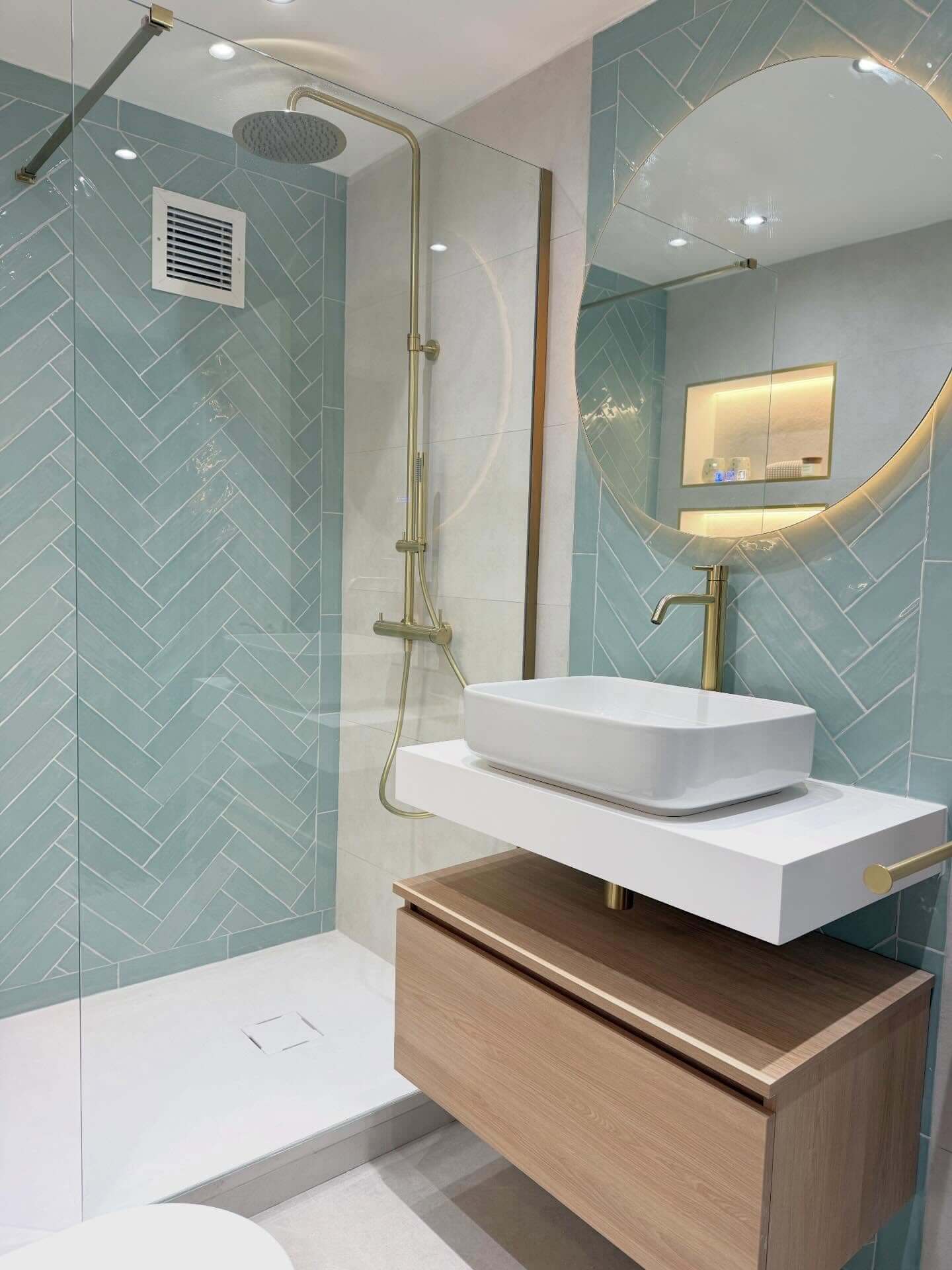
Bathroom lighting can be unforgiving.
One bright ceiling fixture may technically illuminate the room, but that doesn’t mean it makes the bathroom feel good.
Look at yours tonight.
Turn on the lights you normally use.
Where are the shadows?
Does the vanity feel harsh?
Does one side of the bathroom become gloomy while another looks overly bright?
You may not need to replace the existing electrical fixture at all.
Better Homes & Gardens offers a practical solution in its renter-friendly bathroom decorating ideas: “If you want to avoid hardwiring new sconces, try installing renter-friendly versions and using either rechargeable lightbulbs or puck lights.”
That opens up possibilities when electrical changes aren’t practical or permitted.
The important part is not adding lighting simply because it looks good in a photo.
Think about what the light needs to do.
Maybe you want softer illumination around the vanity.
Perhaps one dark area needs attention.
Or maybe your only goal is making the bathroom feel less clinical in the evening.
Whatever you add needs to be suitable for its location and used safely around bathroom moisture and water.
Once the lighting improves, you’ll probably start noticing the surface reflecting all of it.
The mirror.
Make the Mirror Feel Like a Design Feature
Rental mirrors tend to fall into two categories.
They’re either so plain you barely notice them, or so large that you notice nothing else.
Before assuming yours needs replacing, look at its scale.
Stand at the doorway.
Does the mirror feel proportional to the vanity?
Does it visually disappear?
Does it dominate the entire wall?
If you’re allowed to change it, don’t order a new one based on product photos alone.
Use painter’s tape or paper to mark the dimensions first.
Create the rough outline on the wall where the mirror would sit.
Then leave the bathroom and walk back in.
Look at the size from the doorway.
Try it from the position where you normally stand at the sink too.
You may discover that the mirror you thought was enormous online actually makes sense above your vanity.
Or you may realize you don’t need another mirror at all.
Better lighting, artwork beside the existing mirror, or simply clearing the countertop beneath it may be enough to make the entire vanity area feel more intentional.
And that countertop is where I’d go next.
Treat the Vanity Like a Piece of Furniture
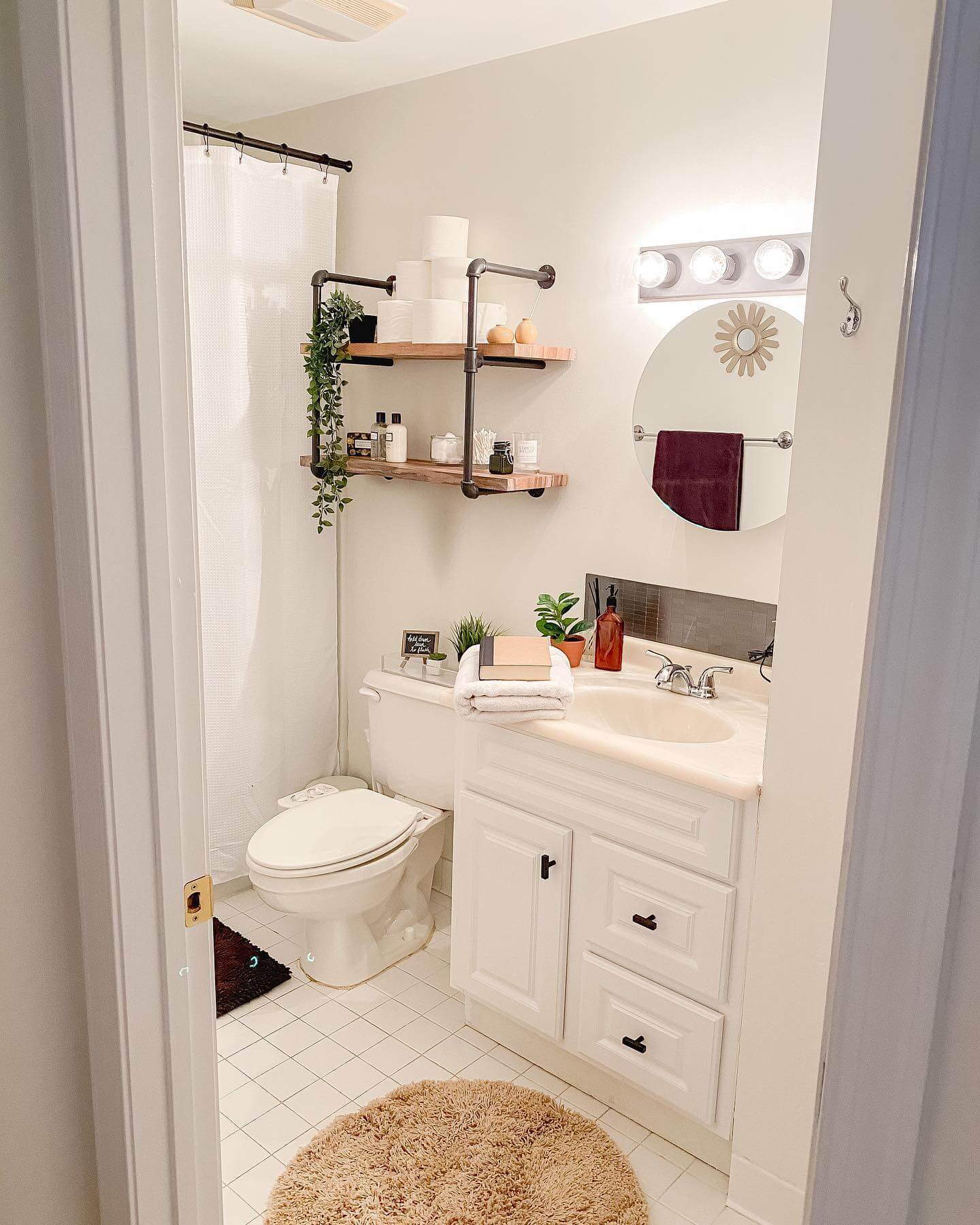
Take everything off the vanity.
Everything.
Soap.
Skincare.
Toothbrushes.
Hair products.
Decorative jars.
The random thing that’s been sitting in the corner for six months.
Wipe down the counter and stand back.
Now look at the vanity as though it were a piece of furniture.
What actually needs to live there?
Put back only the things you use regularly.
Then think about how they’re grouped.
A small tray might make sense for products you reach for every morning.
A ceramic cup may work better for toothbrushes than several little containers.
One attractive soap dispenser can be enough.
The goal isn’t making the bathroom counter look like nobody lives there.
It’s making everyday life look less chaotic.
If the counter fills up again within three days, that’s useful information.
The problem may not be styling.
You may need better storage.
We’ll get to that.
First, there may be one small part of the vanity you’re tempted to change.
Change the Hardware Only When It Actually Helps
Swapping cabinet hardware can change the feel of a vanity without replacing the vanity itself, assuming your lease permits it.
But measure before buying anything.
If the existing pulls use two holes, measure the distance between them.
Look for replacements that fit those holes rather than creating new ones.
And don’t order 10 pulls immediately.
Buy one first.
Hold it against the vanity.
Look at it beside the faucet, mirror, countertop, and existing lighting.
Does it actually improve the room?
You may discover that black hardware makes everything feel too heavy.
Maybe warmer metal looks better.
Or perhaps the existing hardware is perfectly fine once the rest of the bathroom changes.
If you do remove landlord-owned hardware, keep every piece.
Put the handles and their screws together in a labeled bag.
Don’t rely on remembering what went where a year from now.
Small upgrades matter, but there’s a much larger surface beneath your feet that may deserve attention first.
Give the Floor More Presence With the Right Rug
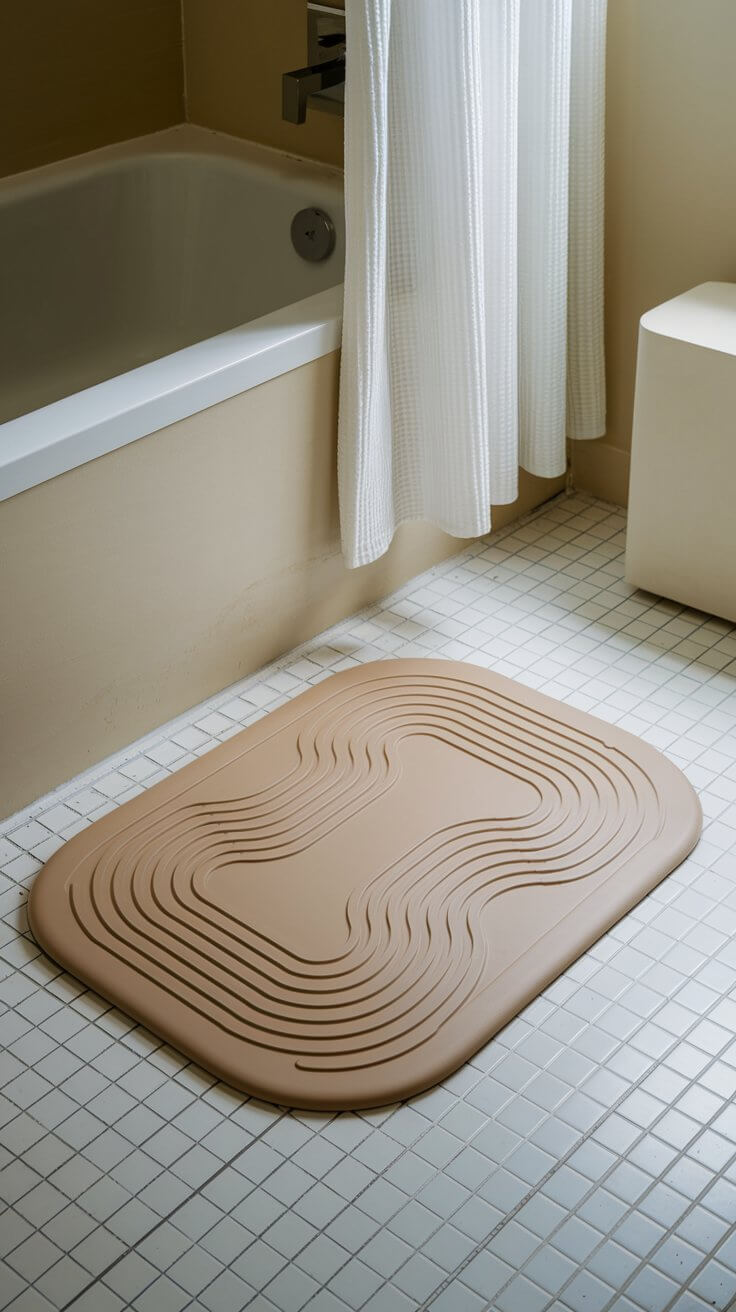
Bathrooms often end up with tiny mats because they’re easy to fit around doors, toilets, and vanities.
Sometimes that’s exactly what the layout needs.
Other times, several little mats make the floor feel more fragmented.
Before buying another one, measure.
If the bathroom layout allows it, use painter’s tape to test the footprint of a larger washable rug or runner.
Mark the dimensions directly on the floor.
Then use the bathroom normally.
Open the door.
Stand at the sink.
Step out of the shower.
See whether the imaginary rug interferes with anything.
Pay attention to practical issues too.
A bathroom rug needs to make sense around moisture, regular washing, door clearance, and the way you move through the room.
You don’t need a rug purely to hide flooring you dislike.
Think of it as another opportunity to bring softness, texture, and color into a room filled with hard surfaces.
Once the floor feels more intentional, the empty walls can become much easier to judge.
Make Blank Walls Feel Intentional
Rental bathroom walls can create the same problem as walls anywhere else.
They’re empty, so you start filling them with small things.
A little print.
A tiny shelf.
Another frame.
Maybe a decorative sign because the wall still looks unfinished.
Before adding more, test something larger.
Cut paper to roughly match the dimensions of artwork you’re considering.
Put it on the wall using a method suitable for the surface.
Then step out of the bathroom and walk back in.
Does the scale work?
One stronger piece can sometimes make a wall feel more finished than five unrelated little decorations.
Just remember that bathrooms aren’t ordinary rooms.
Humidity and moisture matter when you’re deciding what materials and objects belong there.
And if you’re thinking about covering the wall itself, I’d move much more carefully.
Be Careful With Peel-and-Stick Products
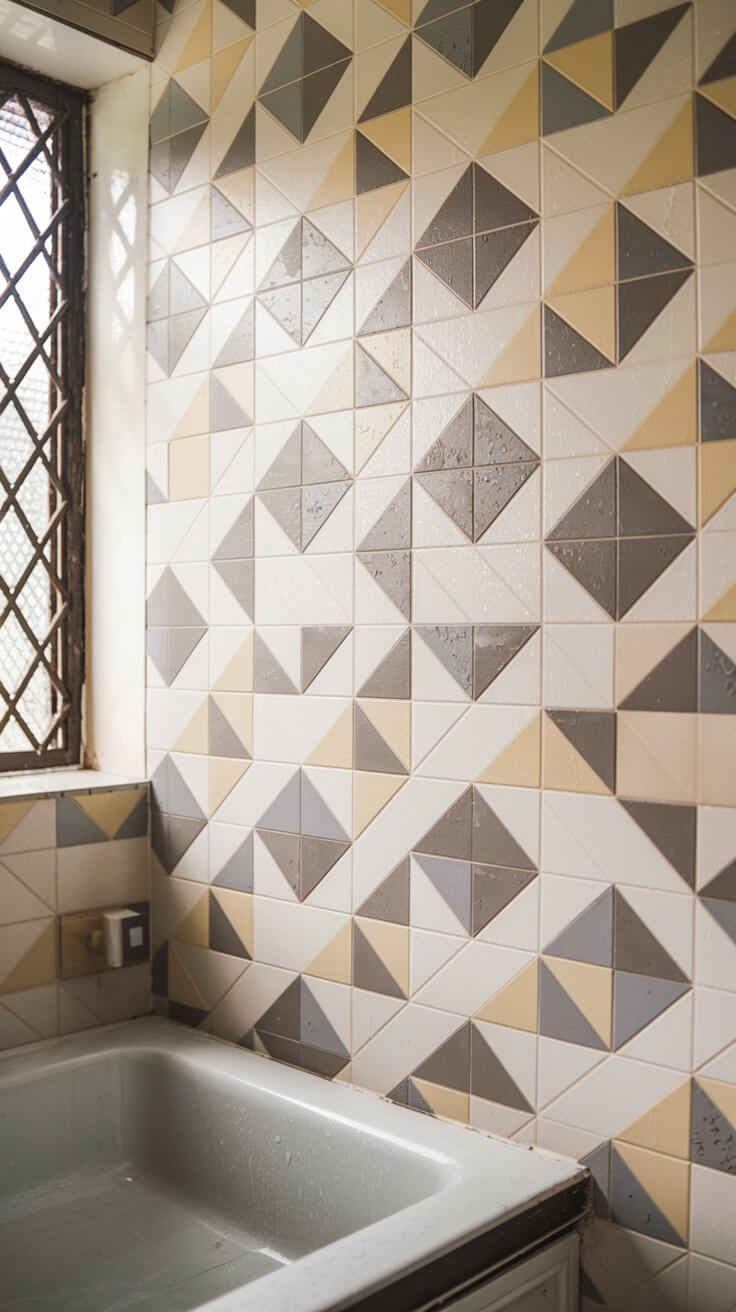
Peel-and-stick products look like the perfect rental solution on social media.
Install.
Enjoy.
Peel away when you move.
Real bathrooms can be more complicated.
You have paint condition, surface texture, humidity, heat, installation requirements, and the product itself to consider.
That’s why I wouldn’t begin by ordering enough material for an entire bathroom.
Read the manufacturer’s instructions.
Check what surfaces the product is designed for.
Check your lease.
And where appropriate, test somewhere inconspicuous before committing to a large installation.
You may decide that a small area gives you enough pattern anyway.
A contained section can create interest without asking one temporary material to carry the entire bathroom.
And sometimes covering an ugly feature isn’t the smartest solution at all.
Redirecting attention can work better.
Redirect Attention Instead of Covering Every Flaw
Let’s say you hate the floor.
You could spend a lot of time searching for a way to cover every inch.
Or you could give your eye something better to notice.
A stronger shower curtain might become the focal point.
A well-scaled rug can interrupt the flooring.
A better mirror can give the vanity wall more presence.
The same principle works with dated tile.
You don’t necessarily need to disguise it.
Bring in textiles and colors that make the tile feel less disconnected from everything around it.
Ask yourself one question.
If I don’t want people looking at this, what do I want them looking at instead?
That’s often much easier to solve.
And if what you keep noticing is bottles, towels, toilet paper, and toiletries everywhere, the problem isn’t the tile.
It’s storage.
Add Storage That Looks Like It Belongs There
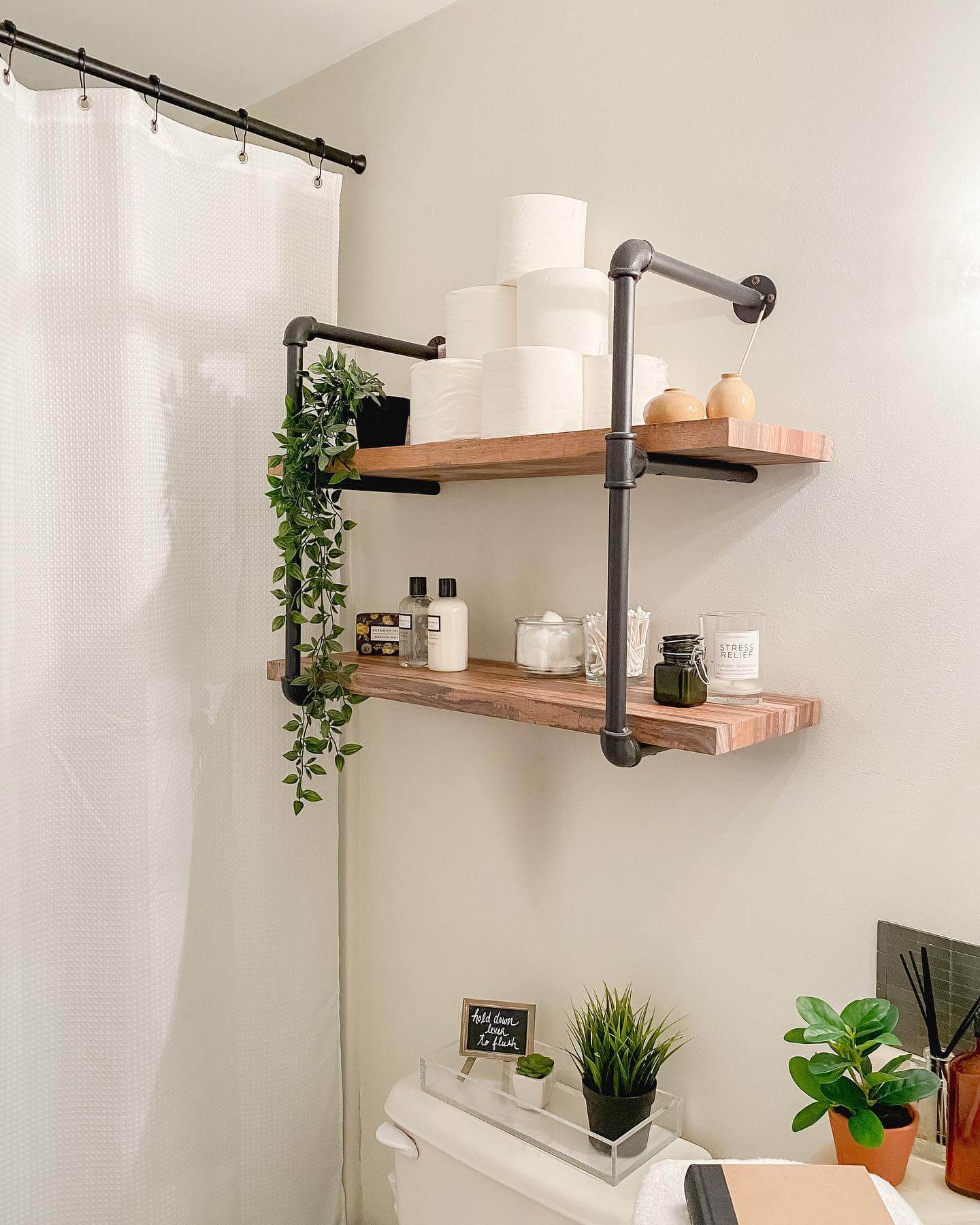
Small rental bathrooms can turn into collections of organizers very quickly.
One plastic bin under the sink.
Another beside the toilet.
A cart in the corner.
Baskets on the floor.
Then suddenly you’ve solved the storage problem while creating a visual one.
Measure before adding anything.
Look for the largest unused space first.
Maybe that’s vertical wall space.
Maybe there’s a narrow area beside the vanity.
Perhaps a slim freestanding cabinet could hold far more than several small organizers scattered around the room.
The Spruce’s advice for making a tiny rental bathroom feel larger includes a useful small-space principle from designer Ruthie Tane: “Lifting [larger storage items or fixtures] off the floor can help make the space feel less crowded.”
That’s worth keeping in mind when every inch of floor already matters.
Don’t simply buy something because it’s labeled bathroom storage.
Measure the wall.
Measure the floor.
Check door swings.
Check whether you’ll actually be able to reach what you’re storing.
Storage should make the bathroom easier to use, not create another obstacle to walk around.
And what goes inside that storage matters just as much.
Hide Everyday Clutter Where You Actually Use It
Bathroom clutter is predictable.
That’s good news.
You probably use the same toothbrush, skincare, hair products, and toiletries in roughly the same places every day.
So build storage around that behavior.
Don’t store your morning skincare across the bathroom because the basket looks nicer there.
Keep it near where you use it.
Hair tools may need their own place.
Cleaning supplies can live somewhere less accessible because you aren’t reaching for them every morning.
Extra toilet paper should be easy enough to reach when you need it.
Homes & Gardens shares designer Nikki Klugh’s advice in its guide to bathroom upgrades: “Adding wall cabinetry or a new vanity with better storage options will make your bathroom feel serene the minute you walk in because there will be less clutter on the counter or around the bathroom.”
That principle is especially useful in a rental even when replacing the vanity isn’t an option.
You may not control the countertop or cabinetry, but you can still work toward the same result by reducing what has to remain visible.
Try a seven-day experiment.
At the end of each day, notice what has migrated back onto the counter.
If you keep reaching for it, it probably deserves easier access.
If you never touch it, move it farther away.
Once the everyday products calm down, you’ll notice how much visual space the textiles occupy.
Make Towels Part of the Color Palette
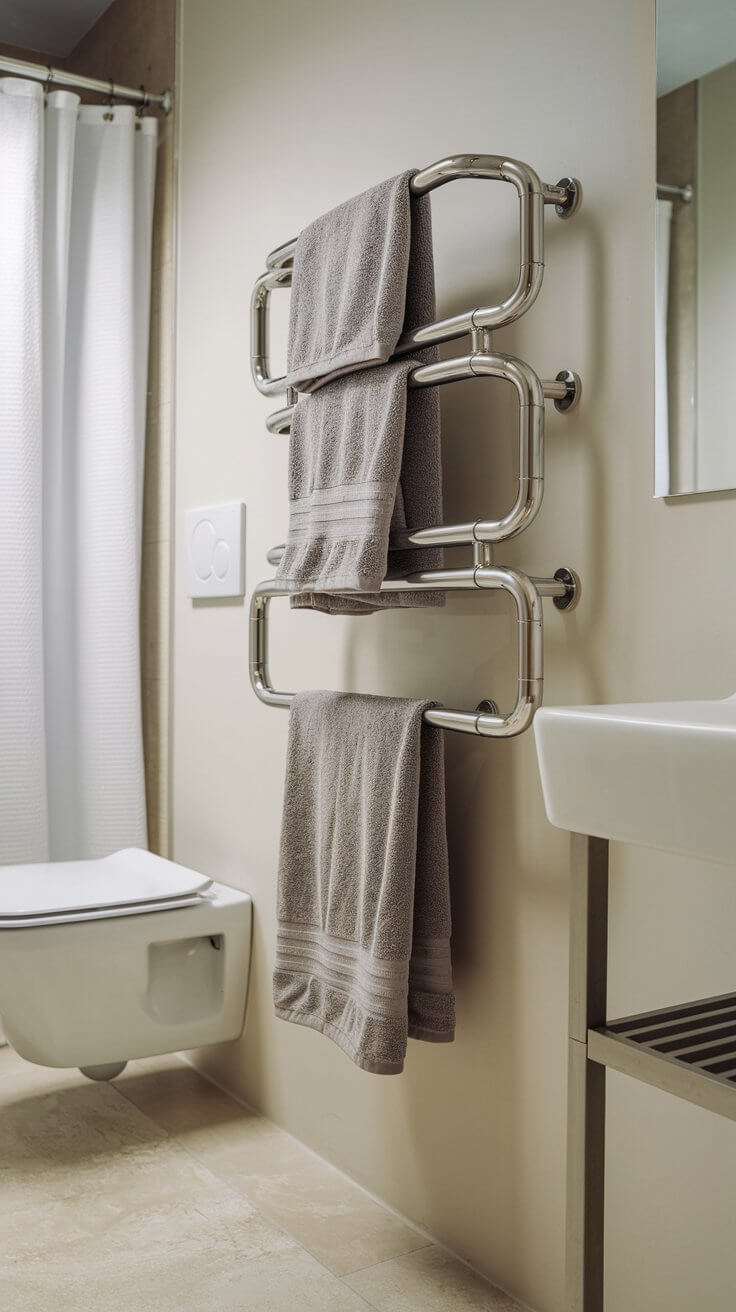
Towels aren’t background objects.
You see them every day.
They hang from hooks and bars, sit beside the sink, and sometimes occupy more visual space than the artwork.
Use that to your advantage.
Look at the permanent finishes again.
What color would make them feel more intentional?
Maybe muted green softens warm beige tile.
Perhaps cream makes a dark vanity feel less heavy.
A bathroom with plenty of white might benefit from something deeper.
Your towels don’t all need to match perfectly.
I care more about whether they feel connected.
And I wouldn’t buy decorative towels nobody is allowed to touch.
If you’re spending money on textiles, choose ones you actually enjoy using and can care for realistically.
The same rule applies to the smaller things around the bathroom.
Useful first.
Pretty second.
Ideally both.
Upgrade the Things You Touch Every Morning
Some of the best bathroom upgrades won’t show up dramatically in a before-and-after photo.
You’ll feel them instead.
A hook where you actually need a towel.
A better place for the hair dryer.
A soap dispenser that doesn’t annoy you.
A wastebasket that fits the available space.
A hamper that stops clothes collecting on the floor.
Shower storage that keeps bottles from gathering around the tub.
Think about your morning tomorrow.
Notice what irritates you.
Then do the same thing the next morning.
If the same little problem bothers you three days in a row, that’s probably a better upgrade than another decorative object.
Your rental bathroom should become easier to live in while you’re making it prettier.
And because bathrooms contain so many practical, hard surfaces, one softer material can make a surprisingly large difference.
Add Warmth With One Unexpected Material
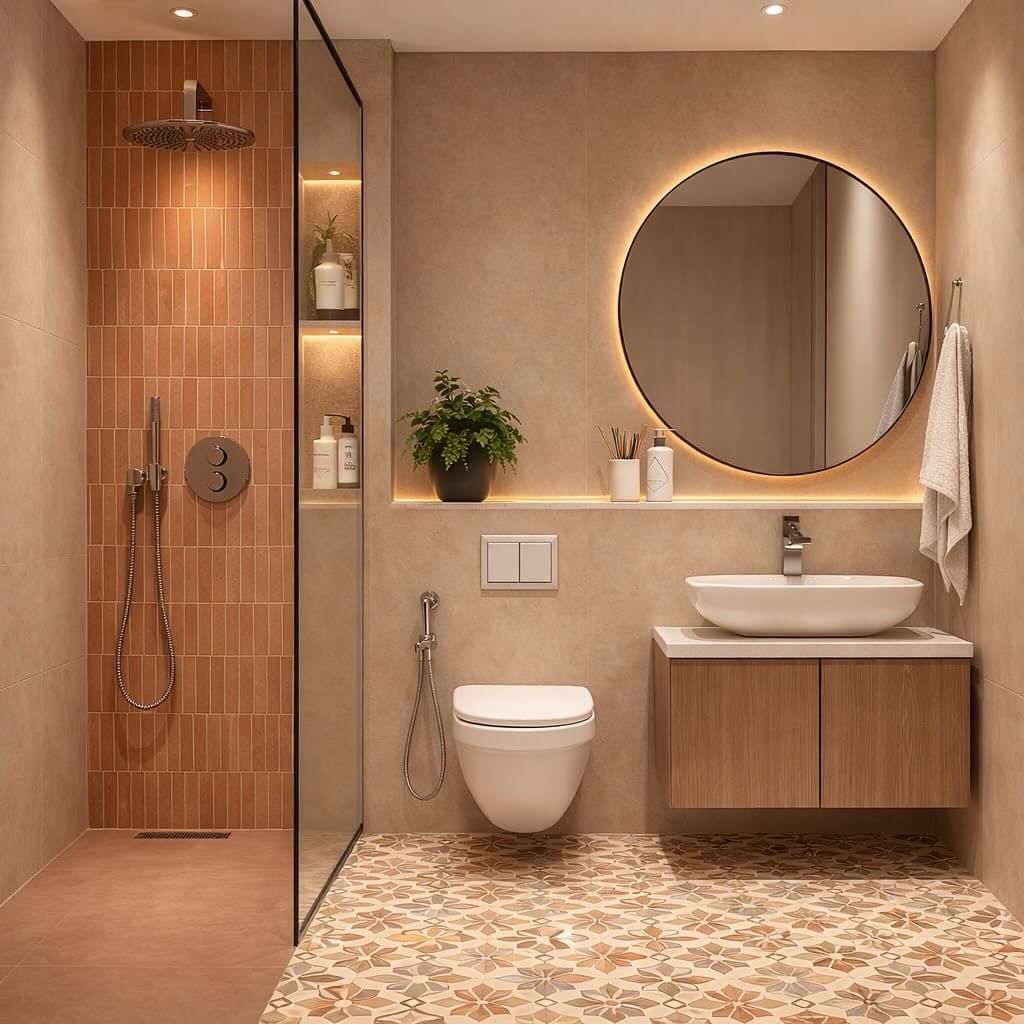
Look around the bathroom.
Tile.
Glass.
Porcelain.
Metal.
Paint.
Laminate or stone.
That’s a lot of hard surface.
You don’t need to add five decorative materials to balance it.
Try one.
A small wood stool can bring warmth.
A woven basket can introduce texture.
A fabric shower curtain can soften a large wall.
A washable rug can make the floor feel less stark.
Even a simple ceramic container may look better than another plastic organizer sitting on the vanity.
Choose the material based on what the room is missing.
If everything already feels warm and busy, you may not need another woven basket.
If the room feels cold and flat, a little natural-looking texture may be exactly what it needs.
This becomes even more important when you’re working with very little space.
Make a Small Rental Bathroom Feel More Intentional
A tiny bathroom doesn’t necessarily need tiny decor.
Sometimes that creates even more visual clutter.
One appropriately scaled mirror may work better than several little wall decorations.
One useful storage piece can beat five separate organizers.
One larger rug may look calmer than multiple tiny mats when the layout allows it.
And one strong shower curtain may provide all the pattern the room needs.
Try removing three decorative objects.
Did the room get worse?
Or did it suddenly feel calmer?
Small bathrooms often benefit from giving your eye fewer places to stop.
Keep the countertop quieter.
Use vertical space carefully.
Let one feature lead.
And resist the temptation to solve every empty inch with another product.
That’s also why I wouldn’t try to finish the entire bathroom in one weekend.
Don’t Buy Everything at Once
Change the biggest problem first.
Then stop.
If the shower curtain is making the whole room feel temporary, replace that.
Live with it for a few days.
Maybe the new curtain brings enough color that you no longer want artwork.
Perhaps it makes the rug look wrong.
Maybe you suddenly realize the bathroom doesn’t need more decor at all.
It needs better lighting.
A room often becomes easier to read after one meaningful change.
Give that process a little time.
I’d rather make three good purchases over several weeks than buy 15 things in one afternoon and discover that half of them were solving problems the bathroom didn’t actually have.
After each meaningful change, ask what still bothers you.
That’s your next clue.
And if your next upgrade involves removing something that belongs to the rental, create a system before touching it.
Keep Everything You Remove
If you remove landlord-owned hardware or another permitted item, don’t throw it into a random drawer.
Label it.
Keep the screws with it.
Put small pieces in a bag.
Photograph the original setup before removing anything.
Then store everything somewhere it won’t get lost or damaged.
Imagine yourself two years from now trying to remember which tiny screw belonged to which cabinet handle.
You won’t want that puzzle while packing an entire home.
A simple labeled bag can save you from it.
This habit also leads into the rule I’d use before making any rental upgrade.
Think about move-out before installation.
Do the Move-Out Test Before Every Upgrade
Before installing something, imagine removing it.
Can you?
Is the change permitted by your lease?
Can the original setup be restored?
Have you kept anything you removed?
Have you followed the manufacturer’s directions?
Is the product intended for the surface where you’re putting it?
If you don’t know yet, wait.
“Renter-friendly” shouldn’t mean something looked removable in a 20-second video.
It should mean the upgrade makes sense for your lease, your bathroom, the particular surface, and the way you’ll eventually need to leave the property.
This test can also save money.
If you’re choosing between something highly specific to this bathroom and something you could take into your next home, I’d put more of the budget toward the piece that belongs to you.
That brings us back to the room as a whole.
Do the Doorway Test Before Spending More
Go back to where you started.
Stand at the bathroom doorway.
Don’t look at the individual accessories.
Look at the room.
What catches your eye first now?
Ideally, it’s something intentional.
Maybe the shower curtain.
Maybe the mirror.
Perhaps the vanity looks calmer because the countertop isn’t covered in products anymore.
Now look for what competes with it.
Is the rug too small?
Are there too many containers sitting around?
Does one towel color feel disconnected?
Is a storage cart making the bathroom feel crowded?
Does the room actually need another purchase?
Compare what you see now with the original doorway photo.
You don’t need a dramatic social-media transformation.
Look for something more useful.
Does the bathroom feel calmer?
Does it look more intentional?
Is it easier to use?
Does your eye notice the things you chose rather than the things you can’t change?
If yes, you’re done for now.
The Best Rental Bathroom Upgrades Leave With You
You don’t have to wait until you own a home to have a bathroom you enjoy using.
And you don’t have to pretend you’re renovating a room that isn’t yours.
Work with what’s staying.
Start with the largest visual problem.
Use the shower curtain to bring softness or color.
Improve the lighting if the bathroom feels harsh.
Clear the vanity before buying more organizers.
Use storage where clutter naturally collects.
Bring in a rug, towels, artwork, and materials that make the permanent finishes feel more intentional.
Then stop.
Live with the room and see what it actually needs next.
The best rental bathroom upgrades don’t pretend the room was renovated.
They make the bathroom feel calmer, easier to use, and more like your home while you’re living there.
And when the lease ends, the rug, shower curtain, towels, artwork, storage, and pieces you genuinely love can come with you.
The bathroom stays behind.
The things that made it feel like home don’t have to.
Also read:
Rental Kitchen Makeover Ideas You Can Do Without Losing Your Deposit