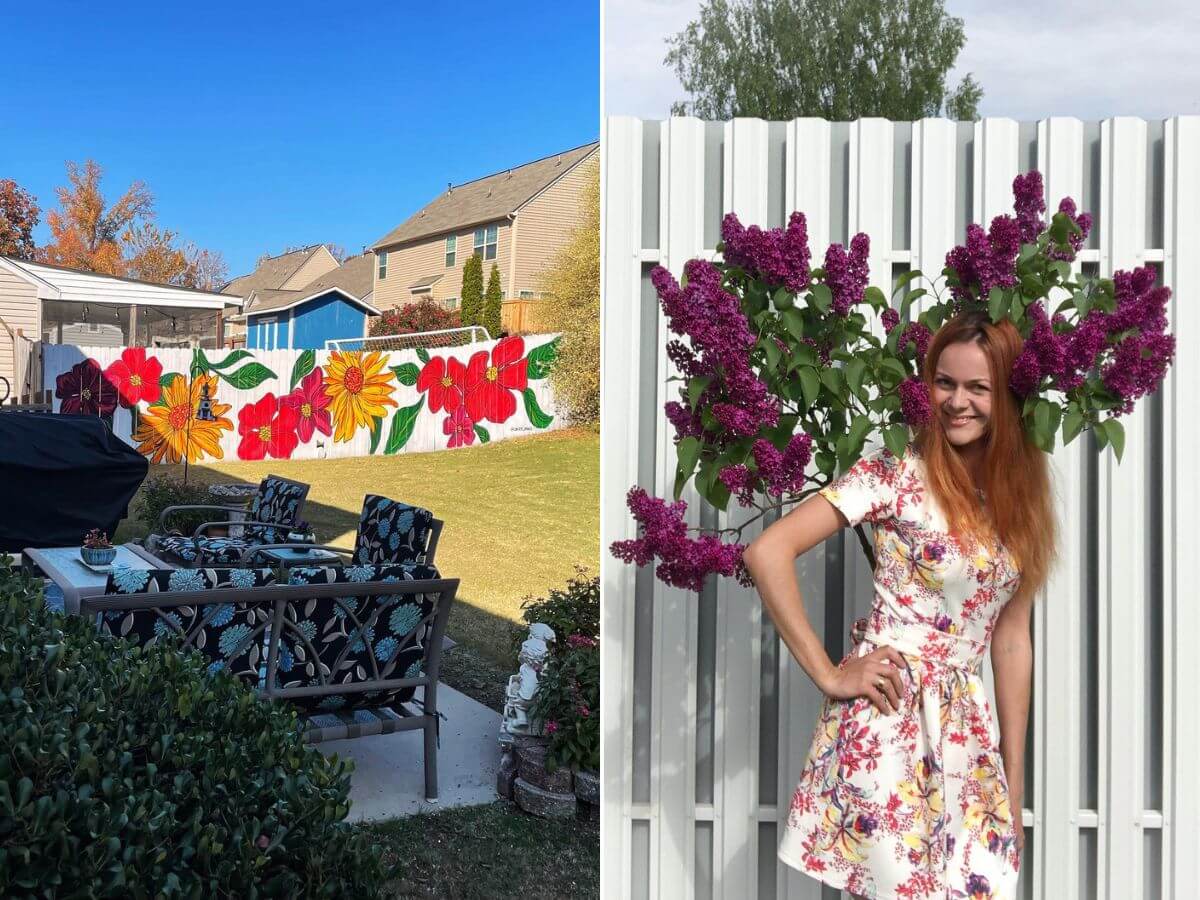
Fence Art Ideas That Turn a Plain Fence Into a Feature
I’ve noticed that a plain fence can make an otherwise beautiful backyard feel strangely unfinished.
You can have comfortable furniture, healthy plants, a nice patio, and a dining area you actually use, but your eye still lands on that long stretch of empty wood or vinyl behind everything.
My first instinct used to be that an empty surface needed more stuff.
A planter here. A little sign there. Maybe another decoration to fill the gap.
But decorating a fence works much better when you stop trying to fill it and start deciding what you want it to do.
Maybe you want the fence to become the backdrop for your seating area. Perhaps you’d rather soften it with greenery. Or you simply need one strong feature that gives your eye somewhere to land.
That’s how I’d approach fence art.
Before buying anything, go outside and take a straight-on photo of your fence from the place where you spend the most time.
If that’s your patio chair, take it from there.
If you usually see the fence through your kitchen window, take another photo from inside.
Now look at the fence as one large surface.
You probably don’t need to decorate all of it.
You need to find the part that matters most.
Start With the Fence Before Choosing the Art
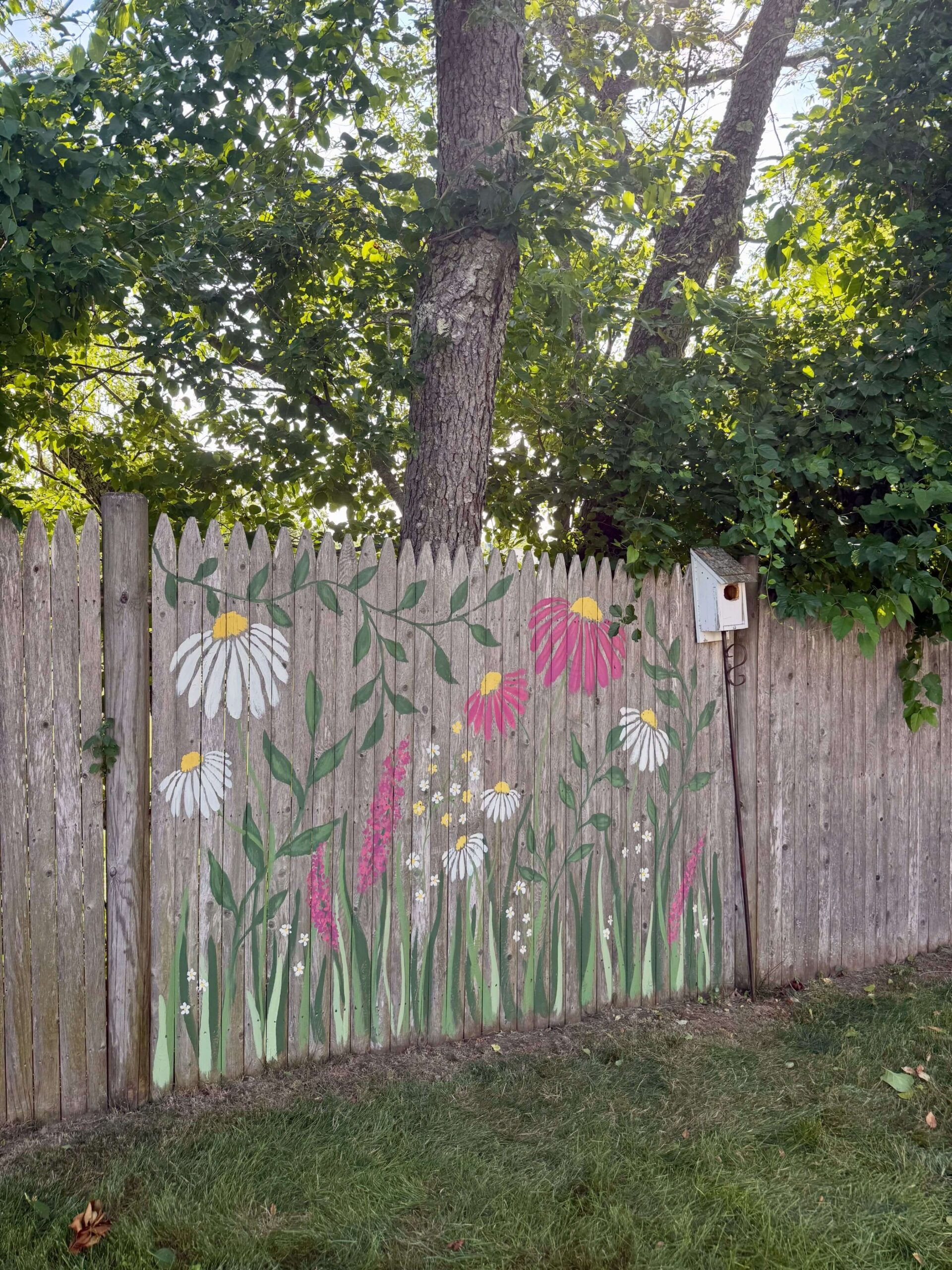
Before thinking about metal panels, planters, mirrors, or climbing plants, look at what you’re already working with.
What color is the fence?
How tall is it?
Is it wood, vinyl, metal, masonry, or another material?
More importantly, what’s happening around it?
Maybe there’s already a large tree creating plenty of visual interest on one side.
Perhaps your outdoor dining table sits against another section.
You might have a garden bed covering the bottom third of the fence while another area is completely bare.
This is why I’d avoid choosing fence art while looking only at close-up inspiration photos.
Look at the whole backyard first.
Find the emptiest or most awkward section.
Then ask what it’s missing.
Color?
Height?
Texture?
Greenery?
A focal point?
If you can answer that question, the rest of the project gets much easier.
And rather than solving the entire fence at once, I’d narrow your attention even further.
Turn One Section Into the Focal Point
A long fence doesn’t need decoration from one end to the other.
Covering every panel can make the yard feel busier rather than more finished.
Choose one section.
I especially like starting behind something that already matters.
If you have an outdoor dining table, the fence behind it is an obvious candidate.
The same goes for a bench, sofa, pair of lounge chairs, or garden bed.
You’re giving that area a backdrop.
Before mounting anything, mark the approximate dimensions.
Painter’s tape can work on suitable surfaces, or you can temporarily position cardboard or paper where you’re considering the feature.
Then step back.
Look from the patio.
Look from the house.
Sit where you’d normally spend time.
Does the size still feel substantial?
Fence art that looks enormous in your hands can suddenly look tiny once it’s surrounded by several feet of empty fence.
That’s why I’d test scale before spending money.
Try One Oversized Piece Instead of Lots of Little Ones
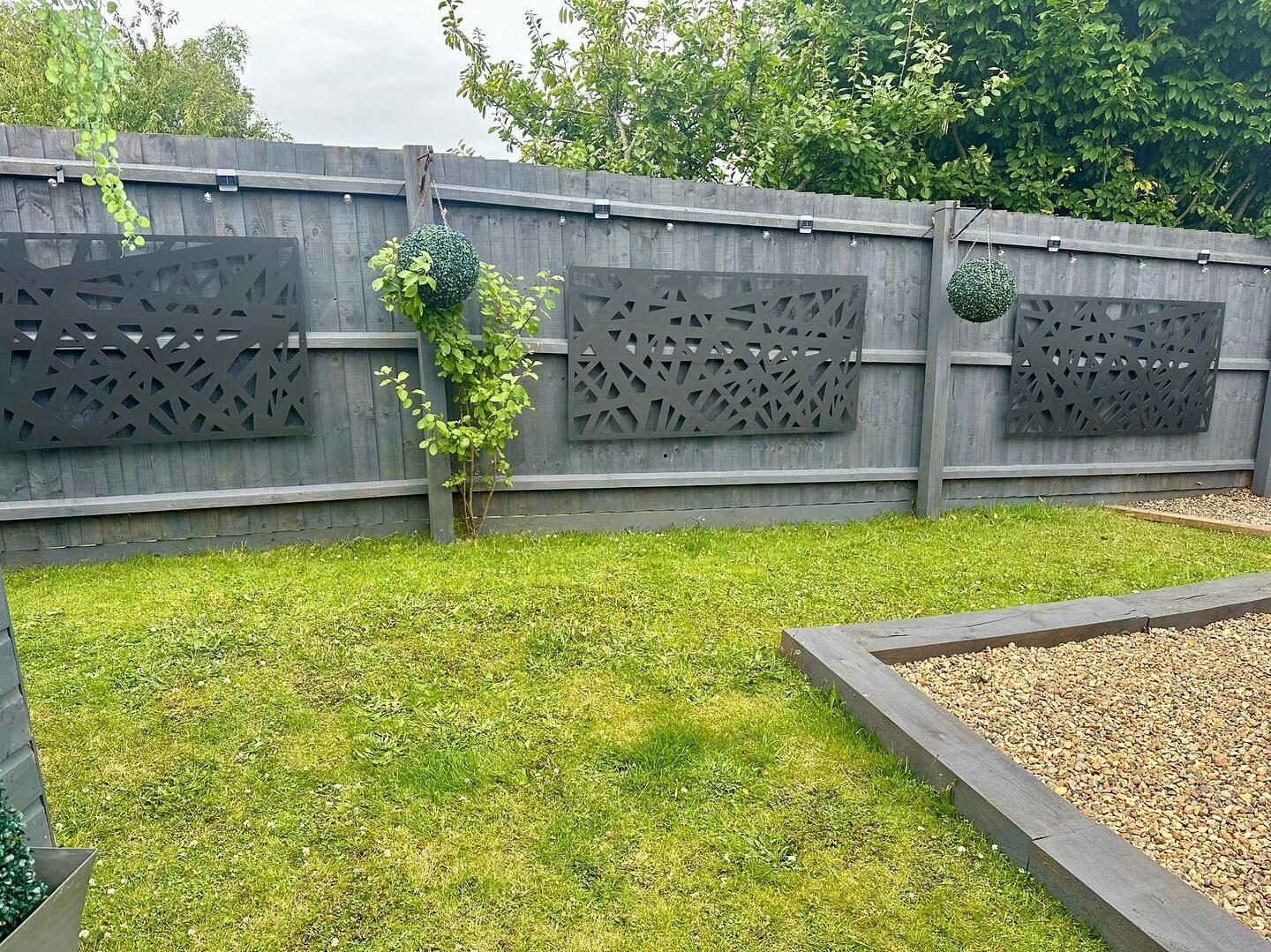
When a fence looks empty, it’s tempting to buy several small decorations.
Then another.
Then one more because there are still gaps.
I’d try the opposite first.
One substantial piece can give the fence enough presence without making it feel cluttered.
That might be a large outdoor-rated metal panel.
It could be a sculptural piece, an exterior-safe decorative screen, or another object designed to handle the conditions where you’re putting it.
Before ordering, recreate its size.
Cut cardboard to roughly the dimensions, or tape together paper.
Temporarily position the template where the artwork would go.
If it disappears against the fence, you know before spending the money.
If one large piece suddenly makes the seating area feel anchored, you may not need anything else.
But your focal point doesn’t necessarily need to be an object.
It can grow.
Create a Living Feature With Planters
Some of my favorite fence art isn’t really art at all.
It’s plants.
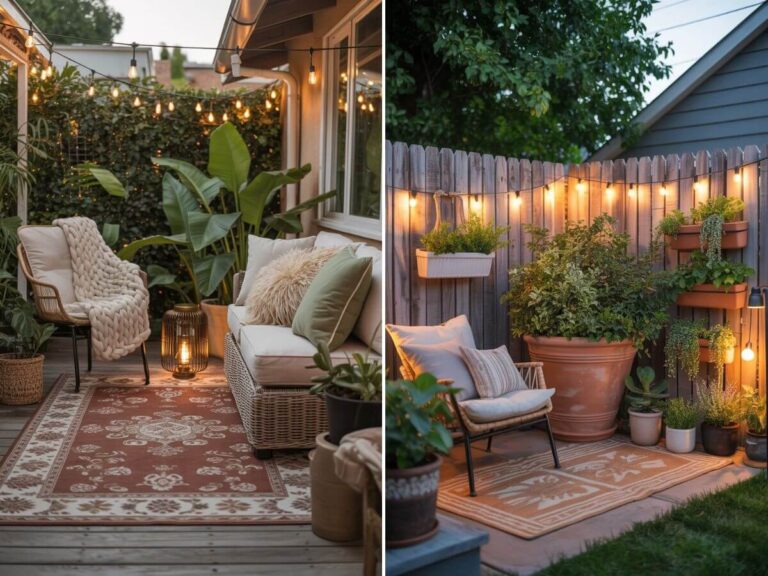
A deliberate group of wall-mounted or fence-mounted planters can turn a plain section into a living feature while leaving ground space open.
That makes the idea especially useful in a compact patio or small backyard.
Better Homes & Gardens explains in its guide to vertical gardening that “Vertical gardening elements save space in a garden or indoors and can draw attention to an area or disguise an unattractive view.”
That’s exactly why I wouldn’t scatter little planters randomly across the fence.
Create a defined grouping instead.
You might use three matching planters in a vertical line.
Or arrange five similar pots in a loose grid.
Another option is to keep the containers consistent while letting the plants vary.
Before buying plants, spend some time watching the fence.
When does it receive sun?
How long does that sun last?
Is the area mostly shaded?
Then think about watering.
A planter that looks beautiful seven feet off the ground isn’t very useful if maintaining it becomes a weekly balancing act.
You also need to consider drainage, mature plant size, mounting requirements, and the total weight the fence will be supporting.
Once those practical pieces make sense, repetition can make even inexpensive planters look much more deliberate.
Use Repetition to Make Simple Pieces Feel Intentional
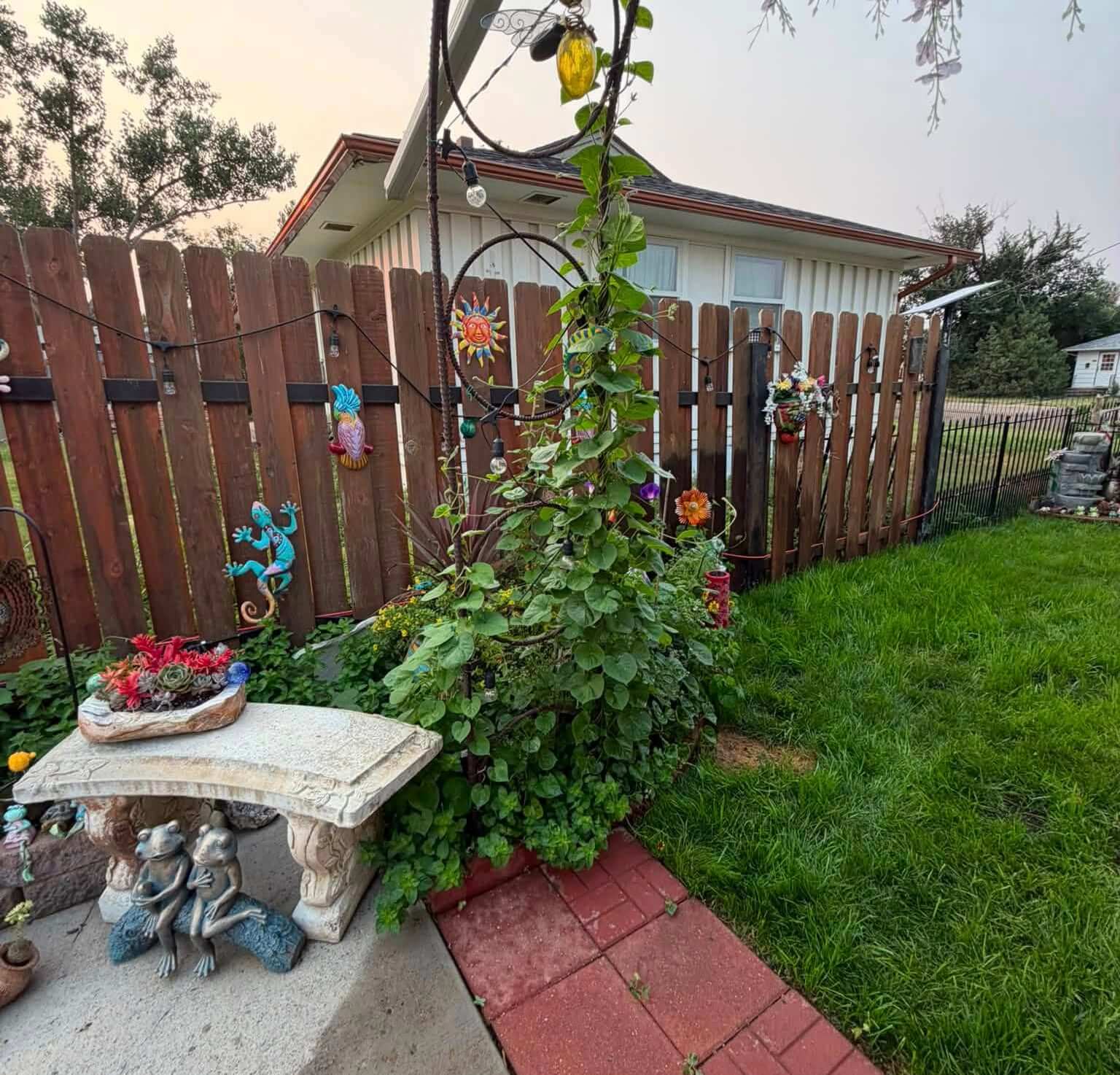
There’s something calming about seeing an idea repeated.
Three related planters.
A row of metal circles.
Several similar frames.
A group of outdoor-safe baskets.
The objects don’t necessarily have to match.
They just need a relationship.
Maybe they share the same shape.
Perhaps they’re all black metal.
Maybe you’re repeating terracotta.
Or the containers vary slightly but every one holds the same type of plant.
Lay everything on the ground before mounting it.
Arrange the pieces approximately the way they’ll appear on the fence.
Then look at the spacing.
If the gaps vary accidentally, the grouping can feel off even when you can’t immediately explain why.
Measure once you find an arrangement you like.
And if you’d rather let plants create the repetition naturally, a trellis gives you another direction.
Add Depth With a Trellis and Climbing Plants
A trellis does something that flat artwork can’t.
It gives the fence depth.
Add a climbing plant and that plain vertical surface can gradually become part of the garden itself.
Homes & Gardens shares gardening expert Leigh Clapp’s advice in its guide to trellis ideas: “The vertical plane is the longest axis in the garden, and using it for planting offers the opportunity to make the most of the space in your garden”.
That’s especially useful when your backyard doesn’t have much ground space to spare.
Instead of adding another large planter that takes up patio room, you’re directing some of that interest upward.
But I’d choose the plant before getting carried away with the finished look.
How much sun does the location receive?
What will the plant look like when mature?
How much pruning will it need?
Does it need strong support?
Is it suitable for your climate?
And how much maintenance are you realistically willing to do?
A plant that needs constant attention isn’t a good choice simply because it looked gorgeous covering somebody else’s fence.
I’d rather choose something appropriate for the conditions and let it develop naturally.
And if waiting for plants to grow isn’t what you have in mind, there are ways to create depth immediately.
Use Outdoor Mirrors Carefully
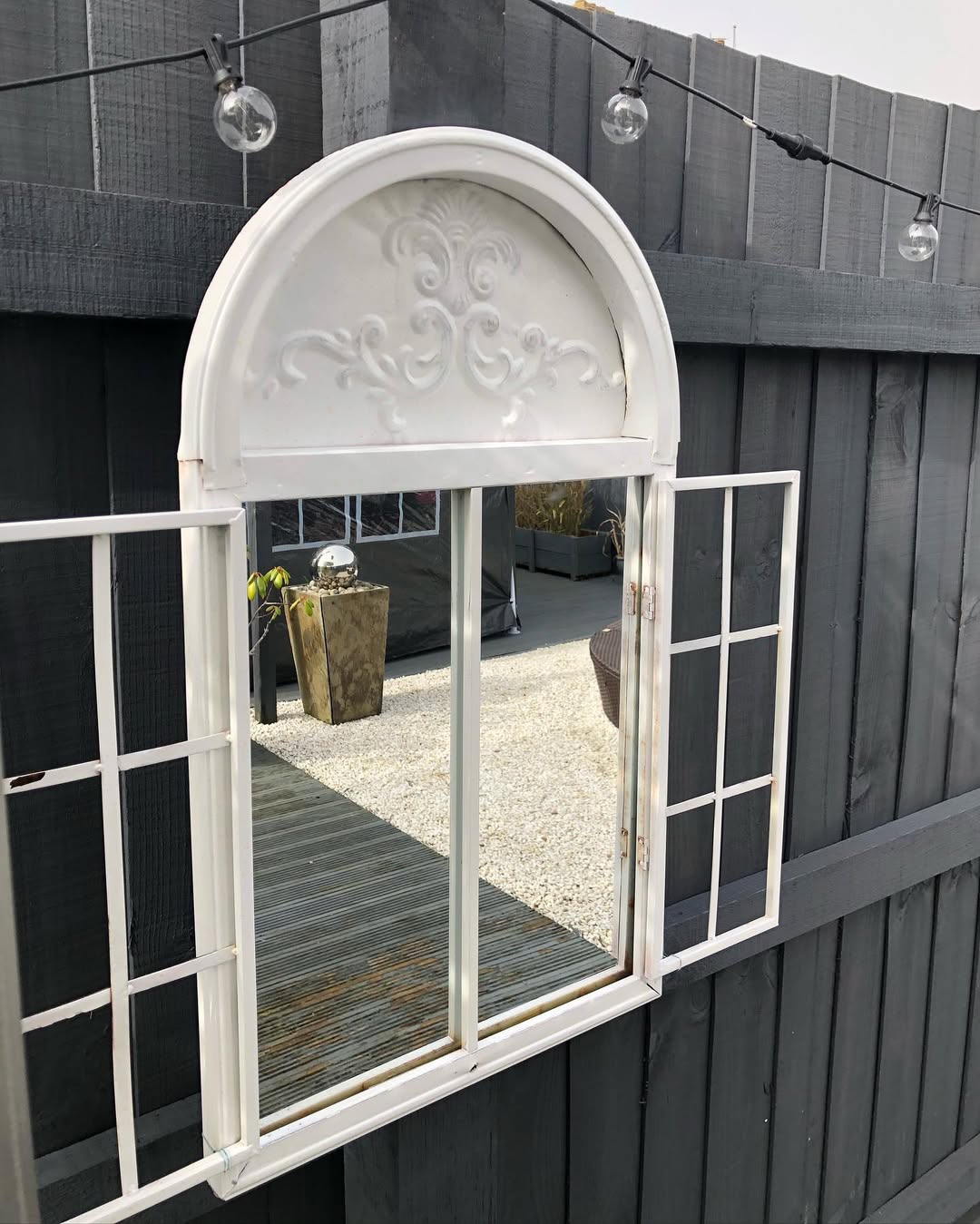
A mirror can completely change how a small outdoor area feels when it’s positioned thoughtfully.
The key is what it reflects.
Don’t hang one simply because there’s an empty spot.
Stand where the mirror would go and look in the opposite direction.
That’s roughly the view you’re working with.
If it reflects greenery, flowers, or another attractive part of the yard, the effect can be beautiful.
If it reflects garbage bins, a garden hose, or the back door, you’re probably not gaining much.
I’d also treat outdoor mirrors differently from indoor mirrors.
The location, material, mounting method, weather exposure, glare, breakage risk, and possible effects on wildlife all deserve consideration before putting reflective glass outside.
Sometimes a weather-suitable reflective or decorative metal piece can provide some of the same interest without using a traditional mirror.
And if a shiny new piece doesn’t suit your yard, you may prefer something with a little history.
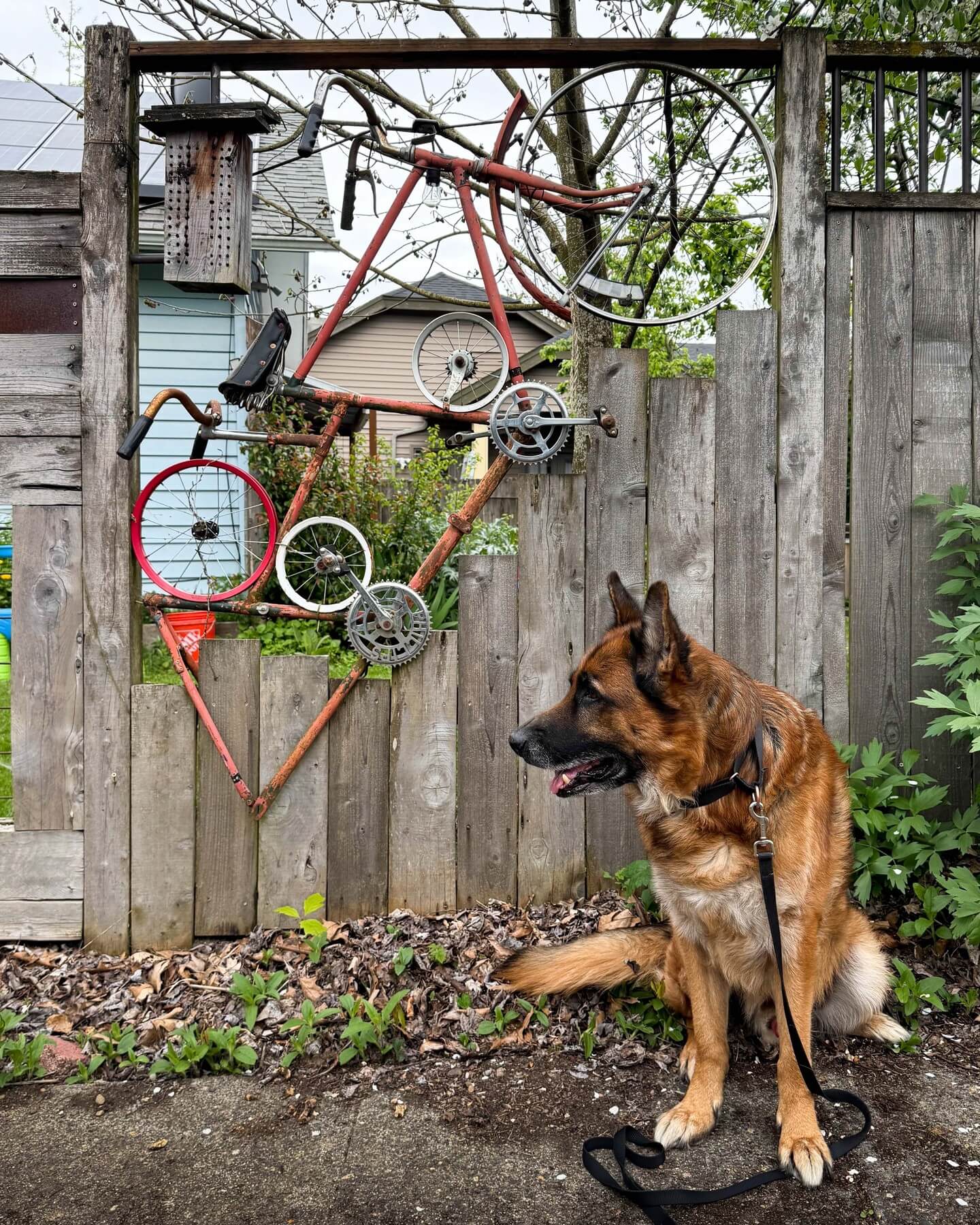
Give Old Objects a Second Life
Fence art doesn’t have to come from the outdoor decor aisle.
Sometimes an older object gives a backyard exactly the character it was missing.
The trick is restraint.
One old shutter can look interesting.
A carefully arranged group of similar architectural pieces can look collected.
Twenty unrelated objects attached to the same fence can start looking like storage.
Pick a category.
Maybe you like old metal pieces.
Perhaps weather-suitable architectural salvage fits your style.
You might have exterior-appropriate frames, shutters, or garden objects that could become a composition.
Before putting anything outside, consider whether the material can tolerate the exposure and whether it can be mounted securely.
Then give the collection boundaries.
Don’t let it slowly spread across every available fence panel.
One thoughtful grouping will usually have more impact.
You can use exactly the same restraint with color.
Add Color Without Painting the Whole Fence
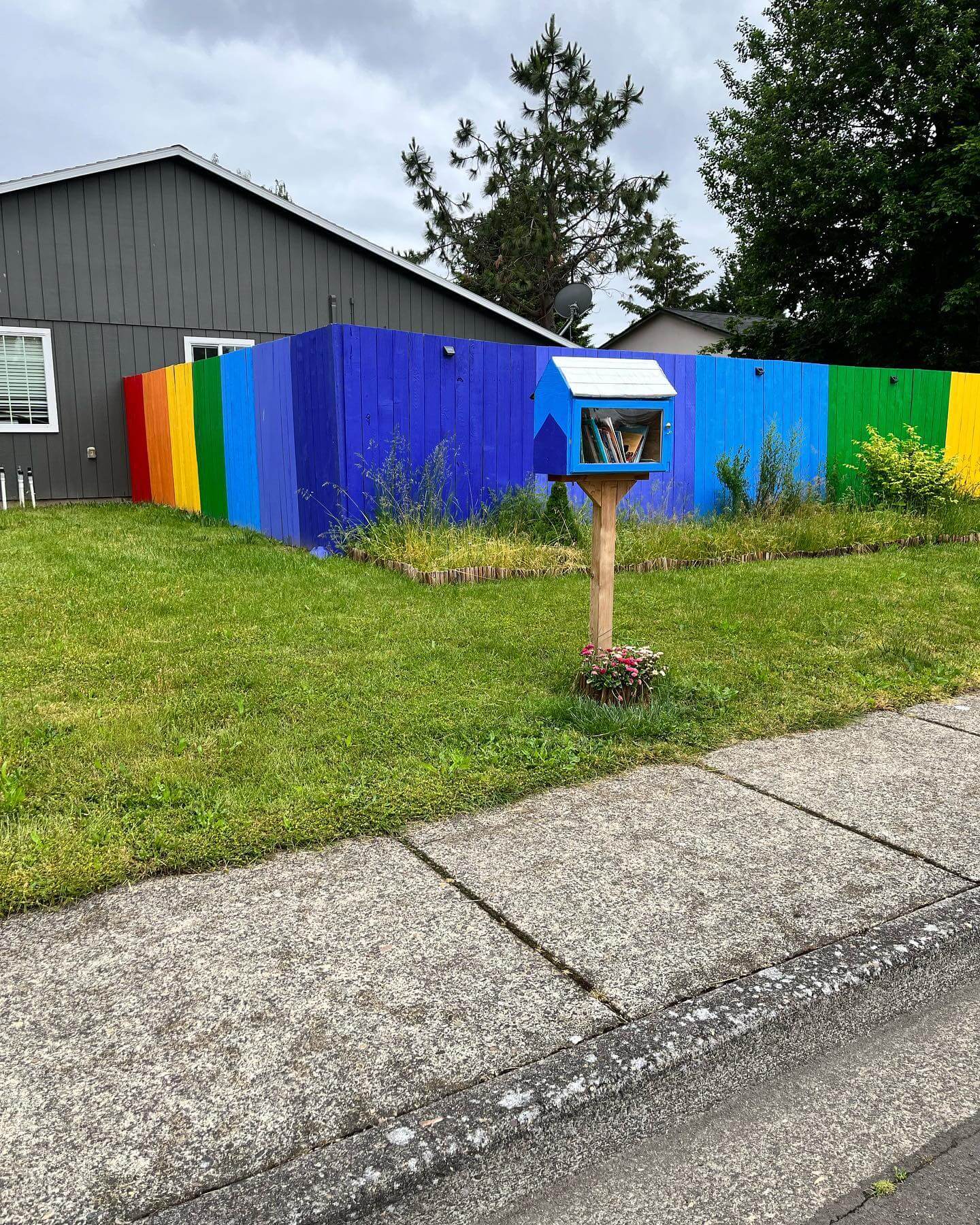
Painting a fence can change a yard dramatically, but you don’t need to repaint the entire thing just because it feels bland.
Fence art can carry the color instead.
Start by looking around the backyard.
What color already appears?
Maybe you have rust-colored outdoor cushions.
Perhaps there’s muted green in the furniture.
Your back door might be blue.
Maybe terracotta already appears in your pots.
Choose one of those colors and repeat it at the fence.
You could bring it in through planters, a painted outdoor panel, pottery, flowers, or weather-suitable decorative pieces.
You don’t need an exact match.
The repetition is what matters.
It gives the new feature a connection to something already in the space.
If your backyard already contains plenty of color, though, another shade may not be the answer.
Texture might do more.
Let Natural Materials Soften a Hard Fence
Backyards can contain a surprising number of hard surfaces.
Fence.
Patio.
Siding.
Concrete.
Metal furniture.
Glass doors.
Sometimes another decorative color just adds more visual information.
A natural-looking material can soften things instead.
Wood can bring warmth.
Terracotta adds earthy color and texture.
Greenery changes with the seasons.
Woven-looking outdoor materials can add another layer when they’re designed to withstand exterior conditions.
I’d choose one rather than trying to bring all of them onto the same fence.
If you already have wood furniture, perhaps repeating that warmth makes sense.
If your patio contains several wood tones, terracotta might provide a better contrast.
And whatever you choose, remember that outdoor decor has a much harder life than indoor decor.
Choose Materials That Can Actually Live Outside
This is the point where I’d temporarily stop thinking about how the fence art looks.
Think about what happens to it in six months.
Will it get direct afternoon sun?
Heavy rain?
Strong wind?
High humidity?
Cold winters?
Your climate should influence what belongs outside.
The Spruce recommends considering durability when choosing decorative panels for a fence, noting that “Metal or vinyl will give you the most weatherproofing.”
Whatever material you choose, check whether the actual product and its finish are intended for exterior exposure.
Don’t assume something is outdoor-safe because it looks rustic.
Also think about maintenance.
If a decorative piece needs frequent refinishing and you know you won’t do it, that’s part of the buying decision.
I’d rather choose something that can age well in the conditions than spend every season trying to preserve something that never suited the location.
Once you’ve narrowed the materials, you can start playing with composition again.
Create a Fence Gallery Without Creating Clutter
A gallery wall doesn’t have to stay indoors.
But outdoors, I’d use fewer pieces and give them more room.
Start by choosing what connects the collection.
Maybe every piece is metal.
Maybe they’re different shapes in the same finish.
Perhaps you’re working with exterior-safe botanical designs.
Lay the composition on the ground before mounting anything.
Can you see one grouping?
Or does it look like several unrelated objects that happened to land beside each other?
Adjust the spacing until the group reads as one feature.
Then measure the overall footprint.
That keeps the gallery from slowly spreading across the fence after you’ve started hanging things.
Better still, some of those pieces can actually earn the space they occupy.
Make Fence Art Useful
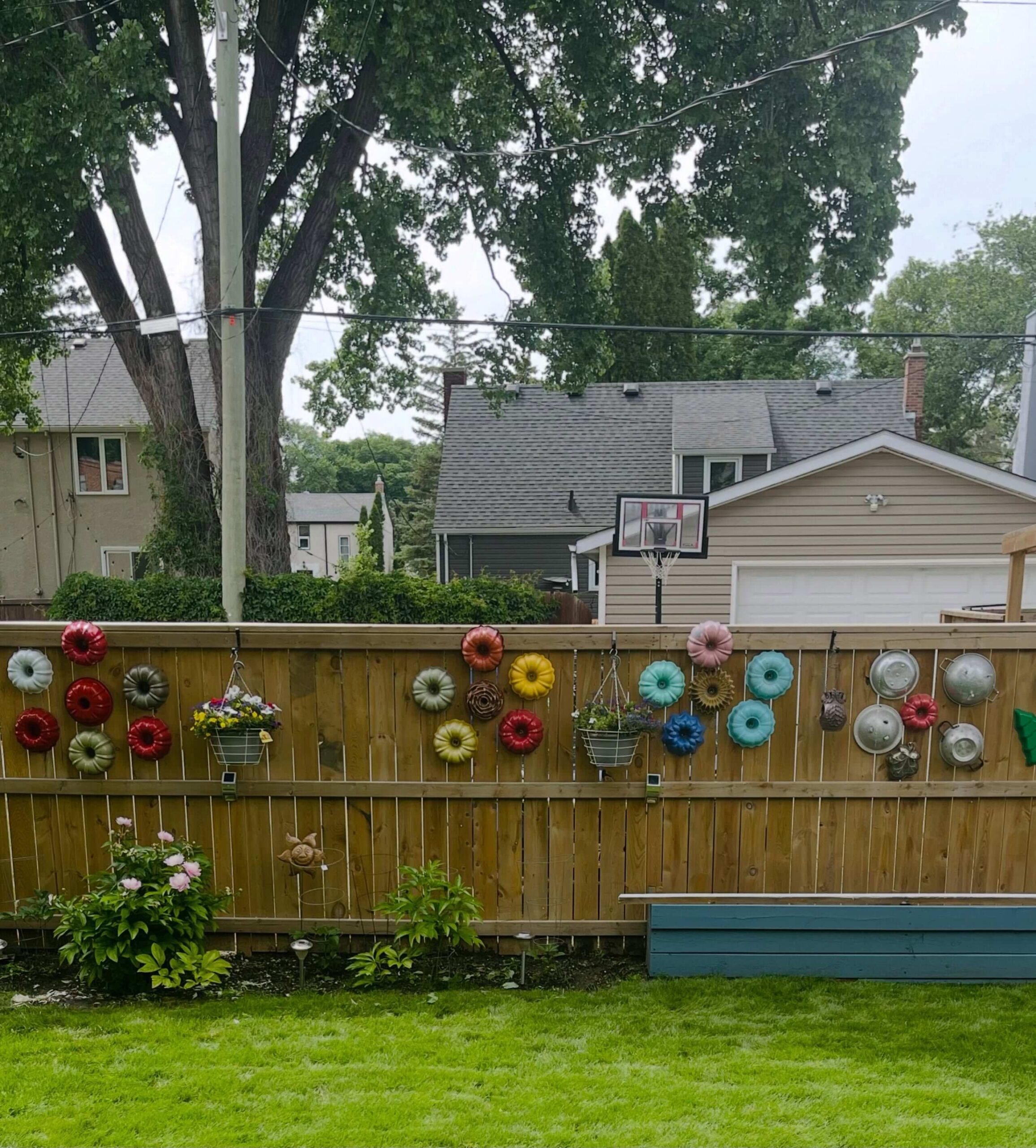
I like decorative ideas more when they solve a small problem at the same time.
Maybe the decorative piece is also a planter.
Perhaps an attractive wall-mounted solution helps organize lightweight garden items where suitable.
A small exterior-rated shelf might hold herbs or other items when properly supported.
Even practical features such as house numbers can become part of the design where their placement makes sense.
This approach is especially useful in small outdoor spaces.
When every square foot matters, I don’t necessarily want another object whose only job is looking pretty.
Use the fence vertically and keep more ground available for walking, sitting, dining, or planting.
Functional fence art can also help define what each part of the backyard is for.
Use Fence Art to Define an Outdoor Zone
Think about your backyard as a series of little rooms.
Maybe there’s a dining area.
A seating corner.
A garden.
A grill area.
A quiet bench where you drink coffee.
Fence art can visually anchor one of those zones.
If your dining table sits in front of a long blank fence, place the feature behind the table rather than randomly farther down the fence.
Now the art and furniture begin reading as one composition.
A vertical planter behind a bench can do the same thing.
So can a trellis.
You’re giving the furniture a backdrop.
This is one reason I’d decide where the outdoor zones are before decorating the fence.
The art should help the backyard make more sense.
And sometimes the most useful viewing spot isn’t actually outside.
Don’t Forget What the Fence Looks Like From Inside
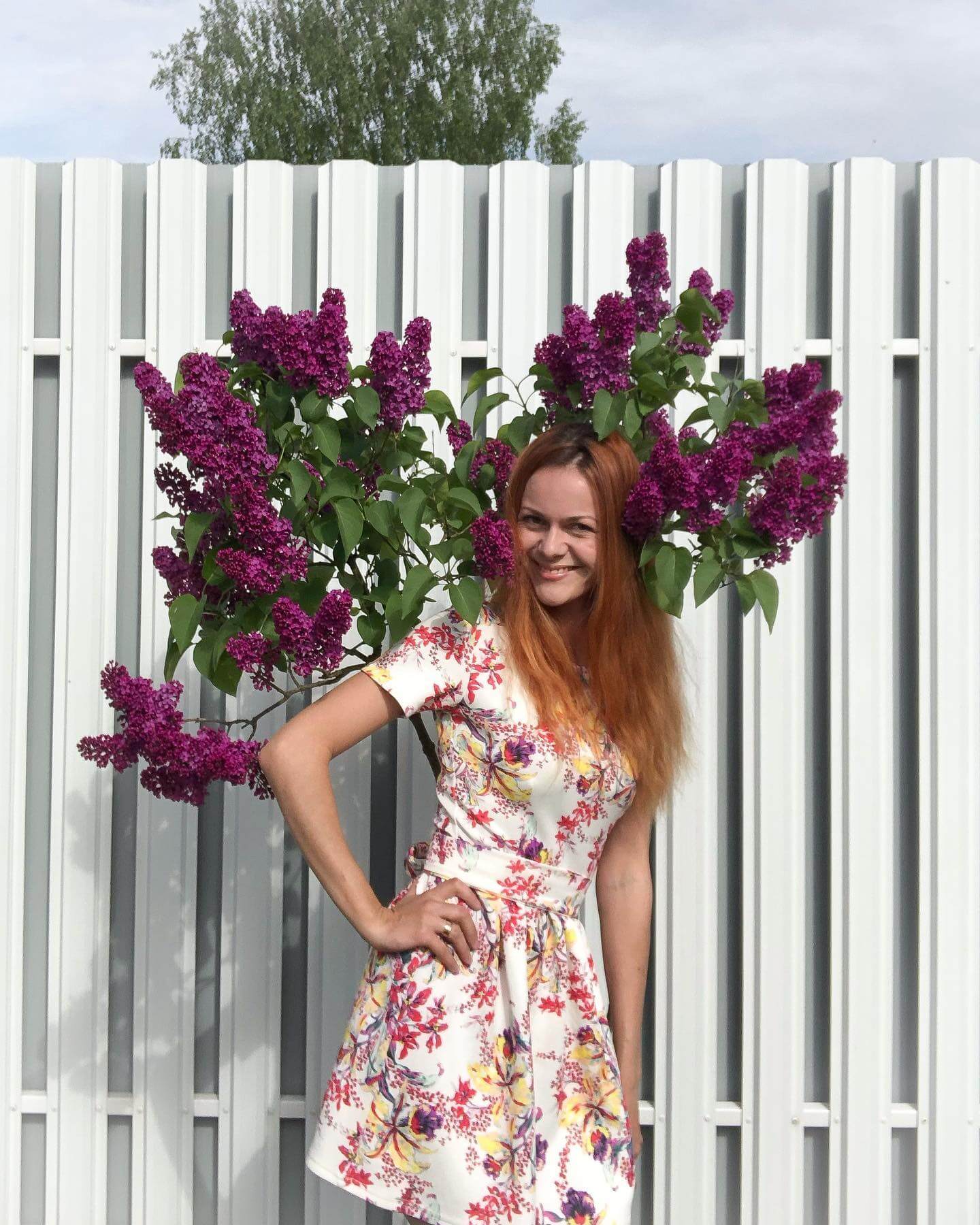
You may spend two hours arranging fence art from the patio and then realize you see the fence far more often through your kitchen window.
Go inside.
Look out.
Where does your eye land?
If you’re decorating a fence section that’s almost invisible from the house while leaving the main view completely bare, reconsider the location.
You don’t necessarily need to change the entire yard to improve the view from inside.
One carefully positioned feature can give you something better to look at every time you stand at the sink or walk through the living room.
Use that perspective when choosing the location and scale of your fence feature.
Once you’ve chosen the right spot, make sure the fence itself is ready for what you’re planning.
Check the Fence Before Hanging Anything Heavy
A decorative idea isn’t worth damaging the fence.
Before mounting planters, panels, shelving, mirrors, trellises, or anything with substantial weight, inspect the area.
Is the fence sturdy?
Are any boards loose?
Does the section lean?
Is there visible deterioration?
Then consider the weight you’re adding.
A planter doesn’t weigh only what it weighs empty.
Add soil.
Add a plant.
Add water.
Now imagine several of them.
The same caution applies to anything that can catch strong wind.
You also need to know whether the fence belongs entirely to you and whether rental, neighborhood, HOA, or property restrictions apply.
Check the installation requirements for the product and the fence material rather than improvising a mounting method.
If the fence isn’t suitable, choose another approach.
A beautiful idea shouldn’t create a repair project.
Try the One-Fence-Section Rule
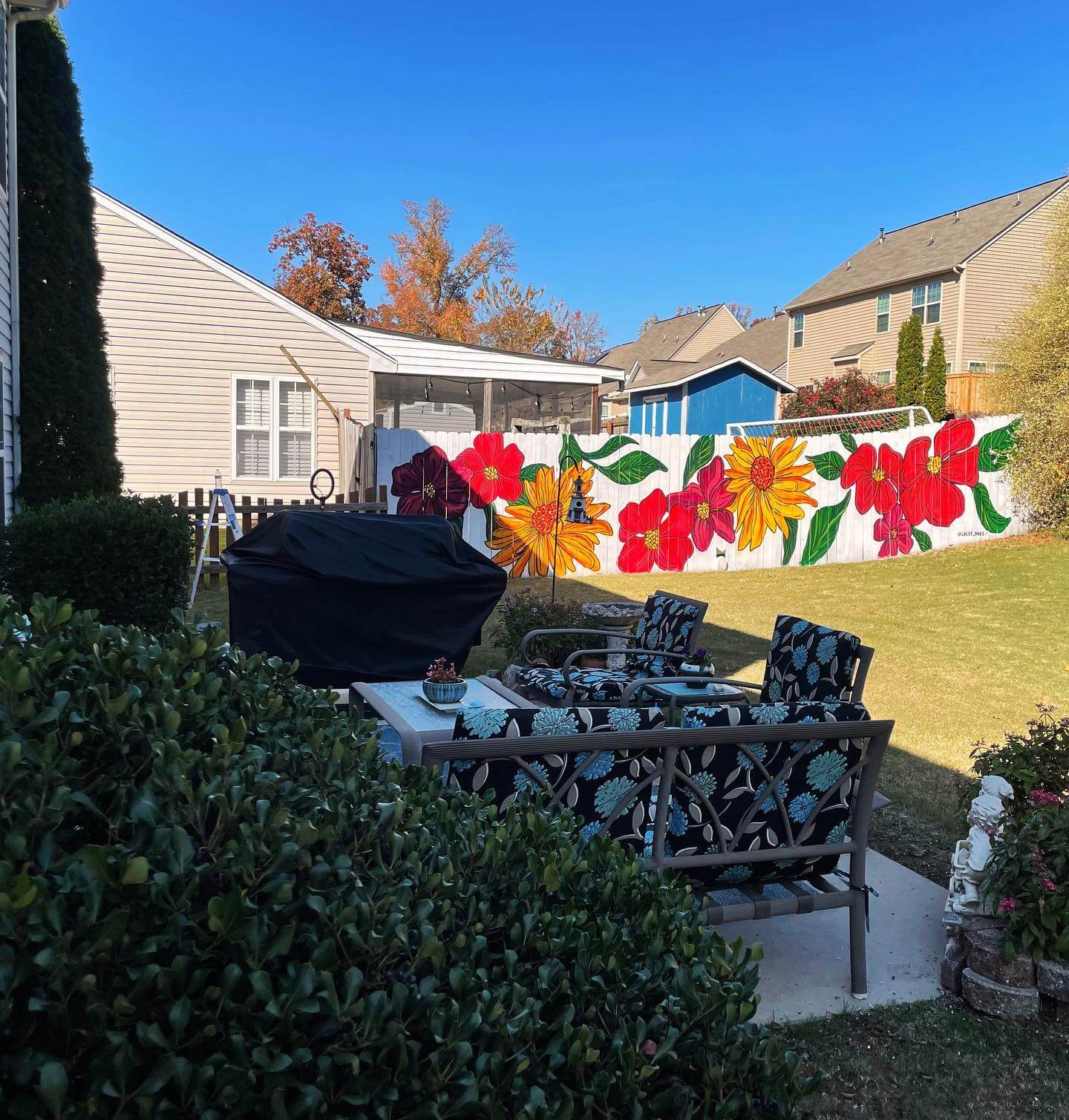
Finish one section.
Then stop.
Look at it in morning light.
See it in the evening.
Sit outside with it.
Look through the window.
You may realize the rest of the fence doesn’t need anything.
That empty space may be helping your new focal point stand out.
If every section gets equal attention, nothing gets to lead.
And if another area still feels unfinished after a few days, treat it as a separate project rather than automatically repeating the first idea.
Before buying anything else, compare where you ended up with where you started.
Do the Backyard Photo Test
Return to the place where you took your first photograph.
Take another one.
Look at the backyard as a whole.
Where does your eye go now?
Does the new feature relate to the furniture?
Does its scale make sense?
Is there enough empty space around it?
Does a color repeat somewhere else?
Did the fence become more interesting without becoming busier?
Now look for what feels wrong.
Maybe one planter is too high.
Perhaps the gallery grouping needs to move closer together.
Maybe the feature is competing with something else nearby.
Fix that before shopping again.
Move something.
Remove something.
Change the spacing.
Let a plant grow.
Rearranging what you already have is often better than buying more.
The Best Fence Art Makes the Backyard Better
You don’t need to cover a fence from one end to the other to make it interesting.
Start with the section you actually see.
Figure out what it’s missing.
Maybe one oversized piece gives the seating area the focal point it needed.
Perhaps a few planters bring greenery onto a patio where ground space is limited.
A trellis can turn an empty vertical surface into part of the garden.
An older object can bring character.
A little repeated color can connect the fence to the rest of the backyard.
Whatever you choose, check the scale, think about the weather, and make sure the fence can support it.
Then stop before adding more.
A plain fence doesn’t need decoration from end to end.
It needs one place that gives your eye a reason to stop.
So take the photo.
Choose one section.
And turn that piece of fence into something you actually enjoy looking at.
Also read: