Outdoor Stairs Ideas That Turn Basic Steps Into a Feature
I’ve seen plenty of outdoor spaces where the landscaping looks thoughtful, the front door has character, and the porch feels welcoming, but the stairs between them look like they were forgotten.
They’re simply there to get you from one level to another.
But outdoor stairs occupy more visual space than we sometimes realize. You see them when you approach the house, walk through the backyard, look across the patio, or glance outside through a window.
That’s why I don’t think improving outdoor stairs necessarily starts with rebuilding them.
Sometimes the problem is color. Sometimes the railing feels disconnected from the house. Maybe the landscaping stops abruptly beside the first step, or the stairs practically disappear after sunset.
Before buying anything, take a photo.
Stand where you naturally approach the stairs and photograph the entire area, including some of the house or landscape around them.
Don’t photograph just the steps.
Now ask yourself what feels unfinished.
Is it the stairs themselves?
The railing?
The area around them?
The landing?
The transition between the walkway and first step?
Find the biggest problem first.
Because turning basic outdoor stairs into a feature isn’t about decorating every tread. It’s about making the staircase feel like it belongs exactly where it is.
Start With the Outdoor Stairs You Already Have
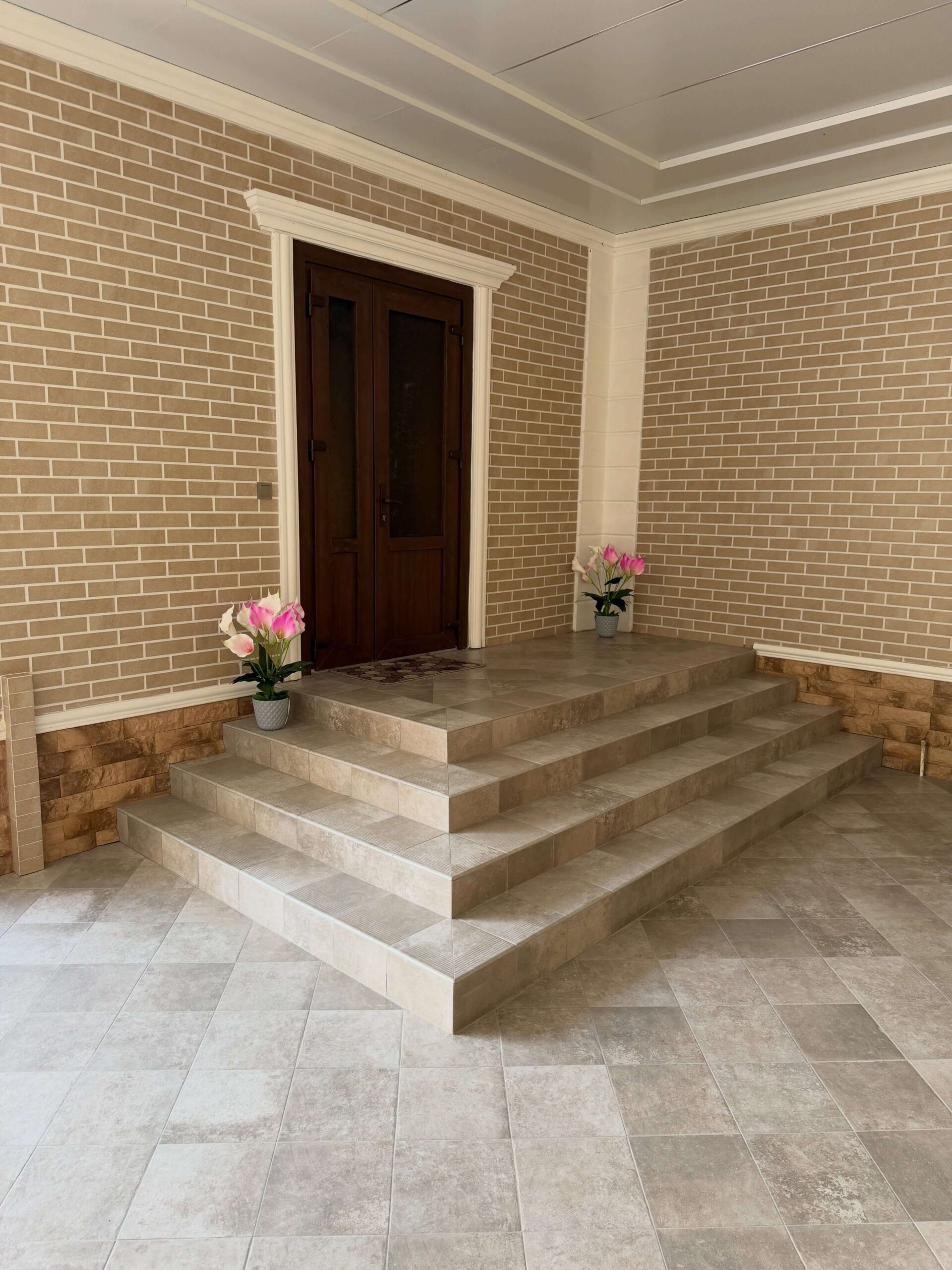
Before thinking about planters, paint, lighting, or new railings, look closely at what’s already there.
What are the stairs made from?
Concrete?
Wood?
Brick?
Stone?
Composite decking?
Then look beyond appearance.
Are the steps stable?
Are surfaces badly damaged?
Does the railing move?
Does water collect where it shouldn’t?
Those aren’t decorating problems.
Anything involving structural damage, significant deterioration, drainage problems, unstable railings, or another safety concern should be dealt with appropriately before you start thinking about how the stairs look.
Once you’ve separated repairs from cosmetic improvements, look at the staircase as part of the entire exterior.
Homes & Gardens shares outdoor expert Andrew Laurier’s advice in its guide to decking steps, noting, “Decking steps are not just a means of accessing different levels of your yard. Instead they can be a design feature that enhances the overall aesthetics of your outdoor space.”
That’s the idea I’d use for the whole project.
Don’t ask only how you can make the individual steps prettier.
Ask how the staircase can make the surrounding outdoor space look better.
The easiest place to begin is usually by creating a visual connection with the house.
Make the Stairs Look Connected to the House
Basic stairs often look more awkward when they seem unrelated to everything around them.
You don’t necessarily need new materials to fix that.
Look at your home’s exterior and find something worth repeating.
Maybe it’s the dark metal on your porch light.
Perhaps you have warm wood around the front door.
There could be stone along the foundation or black detailing around the windows.
Now look back at the stairs.
Could one of those finishes appear there too?
A railing finish might relate to existing exterior metal.
Wood stairs could pick up a tone already present on the porch.
Planters beside concrete steps might repeat a color from the house.
You don’t need exact matches.
You’re creating a relationship.
And if the material making the stairs feel unfinished is concrete, don’t immediately assume it needs covering.
Give Plain Concrete Steps More Character
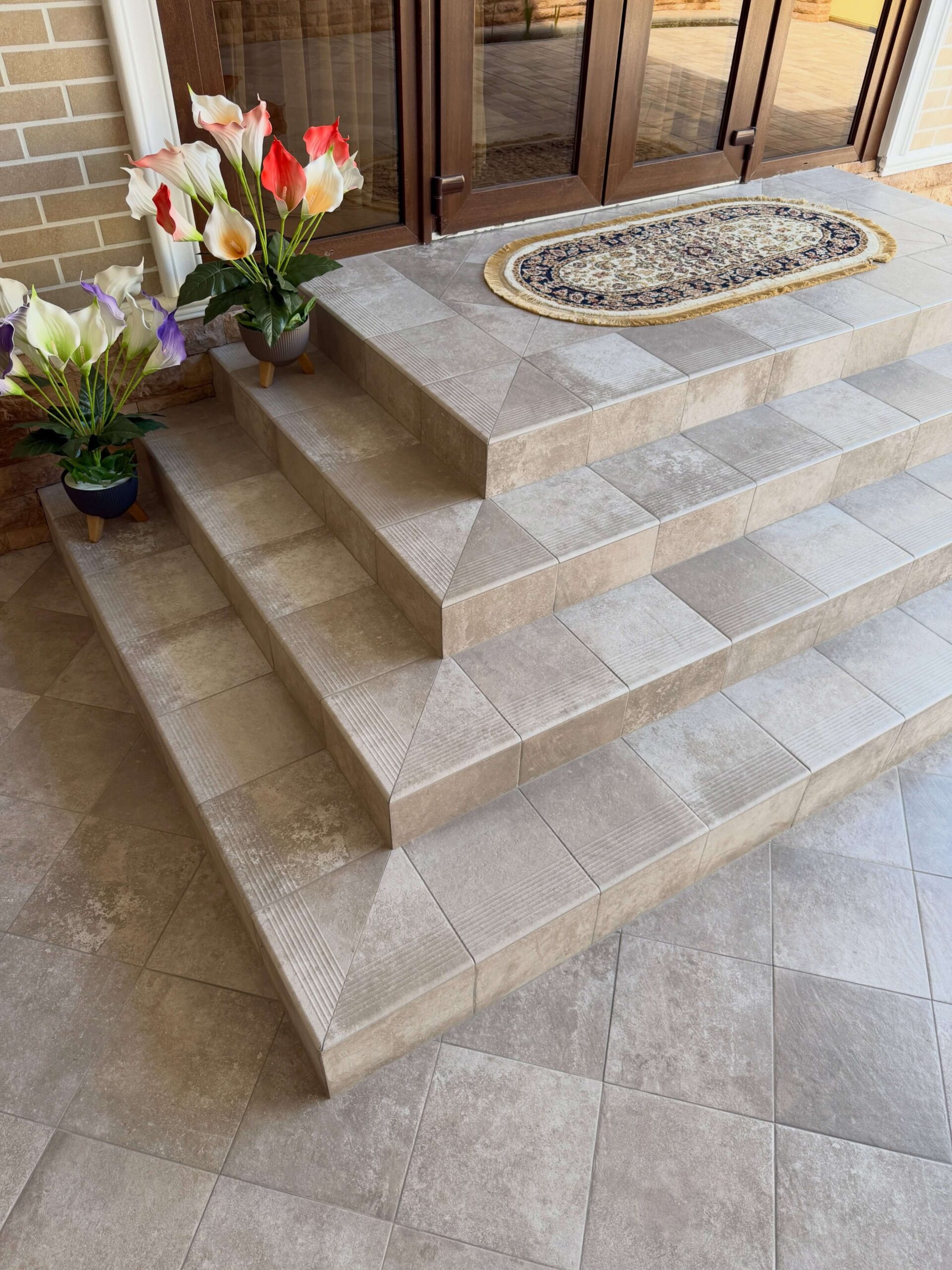
Concrete stairs can look incredibly simple.
That’s not necessarily a weakness.
Their neutral surface gives you room to bring character through contrast, texture, landscaping, or an appropriate finish without turning every step into a decorative project.
First, clean them.
It sounds obvious, but outdoor concrete collects dirt, stains, leaves, algae, and general weathering. You want to know what you’re actually working with before deciding it needs a cosmetic overhaul.
Once the surface is clean and any necessary repairs have been addressed, look again.
You may find that the concrete itself isn’t the problem.
Maybe it needs a stronger railing beside it.
Perhaps greenery would soften the edges.
Maybe the landing needs more presence.
If painting is appropriate for your particular steps, don’t choose a product based only on color.
Better Homes & Gardens recommends using non-skid concrete paint on front steps, advising, “Start by painting concrete steps a solid color; use a concrete-sealing primer and non-skid concrete paint.”
I like that advice because stairs aren’t an ordinary painted surface.
They’re something people walk on.
If you do introduce color, I’d keep it connected to the exterior rather than treating the staircase as an isolated accent.
And if your stairs are wood instead, the same principle of connection still applies.
Make Wood Stairs Feel Intentional
Wood stairs already bring warmth and texture outdoors.
The problem comes when their finish has nothing to do with the porch, deck, railing, or house around them.
Stand back and look at all the wood you can see.
Do the stairs relate to any of it?
They don’t have to match perfectly.
In fact, trying to make every piece of outdoor wood identical can become frustrating as materials weather differently.
Instead, aim for a combination that looks deliberate.
If you’re considering an exterior stain or finish suitable for the stairs, test it first.
Outdoor light can change color dramatically.
A stain that looks subtle on a small sample indoors may appear much warmer in direct afternoon sun.
Test an appropriate sample where you can evaluate it under the actual conditions.
Look in the morning.
Check again later in the day.
Then step several feet away.
You aren’t choosing a pretty color chip.
You’re choosing how the stairs will relate to everything around them.
And one of the biggest things they’ll need to relate to is the railing.
Treat the Railing as Part of the Design
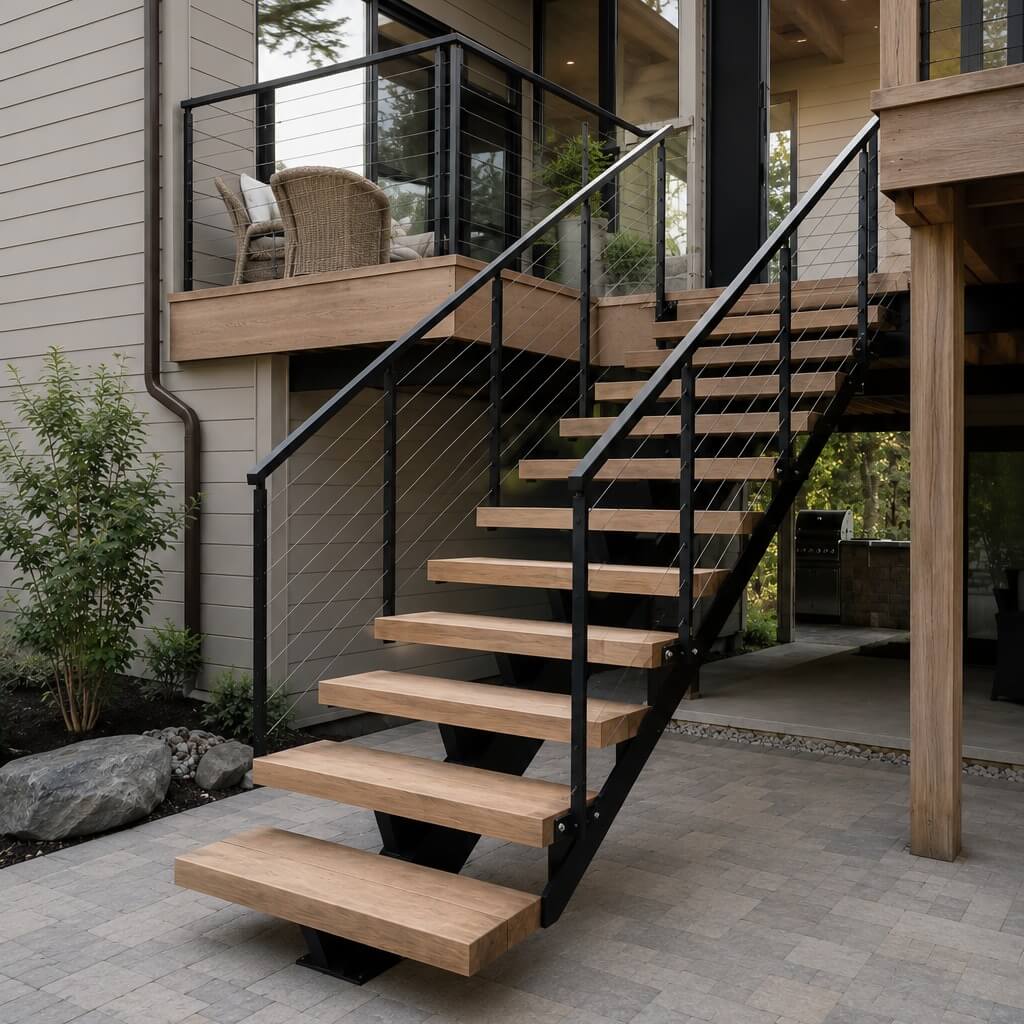
Railings can completely change the personality of outdoor stairs.
A staircase with substantial wood railings feels different from the same stairs paired with simple dark metal.
That’s why I wouldn’t treat the railing as an afterthought.
Stand in front of your staircase and notice how much visual space the railing occupies.
Now think about the house.
Does the railing finish appear anywhere else?
Could it connect visually with exterior lights, door hardware, fencing, or another architectural detail?
Sometimes repeating one finish is enough to make the staircase feel much more integrated.
But railings are also functional safety features.
Changes involving their dimensions, stability, placement, or installation shouldn’t be treated as purely decorative DIY decisions. Check the requirements that apply where you live and get appropriate professional help when needed.
Once the railing itself works visually and functionally, you can use contrast to give the whole staircase more definition.
Use Contrast to Give the Stairs More Definition
You don’t need five colors to make outdoor stairs interesting.
Often, two are enough.
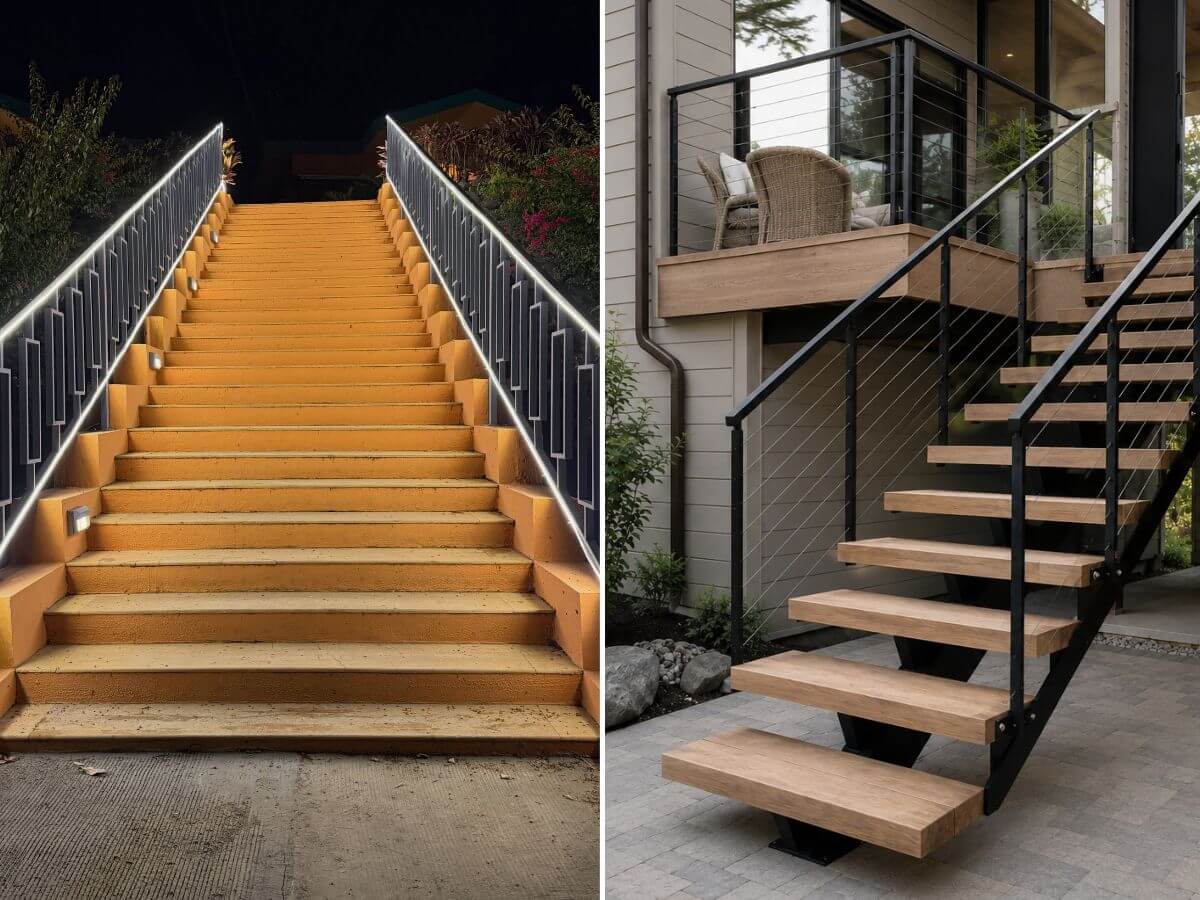
Light concrete can look sharper beside dark metal.
Warm wood can stand out against green landscaping.
Stone steps can become more noticeable when the surrounding planting is softer and less visually busy.
Look at your stairs and identify the dominant color.
Now choose one contrasting element.
It could be the railing.
It might be the planters.
Maybe it’s the landscaping beside the staircase.
Then stop.
You don’t necessarily need another accent color on the risers, another one in the pots, and another one at the landing.
A restrained palette can make basic materials look much more considered.
And during the day, contrast helps define the shape of the staircase.
After sunset, lighting has to do some of that work.
Add Lighting That Makes the Stairs Better at Night
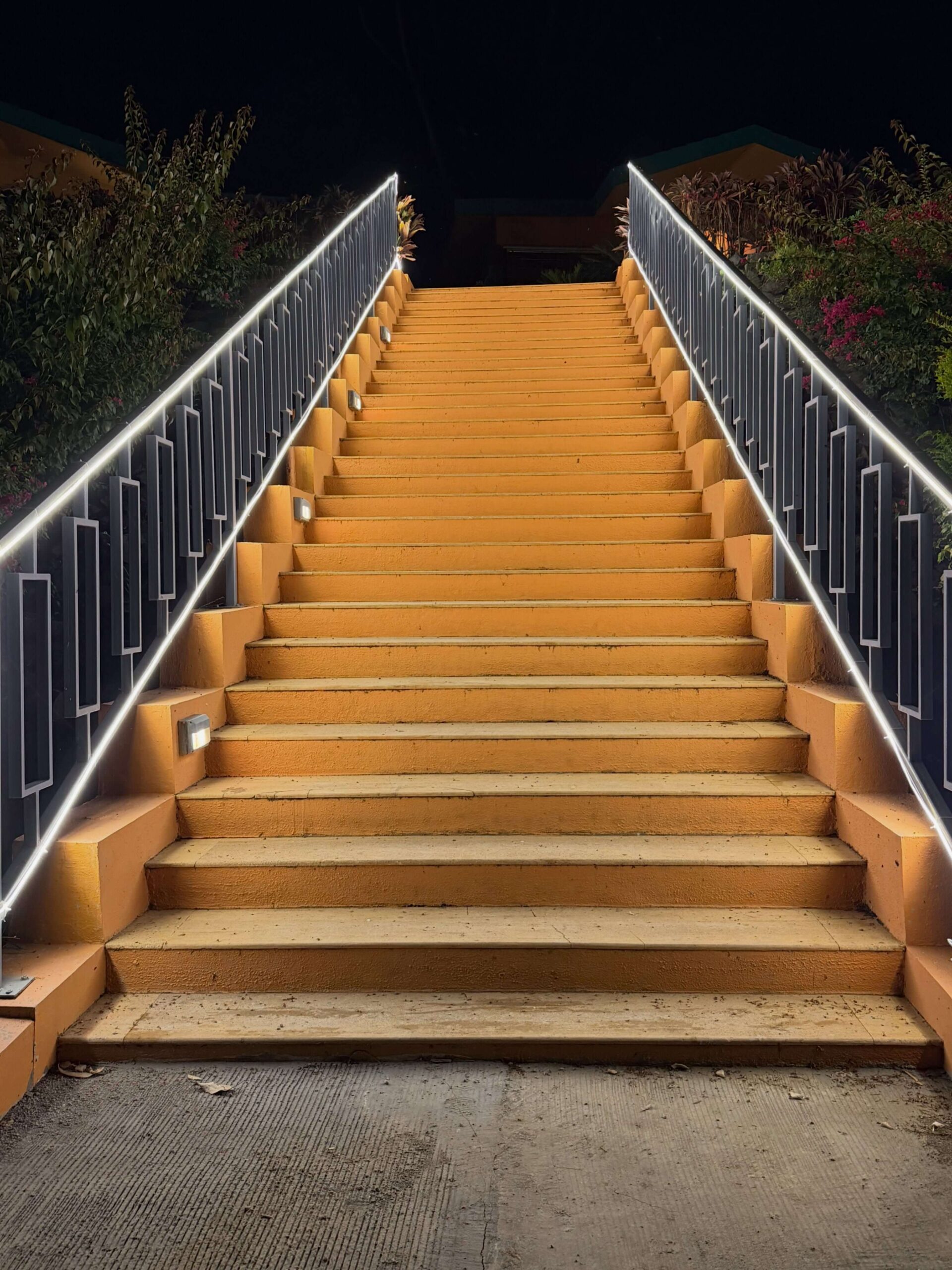
Wait until evening before making decisions about stair lighting.
Then go outside and approach the staircase the way you normally would.
Where does the first step begin?
Can you clearly see changes in level?
Are there dark areas?
Does the existing light create harsh glare while leaving the steps themselves difficult to read?
You’re not looking for a dramatic nighttime scene.
You’re looking for where visibility breaks down.
The Spruce shares landscape designer Caroline Ervin’s advice in its guide to layered outdoor lighting: “Path lights or light fixtures built into stairways can make sure visitors ascend or descend safely.”
That doesn’t mean every stair needs a bright light attached to it.
Think about where illumination is actually useful.
Perhaps the bottom transition is difficult to see.
Maybe the landing is too dark.
The path leading to the stairs may need more definition.
Or appropriately installed step lighting might make sense for your particular setup.
I’d rather solve the dark spots than create a row of lights simply because it looks dramatic.
Consider glare too.
Lighting should help you read the staircase, not shine directly into your eyes while you’re climbing it.
And any electrical work or fixture used around an exposed outdoor area needs to be appropriate for the location and installed according to applicable requirements.
Once the stairs work after dark, go back to the daylight view.
This time, look at where the staircase begins.
Frame the Bottom of the Stairs
The bottom of a staircase can feel surprisingly abrupt.
Walkway.
Step.
Stairs.
Nothing visually connects them.
Try standing several feet away and looking at the transition.
Does the staircase feel like an obvious destination?
Or does it seem to appear suddenly out of the landscape?
You may not need to change the steps at all.
A planting bed beside the base can help anchor them.
Stone or gravel used elsewhere in the landscaping might visually connect the walkway and staircase.
A substantial planter may give the entrance to the stairs more presence where space safely allows.
The key is framing the stairs without narrowing or obstructing the route people use.
You shouldn’t have to dodge a flowerpot to reach the first step.
Keep walking space clear.
Think beside the staircase rather than automatically putting things on it.
That distinction becomes especially important when you start adding plants.
Use Planters Without Turning the Stairs Into Shelves
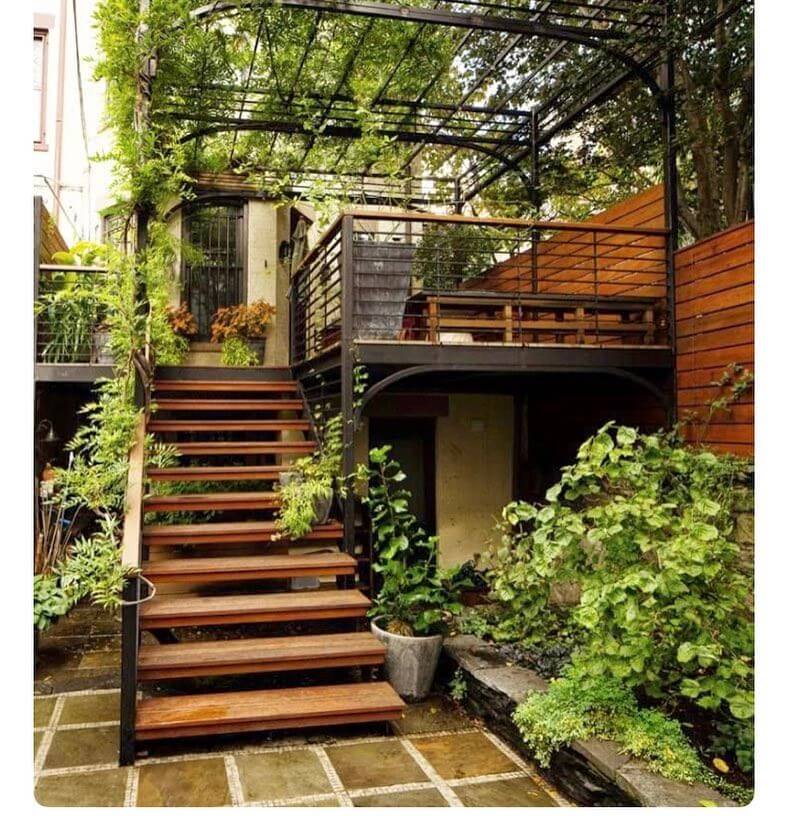
I’ve seen plenty of beautiful inspiration photos with pots cascading down outdoor stairs.
They photograph wonderfully.
But I wouldn’t automatically copy that arrangement onto the stairs you actually use every day.
First, look at the available width.
Where do people naturally walk?
Where would a planter become an obstacle?
If your staircase is generous and there’s genuinely safe unused space, a small number of thoughtfully positioned containers may work.
Otherwise, move them.
Cluster planters beside the staircase.
Put one substantial container on a roomy landing where appropriate.
Use landscaping around the base.
A single large planter can often have more impact than five tiny pots anyway.
And before choosing the plant, study the location.
How much direct sun does it receive?
How quickly will the soil dry?
Where will excess water go?
How large will the plant become?
Will you realistically water something positioned there?
Answer those questions before choosing based on flower color.
If the staircase is narrow, you can get greenery without giving up tread space at all.
Let Landscaping Soften the Edges
Concrete, brick, stone, and wood all create strong lines.
Plants can soften them.
You don’t need to bury the staircase in greenery.
Look for the places where the stairs meet the surrounding yard.
Could a planting bed follow one side?
Could low-growing plants soften a hard edge without spilling into the walking area?
Could an existing garden bed be extended so the staircase feels like part of the landscape rather than something dropped into the middle of it?
Repeat plants when possible.
A dozen unrelated plants can make a small area look busier.
Repeating one or two varieties can create a stronger visual rhythm.
But choose for the conditions you actually have.
Look at sunlight, climate, water needs, mature size, and maintenance.
And keep visibility in mind.
Plants shouldn’t eventually grow across steps, hide important edges, or make the route harder to use.
For stairs built into a slope, landscaping can become an even bigger part of the design.
Make Stairs on a Slope Feel Like Part of the Garden
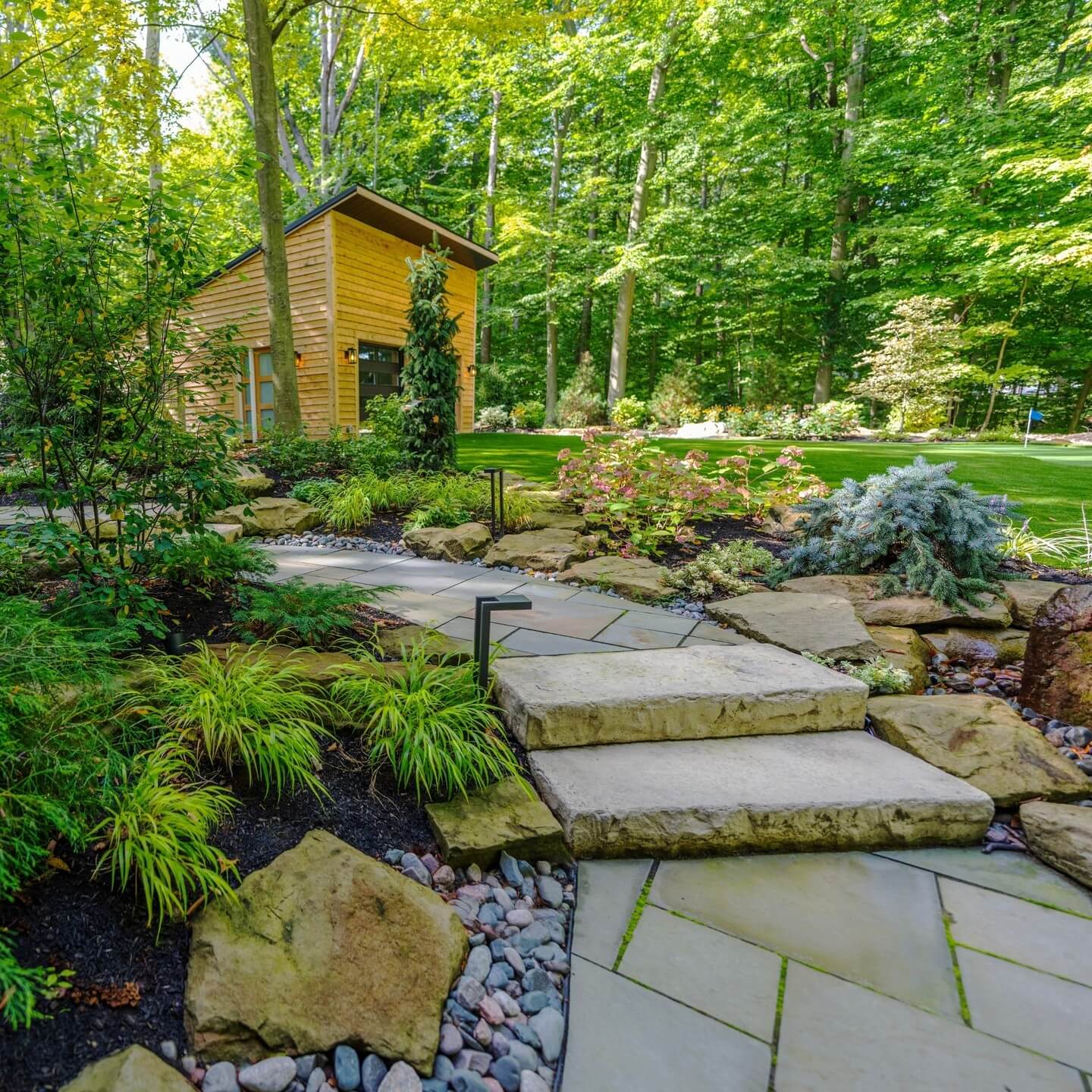
Long backyard stairs can easily feel like a corridor.
The goal becomes getting from the top to the bottom as quickly as possible.
But when the surrounding slope is landscaped thoughtfully, the staircase can feel more like a journey through the garden.
Look for natural places where the eye could pause.
Maybe the stairs change direction.
Perhaps there’s already a landing.
A planting area beside one section might create a visual break.
Stone, gravel, retaining elements, or repeated plants can help connect the staircase to the surrounding terrain where they’re appropriate for the site.
But this is also an area where I’d know when to stop decorating and start asking structural questions.
Steep slopes can involve drainage, erosion, retaining structures, and construction concerns.
If you’re dealing with those issues, treat them as site problems first.
Once the staircase and slope are functioning properly, the prettier decisions become much easier.
And one of those decisions may involve a surface people often overlook.
Don’t Forget the Risers
We tend to look at the treads because that’s where our feet go.
Visually, however, the risers can be surprisingly noticeable when you’re approaching the stairs from below.
Stand at the bottom.
What do you see?
If the risers occupy a large part of the view, they may be an opportunity to make the staircase feel more deliberate.
That doesn’t mean every riser needs a different color, pattern, or decorative treatment.
Sometimes a simple contrast between the horizontal and vertical surfaces is enough.
If you’re considering a change, mock it up first.
Use a phone editing tool to roughly alter the color in a photograph.
Or create a temporary visual sample where appropriate without affecting the stair surface.
Does the treatment strengthen the staircase?
Or does it turn the stairs into the loudest thing in the yard?
I usually prefer the first.
And one easy way to keep the result connected to the rest of the exterior is repetition.
Repeat One Material Somewhere Else
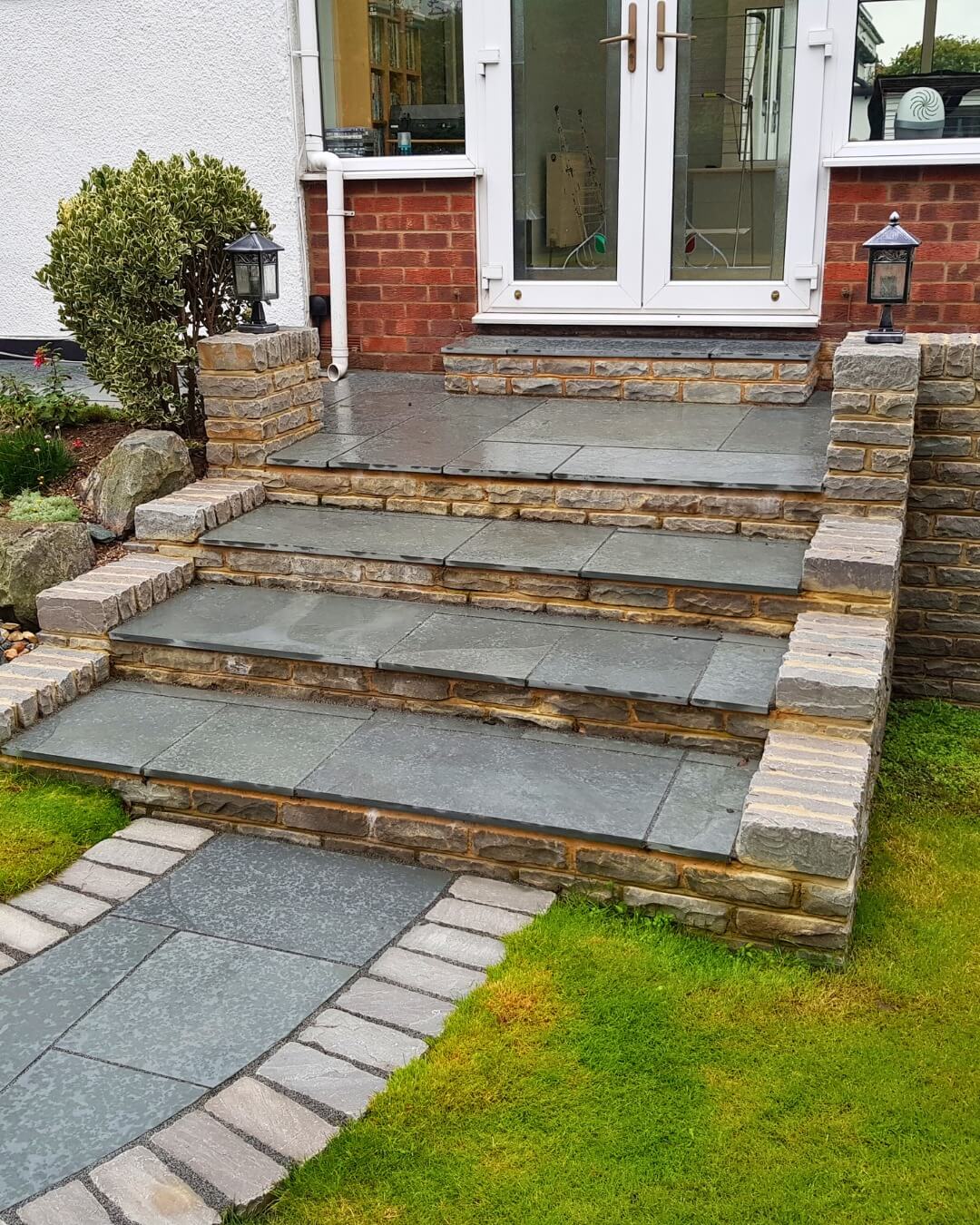
Choose one material or finish already present around the staircase.
Then repeat it once.
If you have dark metal railings, perhaps the exterior light nearby uses a related finish.
If the staircase includes stone, that stone tone might appear again in the surrounding landscape.
If the steps are wood, a related wood tone near the entrance can create another visual connection.
You’re not trying to create a matching set.
You’re creating a thread between the stairs and the rest of the exterior.
Once you establish that connection, you may find you need far less decoration than you originally thought.
Use Fewer, Larger Details
Outdoor stairs can become cluttered quickly because there’s an obvious temptation to decorate each step.
A pot.
A lantern.
Another pot.
A seasonal sign.
Something at the top.
Something at the bottom.
Soon the staircase is doing more displaying than stair climbing.
Try stripping it back.
Temporarily remove the decorative pieces you already have.
Now return only the item that makes the biggest positive difference.
Maybe it’s one large planter.
Perhaps it’s a strong light fixture near the landing.
Maybe the railing already provides enough visual interest and you don’t need much else.
Give architectural elements some empty space around them.
That becomes even more important when the stairs themselves are narrow.
Make Narrow Outdoor Stairs Feel Finished Without Crowding Them
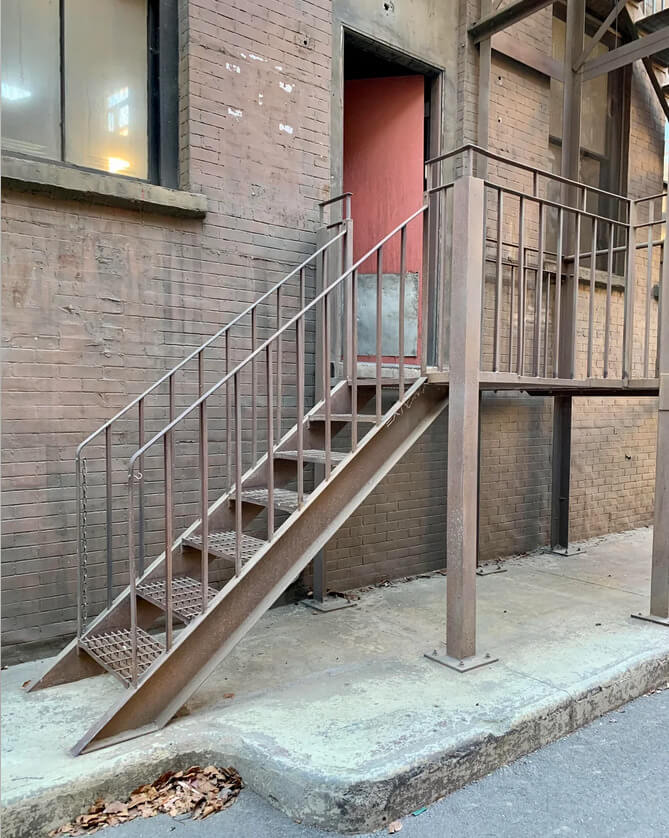
Small outdoor stairs don’t need smaller versions of every decorating idea.
They need different ideas.
If the treads are narrow, keep them clear.
Move visual interest beside or above the staircase where appropriate.
Use the railing finish.
Use landscaping.
Use color.
Use lighting.
Pay attention to the landing.
These elements can change the way the staircase looks without putting objects where people need to walk.
You don’t need to prove that the stairs are decorated.
You want the whole entrance to feel finished.
And if there’s enough room at the top, that’s often the better place for one meaningful detail.
Make the Top Landing Feel Like a Destination
Stand at the bottom of your stairs and look up.
What’s waiting for you?
Sometimes the staircase itself is fine, but the top feels empty.
The stairs lead somewhere without visually arriving.
If they lead to a front door, look at the entire entry composition.
Door.
Light.
House numbers.
Doormat.
Planter, if space allows.
You don’t need all of them to become statement pieces.
Choose what matters.
Maybe one appropriately scaled planter gives the doorway enough weight.
Perhaps the existing light fixture already looks good and simply needs to be noticed rather than surrounded by more decor.
The landing should feel like the visual conclusion of the staircase.
But keep the usable area in mind.
Doors need clearance.
People need somewhere comfortable to stand.
Packages may need somewhere to go.
Decor shouldn’t make arriving at the door more awkward.
The same practical thinking applies to another strange area outdoor stairs sometimes create.
Fix the Awkward Space Under the Stairs
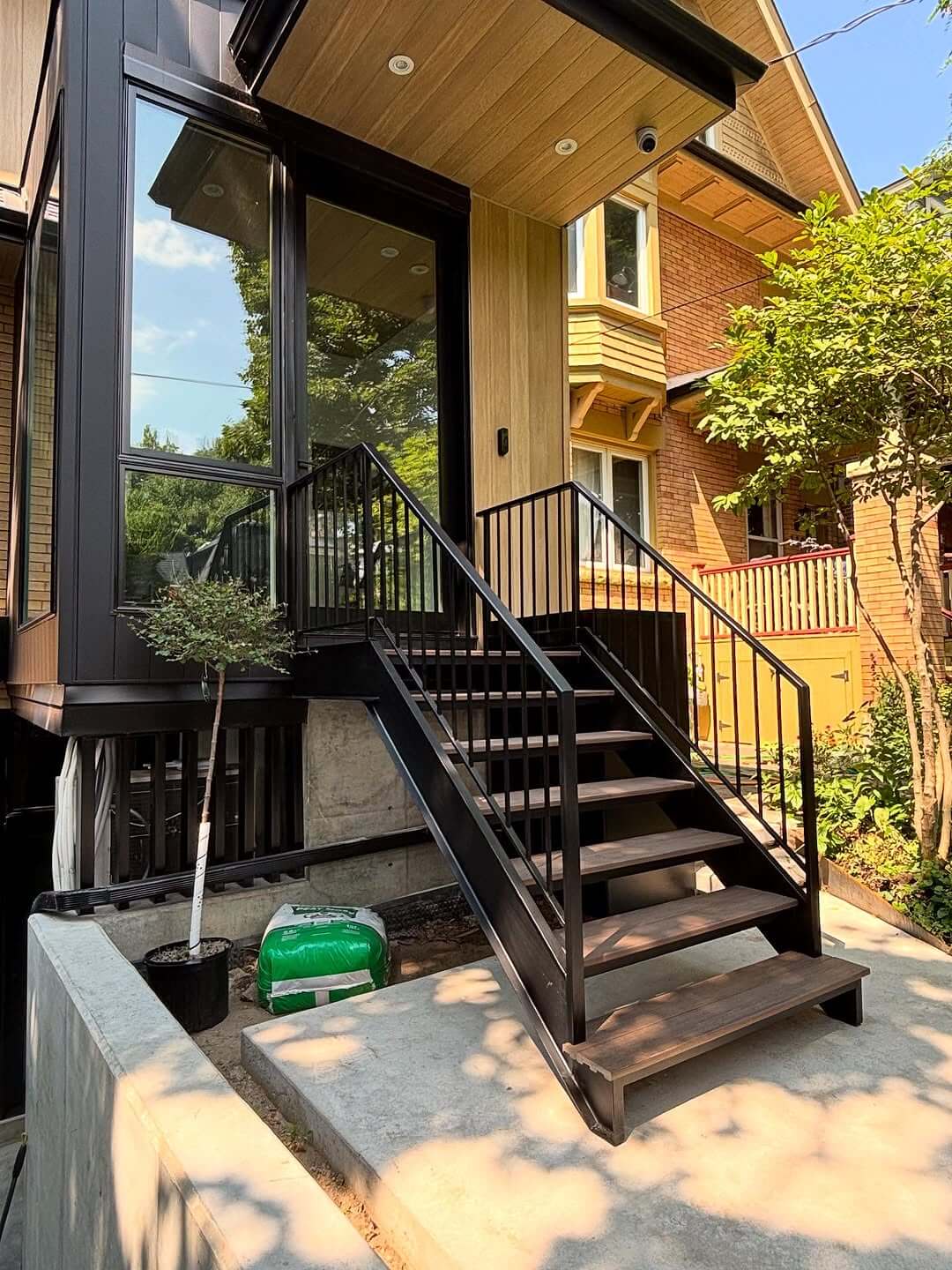
The area beneath outdoor stairs can easily become forgotten space.
A hose gets pushed there.
Then an empty pot.
Then leftover soil.
Before long, the staircase has acquired its own junk drawer.
Decide what you want that area to do.
Maybe you want it to visually disappear.
Gravel or simple landscaping may be enough, depending on the construction and site.
Perhaps appropriate screening makes sense.
In some situations, usable outdoor storage may be possible if it’s designed properly for the area.
The important thing is making a decision.
Don’t let the space become accidental storage simply because it’s out of the main walking path.
If the area underneath is highly visible, simplifying it may improve the stairs more than adding another decorative feature above.
And before you buy anything new for any part of the staircase, think beyond how it looks today.
Choose Outdoor Materials for Your Actual Weather
Pinterest doesn’t know what happens outside your house in January.
Or July.
Your outdoor stairs do.
Anything you add needs to deal with the conditions where you live.
Think about direct sun.
Rain.
Humidity.
Snow and ice where relevant.
Temperature changes.
Wind.
Drainage.
Then think about maintenance.
How often will a material need cleaning?
Will a finish require periodic maintenance?
Is the product intended for exterior exposure?
How does the surface behave when wet?
I like asking one simple question before buying something for outdoor stairs.
What is this going to look like after a year outside?
Not after installation.
After weather.
After dirt.
After people walking past it every day.
If the answer makes you nervous, keep looking.
And while durability matters, there’s one thing more important than making outdoor stairs beautiful.
Don’t Sacrifice Safety for the Look

Outdoor stairs aren’t shelves.
They’re circulation.
People need to move up and down them comfortably.
Keep the walking area clear.
Don’t position decor where feet naturally land.
Be thoughtful about anything that could affect traction.
Don’t let plants grow across the steps.
Pay attention to lighting and visibility.
And don’t use decorating to disguise a problem that needs repair.
A loose railing doesn’t need prettier planters beside it.
A damaged step doesn’t need paint.
Significant drainage, structural, surface, or stability issues should be addressed appropriately first.
Local requirements may also affect stairs, guards, handrails, electrical work, and other parts of the project.
Once the fundamentals are right, you can concentrate on appearance without asking decoration to compensate for something more important.
Then I’d deliberately slow the project down.
Try the One-Upgrade Rule
Go back to the problem you identified at the beginning.
Choose one thing.
Not six.
If the stairs look disconnected from the house, create that connection first.
If the concrete looks tired, deal with the surface appropriately.
If nighttime visibility is poor, investigate the lighting.
If the base looks abrupt, work on the surrounding landscape.
If the landing feels empty, concentrate there.
Make that one improvement.
Then wait.
Use the stairs.
See them in different weather.
Look at them from inside the house.
You may discover that fixing the largest problem makes several smaller ones disappear.
And before deciding whether the staircase needs anything else, walk toward it.
Do the Approach Test
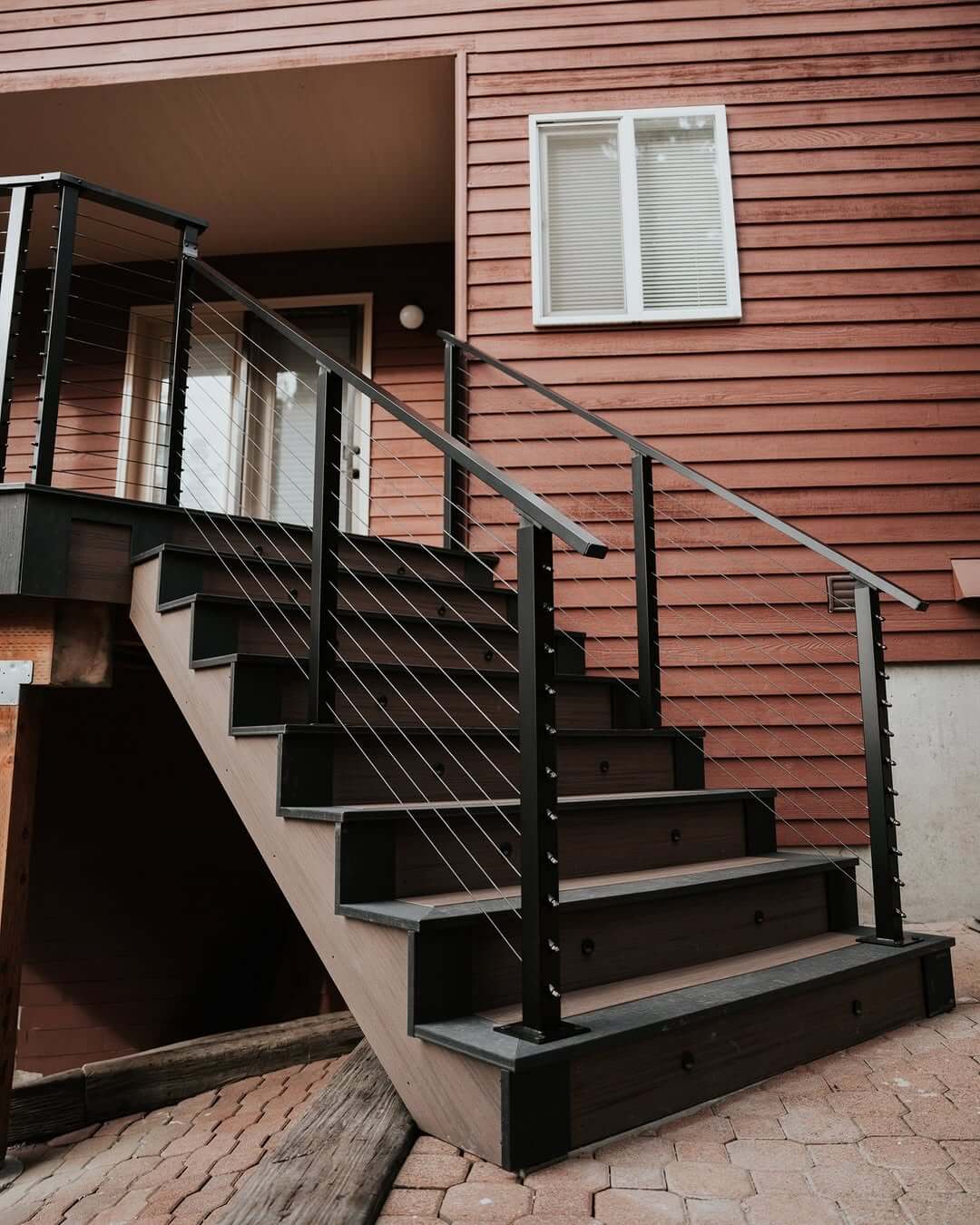
This is one of the easiest ways to judge outdoor stairs because it’s how you actually experience them.
Start where someone would naturally approach.
Maybe that’s the sidewalk.
The driveway.
A garden path.
The patio.
Walk toward the staircase.
Is it obvious where you’re supposed to go?
Do the stairs feel connected to the route leading toward them?
Does your eye travel naturally toward the landing?
Does the railing look like part of the house?
Is anything cluttering the approach?
Now do the same test after dark.
Don’t look only at whether the stairs are pretty.
Look at how understandable the route feels.
Where does the staircase begin?
Where does it end?
Can you read the changes in level?
This little walk can tell you much more than staring at an inspiration photo.
Then there’s one final test.
Take the After Photo Before Spending More
Return to exactly where you took your original photograph.
Take another.
Put the two images side by side.
Don’t zoom in on the improvement.
Look at everything.
Does the staircase feel more connected to the house?
Did the proportions improve?
Is the landscaping helping?
Does the railing feel intentional?
Is there a clear focal point?
Did you accidentally add too much?
If something still feels wrong, don’t automatically shop.
Move something.
Remove something.
Change the spacing.
Let the landscaping develop.
Clean a surface.
Reworking what you already have can be better than buying more.
And sometimes the best sign that your staircase is finished is that you stop noticing individual upgrades at all.
The Best Outdoor Stairs Feel Like Part of the Home
Outdoor stairs don’t need to become elaborate to become a feature.
They need to feel connected to the home around them.
Start with the stairs you already have.
Make sure the fundamentals are sound.
Look for a visual connection with the house.
Use materials that make sense outdoors.
Bring in contrast where the staircase needs definition.
Light the route thoughtfully.
Use landscaping to soften hard edges.
Keep the walking surface clear.
Then make one meaningful improvement and see what changes.
Maybe it’s the railing.
Maybe it’s the concrete finish.
Perhaps it’s a planting bed at the bottom or a better-defined landing at the top.
You don’t need to transform everything at once.
The goal isn’t to make your outdoor stairs look heavily decorated.
It’s to make them look as though they were always meant to be part of the home.
Also read:
Lighting Ideas for Outdoor Stairs That Are Safe and Stunning